


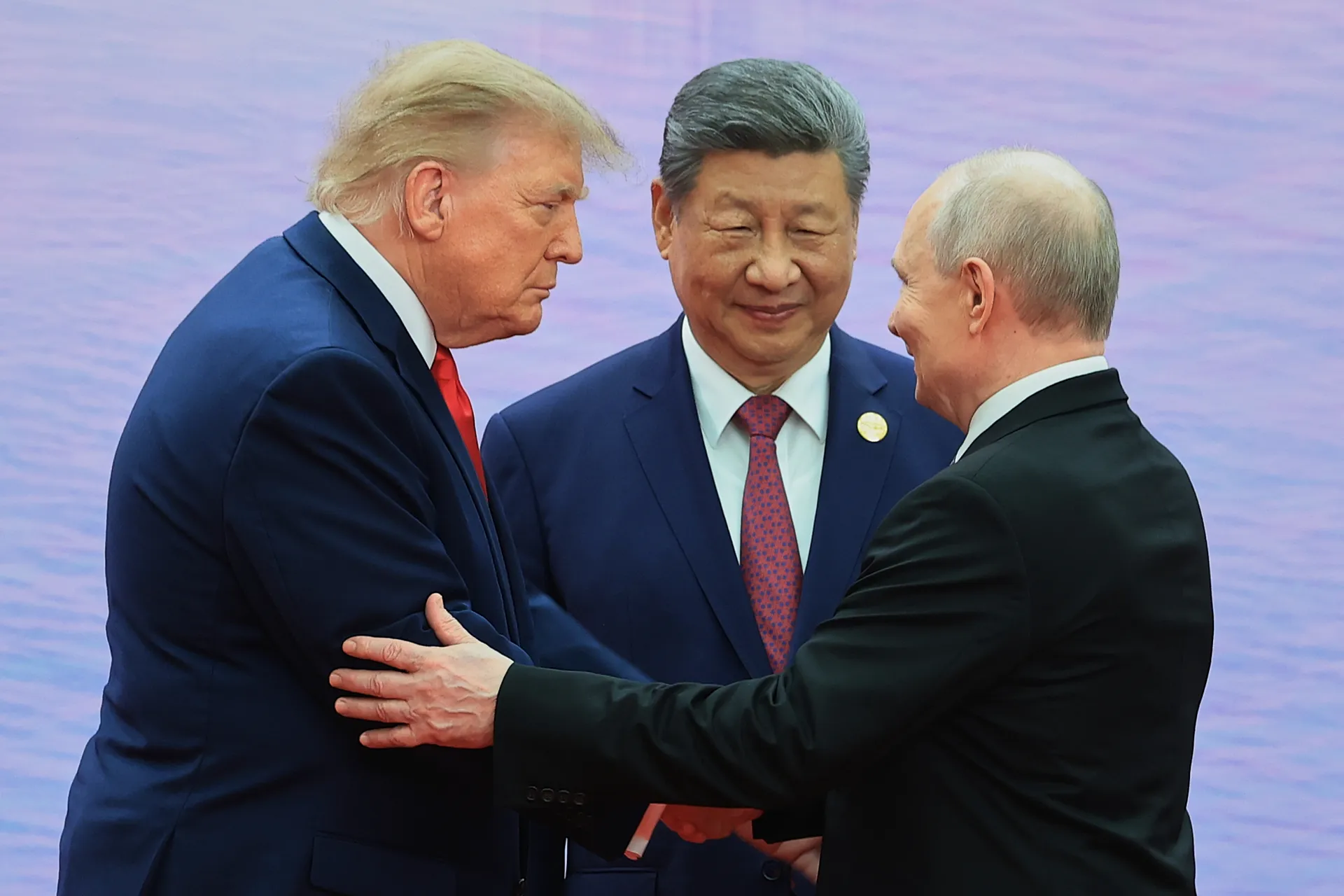
The unprecedented trilateral meeting held in Shenzhen between U.S. President Donald Trump, Chinese President Xi Jinping, and Russian President Vladimir Putin ended on Thursday without a joint statement from the three leaders, after Trump said at its outset that the three world powers “are making history.”
At the opening of the first summit of its kind, which could mark a decisive moment in world history, Trump said the three leaders “will discuss all the problems being addressed in the world.”
“We have great responsibilities to solve the problems that affect the entire planet,” he added.
Trump said he had held a “long discussion” with Putin about the all-out war Russia is waging in Ukraine, adding that all parties “want to end this war.”
Xi joined Trump in saying that their summit “has historical and pioneering significance.” He added that “the world is at peace when great powers live in harmony,” calling on the three countries to “abandon the Cold War mentality and not pursue economic decoupling or supply chain disruption.”
“The three countries must work together to meet global challenges” and “can strengthen coordination to ensure the stability of global energy supply chains,” Xi said. “Difficulties reveal true responsibility.”
Putin said that Russia’s war in Ukraine would be part of the discussions, stressing that “we have common interests in Ukraine.”
“Russia, the United States, and China are united not only by their status as victorious countries in World War II, but also by the responsibility for maintaining international peace,” Putin said.
However, after the summit concluded, Kremlin spokesman Dmitry Peskov told Russian media that Ukraine was not the “central topic” of the meeting.
At the same time as the summit began, the Chinese state news agency published a statement from Xi Jinping, according to which “nuclear weapons must be completely banned and thoroughly destroyed, in order to build a nuclear-weapon-free world.”
In his opening remarks, Trump said that “the three countries are in a unique position to discuss the issue of nuclear weapons.”
“Very often, previous leaders avoided talks with leaders with whom they had disagreements,” Trump added.
At the start of the summit, the leaders posed for a group photo without shaking hands with one another. Even at the end of the meeting, they made no public statement.
The meeting lasted about an hour and 20 minutes. Trump immediately left the summit venue for Shenzhen airport, from where his plane departed shortly afterward. Meanwhile, Xi saw off Putin, who also departed for Russia.
The Chinese state news agency Xinhua published the full text of what it called the “tripartite peace declaration,” which listed four main points: commitment to reforming the United Nations (UN), plans to increase the production and supply of refined petroleum products, respect for the immunity of state officials, and opposition to the International Criminal Court (ICC) and similar institutions when they exceed their competencies, as well as an agreement to develop a dialogue on nuclear risk reduction and nuclear non-proliferation.
The declaration does not contain any direct reference to Ukraine, Iran, Taiwan or North Korea.
High-stakes bilateral talks ahead of the trilateral summit
The presidents of the United States and China met separately earlier on Thursday, in their third significant meeting this year.
During the meeting, Trump said that the U.S. and China want to help end the war in Ukraine, stating, “We are trying to help with the war between Russia and Ukraine.”
The American president praised the friendly relations between the two countries and their shared interest in ensuring oil transport through the Strait of Hormuz, which has become one of the main targets of attacks during the war with Iran.
Xi said that relations between the U.S. and China have been “generally stable and have improved” during Trump’s presidency.
“The efforts you have made are visible to everyone and will remain in history,” Xi said.
Trump also met with Putin ahead of the trilateral summit, declaring that “we have had an excellent relationship for many years.”
The meeting marks the first time the two leaders have held talks since their discussions in Alaska last year, which failed to secure an agreement to de-escalate Russia’s all-out war in Ukraine.
“Wonderful things can come out of this meeting, or at least they can get started,” Trump said as he greeted Putin, adding, “Who is he? He’s my friend.”
The summit has stoked fears that the three powerful leaders might try to divide the globe into spheres of influence, for example, by making decisions that affect Ukraine’s fate without involving Kyiv or Europe.
A wide-ranging debate unfolded among observers on social media over whether the summit could be considered a “Yalta 2.0,” while others argue it should be better called “Munich 1938,” given the fundamental differences in time, space, and protagonists.
To underscore the importance of the summit and to balance the media coverage from European and Western outlets overall, Asian television networks and newspapers focused on the possible consequences this meeting could have for their own countries.
Chinese state media, particularly the Xinhua news agency and the People’s Daily newspaper, portrayed the APEC summit and the trilateral meeting as evidence of Xi Jinping’s diplomatic leadership, multilateral cooperation, and China’s commitment to free trade. Beijing is presenting the trilateral summit as an opportunity to promote global peace and strategic stability among the major powers.
In South Korean media, a recurring theme was concern about the possibility of a “Yalta 2.0” conference, where leaders could discuss the future of the Korean Peninsula without Seoul’s participation. The Yonhap news agency reported that the South Korean government has conveyed these concerns to both Washington and Beijing.
The media are also focusing on the possibility of resuming dialogue between the U.S. and North Korea, as well as on the risk of tacitly accepting North Korea’s nuclear status.
Japanese media are paying attention to the tense relations between China and Japan. One of the main television channels reported on the first face-to-face meeting in about a year between Japanese Prime Minister Sanae Takaichi and Chinese President Xi Jinping.
No official bilateral meeting between Takaichi and Xi Jinping was scheduled. Meanwhile, Japanese media reported that the Japanese prime minister was seeking a meeting with Trump after the trilateral summit concluded.
Germany was also scheduled to host Ukraine’s allies on Thursday for a meeting of the so-called “Coalition of the Willing,” which would also be attended by American envoys Jared Kushner and Steve Witkoff. /Adapted from Euronews, ekofin.al
