


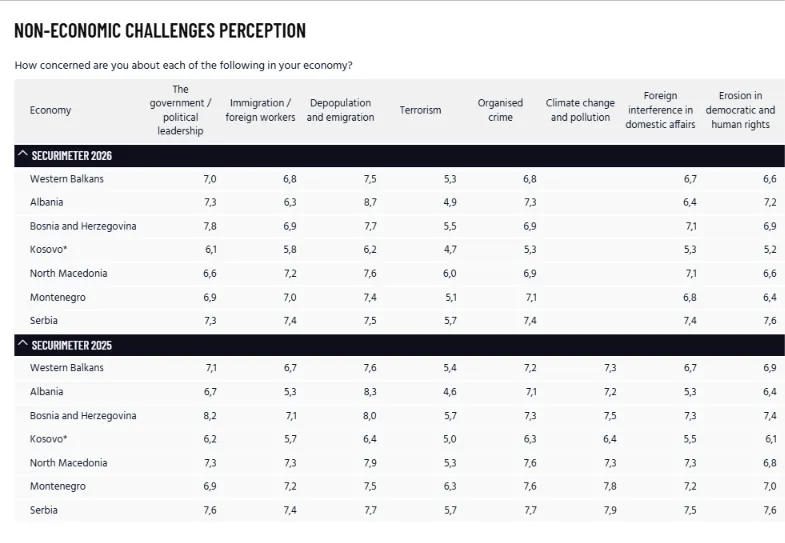
Depopulation and emigration remain the biggest concerns for Albanians, deepening even further in 2026, at a time when the perception of this problem has eased slightly in the rest of the Western Balkans. According to the SecuriMeter 2026 survey, published by the Regional Cooperation Council (RCC), the level of concern about population outflow in Albania has reached 8.7 points out of a possible 10, up from 8.3 points in 2025.
Albania records the highest level of concern about this phenomenon among the six Western Balkan countries. The regional average is 7.5 points, a slight decrease from 7.6 points a year ago. Thus, the gap between Albania and the region has widened from 0.7 to 1.2 points within a year.
The survey data also show that Albanians’ concern has increased for a number of other problems, from road safety and organized crime to the functioning of institutions and democratic rights. In some of these indicators, Albania has moved from a level of concern below the regional average in 2025 to a higher level during 2026.
Road Safety, the Strongest Increase in Concern
One of the most notable changes concerns road safety. In 2026, the level of concern among Albanians about low traffic safety reached 8.1 points, up from 7.2 points in 2025, marking an increase of 0.9 points.
This trend contrasts with the region, where the indicator has dropped from 7.4 to 7.2 points. Albania is the country with the highest level of concern for road safety, followed by North Macedonia and Montenegro, both with 7.5 points, while Kosovo registers the lowest level, with 6 points.
Construction safety is also a greater concern in Albania than in other countries in the region. This indicator is rated at 7.5 points, compared to the regional average of 6.5 points. Albania also leads this category, although the table does not provide comparative data for 2025.
Cybercrime and disinformation are major concerns.
In the area of digital security, Albania registers the highest level of concern for cybercrime and online fraud, with a score of 8 out of 10, compared to the regional average of 7 points.
Following Albania is Serbia with 7.5 points, while Kosovo registers the lowest level, with 5.8 points. This difference shows that the risks associated with online activity are perceived as a particularly serious problem by Albanian citizens.
Similarly, disinformation and fake news are rated 7.6 in Albania, compared to 7 points in the region. Serbia registers the highest level for this indicator, at 8 points.
According to more detailed data from the RCC, 82.6% of respondents in Albania express concern about cybercrime and online fraud, while 87.3% are concerned about disinformation and fake news. At the regional level, these percentages are 70.1% and 72.2%, respectively.
Concern over political leadership, democracy, and organized crime is growing
Significant changes are also observed in Albanians’ perception of the functioning of institutions and political developments.
Concern about governance and political leadership has increased from 6.7 points in 2025 to 7.3 points in 2026. Over the same period, the regional average has seen a slight decline, from 7.1 to 7 points.
An even stronger difference appears in the perception of the weakening of democracy and human rights. In Albania, this indicator has risen from 6.4 to 7.2 points, while in the region it has fallen from 6.9 to 6.6 points. This means that, within one year, Albania has moved from a level of concern 0.5 points below the regional average to 0.6 points above it.
Organized crime also shows a similar development. In Albania, the concern level has risen from 7.1 to 7.3 points, while in the region it has fallen from 7.2 to 6.8 points. For 2026, only Serbia has a slightly higher concern level for this phenomenon, at 7.4 points.
Meanwhile, political instability is rated at 7.1 points in Albania, compared to 6.8 points in the region.
Foreign workers and external interventions, rising concern
Another development concerns the perception of immigration and foreign workers. In Albania, the level of concern has risen from 5.3 points in 2025 to 6.3 points in 2026.
Although it remains below the regional average of 6.8 points, the one-point increase within the year shows that this issue is drawing more attention from Albanian respondents. In the region, the change has been much smaller, from 6.7 to 6.8 points.
A significant increase is also observed for foreign interference in internal affairs, with Albania rising from 5.3 to 6.4 points, while the regional average remains unchanged at 6.7 points.
On the other hand, Albanians continue to show lower-than-regional-average concern about ethnic tensions and terrorism. Ethnic tensions are rated 4.6 in Albania, compared to 5.9 in the region, while terrorism is rated 4.9, compared to 5.3.
