

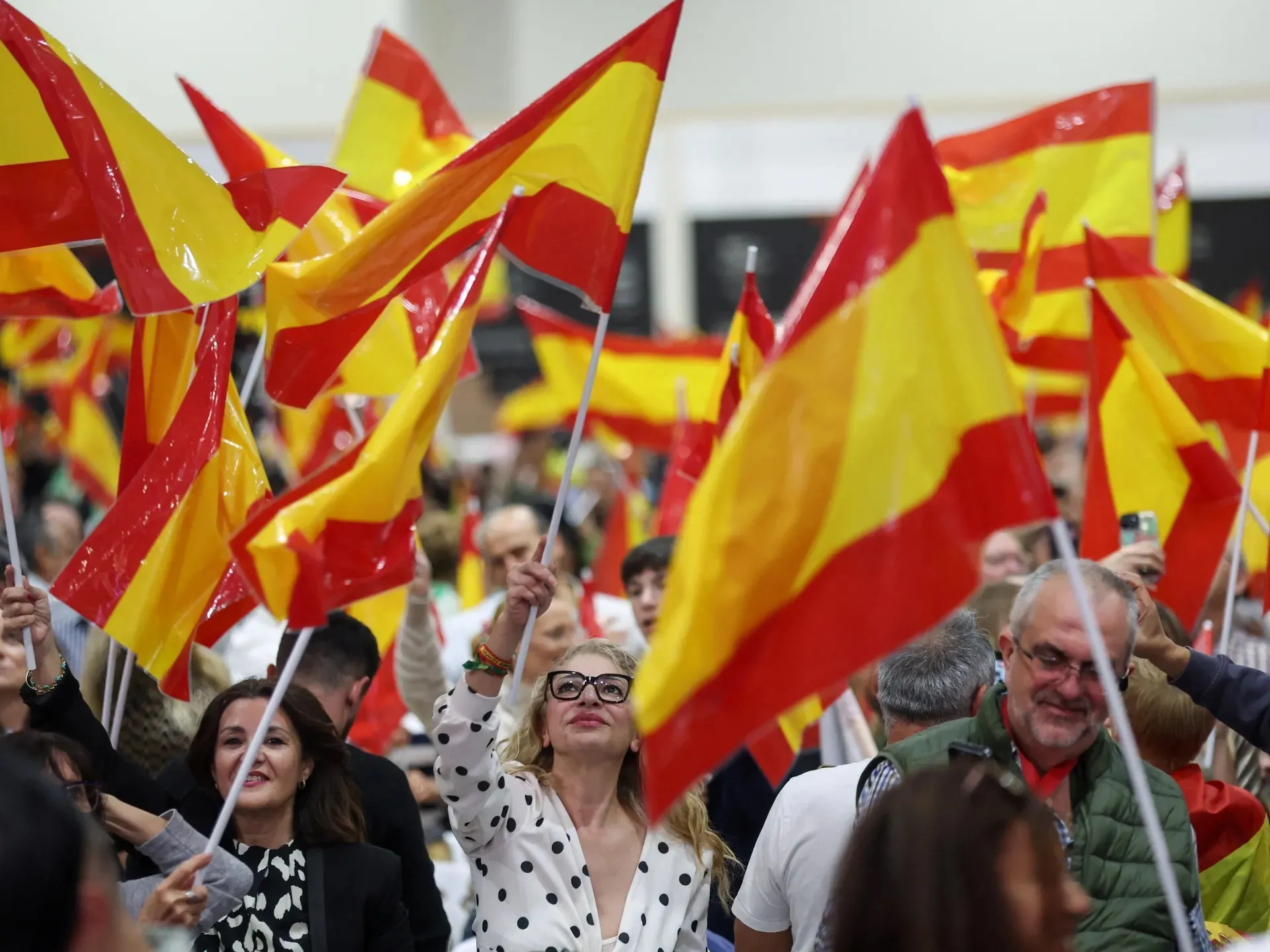
Spain’s Socialist Prime Minister, Pedro Sánchez, and his conservative rival, Alberto Núñez Feijóo, have held their final campaign rallies ahead of Sunday’s elections, in a tight race that could change the political direction of one of Europe’s largest economies.
Sánchez has appeared optimistic, despite recent polls putting Feijóo’s People’s Party (PP) in a slight lead. “I can’t imagine us losing,” the prime minister declared to his supporters, dressed in red shirts, as he accused his conservative rival of preparing a governing pact with the far right.
He asked voters to support keeping the left-wing government in power, at a time when the election results could also influence political developments in other European countries.
On the other hand, Feijóo closed the campaign with a message of political change, promising a new era based on “truth, honesty, and good governance.” During stops in Barcelona and Seville, he attacked Sánchez’s government for corruption scandals, railway disasters, immigration, and the national debt, accusing the prime minister of avoiding responsibilities and questions about the country’s most important issues.
“This time, yes, we will succeed,” declared the leader of the People’s Party, referring to his failure to form a government three years earlier, despite having won the largest number of seats in parliament. However, to secure a majority, the conservatives may need the support of the far-right party Vox, led by Santiago Abascal. The latter ended his campaign in a bullring in Valencia, having earlier accused Sánchez of “betraying us, stealing from us, and lying to us.”
Vox aims to nearly double its parliamentary representation by promoting anti-immigration policies, including giving priority to Spanish citizens for social benefits and repatriating foreigners who, according to the party, do not contribute to the country’s economy.
The campaign has unfolded in a climate of intense political polarization, with clashes between the two camps focused on corruption, immigration, the economy, and the housing crisis. In the televised debate among the four leaders, all presented their proposals to address the housing shortage. Feijóo promised to build one million homes within four years, while Sánchez insisted that housing should be a right and not an object of speculation and profit.
Nearly 39 million Spaniards are eligible to vote in Sunday’s elections, and although a high turnout is expected, the latest polls have indicated a tight race. Under Spanish electoral law, the publication of polls has been banned since Monday, leaving the outcome open until the votes are counted.
Of particular importance is Andalusia, the southern region where Feijóo chose to close his campaign, as it is represented by 61 seats in the 350-member parliament. The region is governed by a coalition of the People’s Party and Vox, as are Extremadura, Aragón, and Castilla y León.
Feijóo has insisted that he aims to govern with a majority, leaving open the possibility of parliamentary agreements with Vox, but without promising that party ministerial posts. Meanwhile, Sánchez appeared at the closing rally in Madrid alongside his wife, Begoña Gómez, wearing a shirt that read “The Power of the People.”