Unemployment among 15–24-year-olds in the European Union is three times higher than that of the 25–74 age group. In which European countries is youth unemployment highest, and what factors explain the gap between the two age groups?
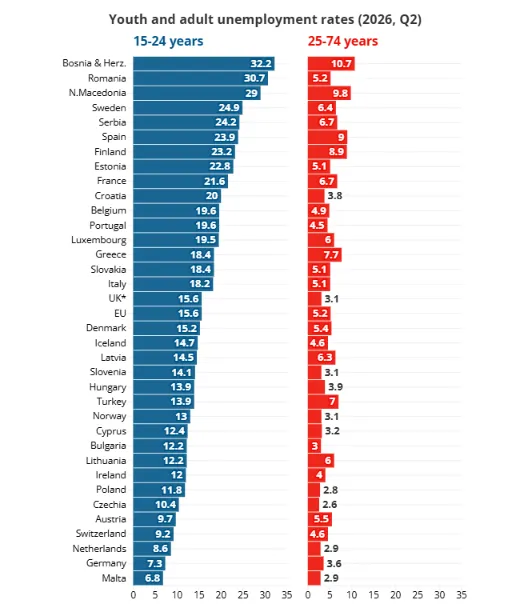
In Bosnia and Herzegovina, almost one in three economically active young people aged 15–24 were unemployed in the second quarter of 2026. This was the highest level among the countries analyzed. In Malta, which recorded the lowest rate, the ratio was about one in 15 young people, while in the European Union it was about one in six.
According to Eurostat, in the same period, the youth unemployment rate in the EU was 15.6%, three times higher than that of the 25–74 age group, which was 5.2%.
The indicator includes only persons who are part of the labor force, that is, those who are employed or actively seeking work.
This gap varies significantly across Europe. In Poland, for example, youth unemployment was below the EU average but more than four times higher than that of the 25–74 age group.
Where is this gap most pronounced and what factors explain it?
Youth unemployment is highest in the Balkans
Among the 35 European countries included in the analysis, youth unemployment is highest in Bosnia-Herzegovina, at 32.2%. It is followed by Romania (30.7%) and North Macedonia (29%).
Countries where at least one in five young people in the labor force cannot find a job include Sweden (24.9%), Serbia (24.2%), Spain (23.9%), Finland (23.2%), Estonia (22.8%), France (21.6%), and Croatia (20%).
In these countries, many young people struggle to find their first job and gain the professional experience that employers require.
Where is the largest gap in unemployment between age groups?
Comparing youth unemployment rates across countries does not reflect the full situation. Youth unemployment may be low by European standards but high compared to the unemployment rate of the older age group within the same country.
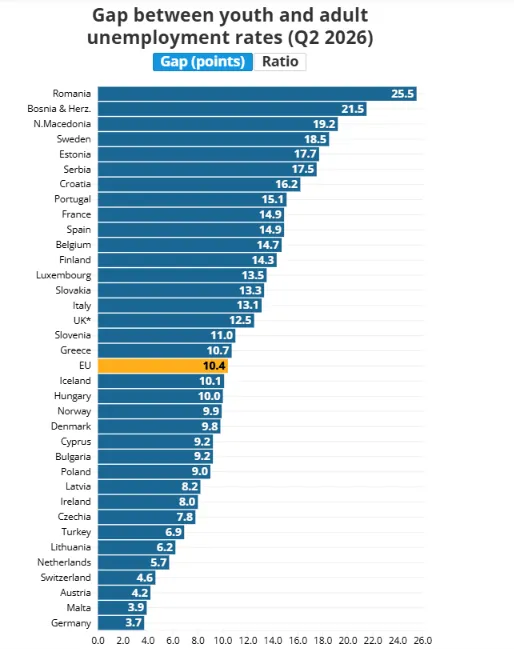
There are two ways to measure this gap. The first is the difference between the two rates, expressed in percentage points. The second is the ratio obtained by dividing the youth unemployment rate by that of the older age group, showing how many times higher youth unemployment is.
Romania has the largest gap according to both indicators. The difference is 25.5 percentage points, and the youth unemployment rate is 5.9 times higher than that of the 25–74 age group.
In Croatia and the United Kingdom, youth unemployment is at least five times higher than that of the older age group. Youth unemployment is 20% in Croatia and 15.6% in the United Kingdom, compared with 3.8% and 3.1%, respectively, for the 25–74 age group.
Low youth unemployment can mask a large gap
Some countries with relatively low youth unemployment rates nevertheless have a significant gap between age groups.
In Poland, the youth unemployment rate is 11.8%, while that of the older age group is only 2.8%. In the Czech Republic, the rates are 10.4% and 2.6%, respectively, and in Norway 13% and 3.1%.
In all three countries, youth unemployment is about four times higher than that of the 25–74 age group.
In other countries, unemployment is relatively high in both age groups, but the relative gap is smaller.
For example, Spain has one of the highest youth unemployment rates, at 23.9%, but the unemployment rate for those aged 25–74 is also high, at 9%. This makes youth unemployment 2.7 times higher than that of the older age group, below the EU’s 3-to-1 ratio.
In Greece, youth unemployment is 18.4%, compared to 7.7% for the older age group, resulting in a 2.4-to-1 ratio. /Adapted from Euronews, ekofin.al