
In the fall of 1912, European newspapers tried to explain to their readers a country emerging from the ruins of the Ottoman Empire.
On November 21, 1912, one week before the declaration of Independence, the French newspaper Le Temps published an article with a question in the headline: Qu’est-ce que l’Albanie? (What is Albania?)
For the Albanians, the question had an answer that stemmed from their language, history, and identity. For the readers of the Parisian newspaper, the answer was more complicated.
Albania was not yet a state. On the political maps of Europe, the territories where Albanians lived were included within the Ottoman Empire.
The names of Albanian cities appeared in the international press mainly in connection with uprisings, war, and the interests of other powers.
But in November 1912, European newsrooms were facing the possibility that Albania would no longer be merely a geographical name.
It could become a state.
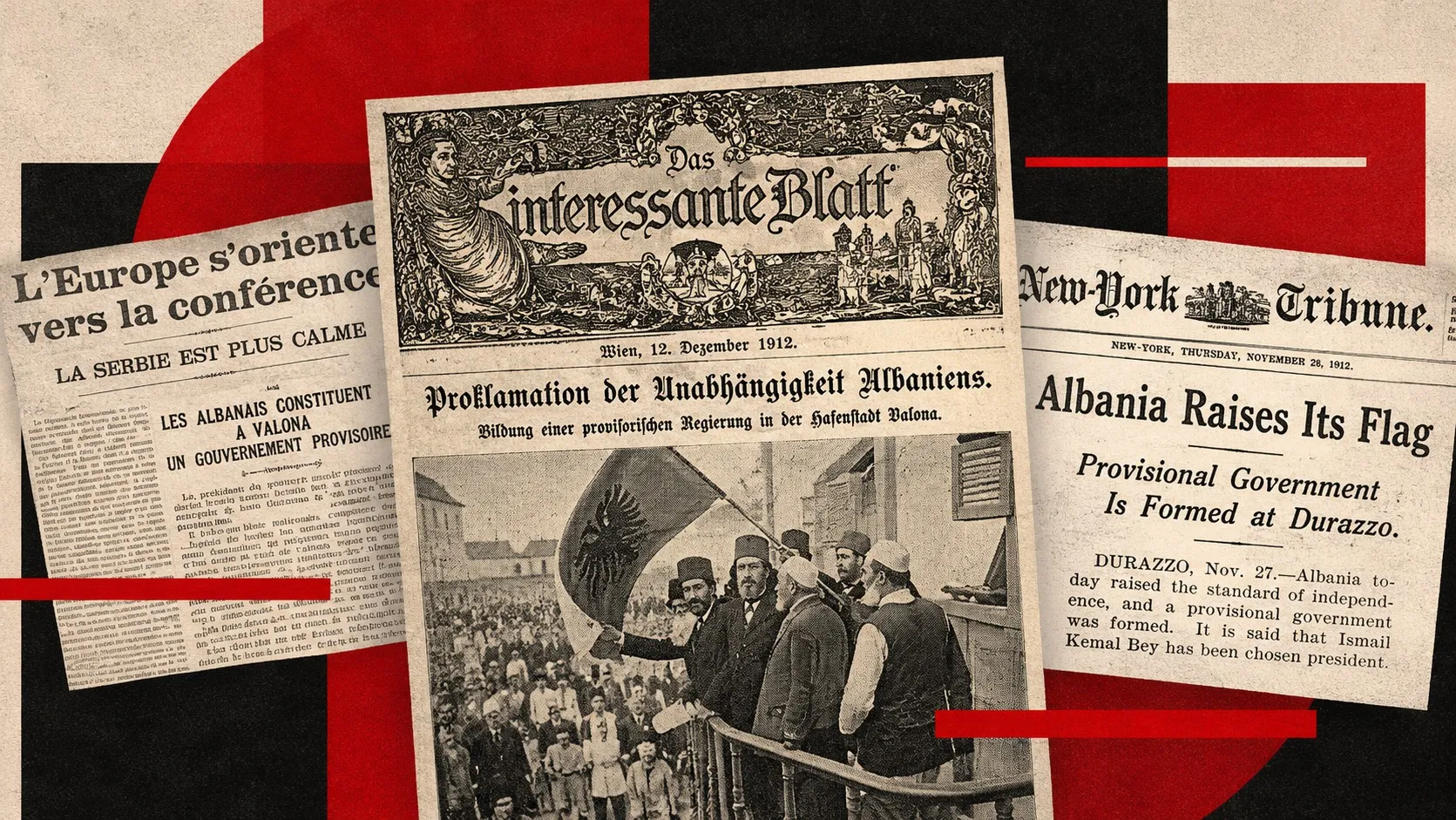
Some of the headlines from French newspapers of that period, collected in a historical press catalog, illustrate the rapid shift in narrative.
Just three weeks before Independence, Le Petit Parisien had reported on the occupation of Albanian territories by Serbs and Montenegrins.
Then, the newspaper pages began to fill with discussions about Albanian autonomy, Italian and Austro-Hungarian interests, and claims to the Adriatic ports.
Albanian geography was being learned through conflict.
Scutari was Shkodra. Durazzo was Durrës. Valona was Vlora.
For a reader in Paris, London, or Vienna, these names were part of a map that was changing at an unprecedented speed.
In a way, Albania was being forced to explain to the world who it was, precisely at the moment when it had to fight to avoid disappearing from its map.
On November 29, the German newspaper Wiesbadener Tagblatt published a notice about the declaration of independence and the raising of the flag in Vlora.
The reporting relied on information from the Italian Stefani agency and mentioned demonstrations by the population in front of the Italian and Austro-Hungarian consular offices.
For German readers, Albania was already a story arriving through an international network of agencies, correspondents, and telegraphs.
But for another category of readers, the news had a more intimate meaning.
On November 30, in Italy, the Arbëreshë newspaper La Nazione Albanese reported on developments in Albania, citing a November 28 report by the British newspaper Daily Telegraph.
In December, news of the Independence would also reach the pages of Albanian diaspora publications in the United States, including the newspaper Dielli.
For Albanians living abroad, Independence was not just a development in international politics. It was a change in their relationship with their homeland.
The diaspora now had a state to which it could refer.
For decades, a significant part of Albanian national activity had taken place outside Albanian territories.
Now, the newspapers that had helped shape the image of Albania as a national community were reporting on its creation as a political entity.
In Vienna, two weeks after Independence, this story would also take on a visual form.
The illustrated magazine Das Interessante Blatt devoted its cover to the declaration of Independence.
It was an illustration, not a photograph, in which the Albanian ceremony took on the proportions of a European public event.
For Viennese readers, the illustration offered a visual identity to a country that until recently had been treated mainly as a diplomatic problem.
But illustrations of this kind also served another function. They translated a distant reality into a visual language that the European public could understand.
Albania was still, for many of these readers, an exotic country. The way of dress, traditions, and social organization often received as much attention as the political aspirations of the Albanians.
This way of seeing created a tension between the Albania that was trying to present itself as a modern European state and the Albania that a portion of the foreign public wanted to see as a remnant of an older world.
Even after Independence had been declared, the question posed by the newspaper Le Temps had not received a definitive answer.
In the months that followed, the European press would continue to debate what kind of country Albania would be, who would govern it, and what its borders would be.
But something important had changed. Before November 1912, Albania was a country for which European newspapers tried to find an explanation. After Independence, it was a country that European governments had to take into consideration.
The difference between these two states largely describes what the Albanians had achieved in Vlorë.