
At the beginning of 2012, Greece was the country that no one wanted to lend to.
As Athens prepared for the largest sovereign debt restructuring in history, the yield on 10-year Greek bonds climbed above 35%. Italy, which at the time was seen as the next domino likely to fall, had paid more than 7% at the height of its crisis a few months earlier.
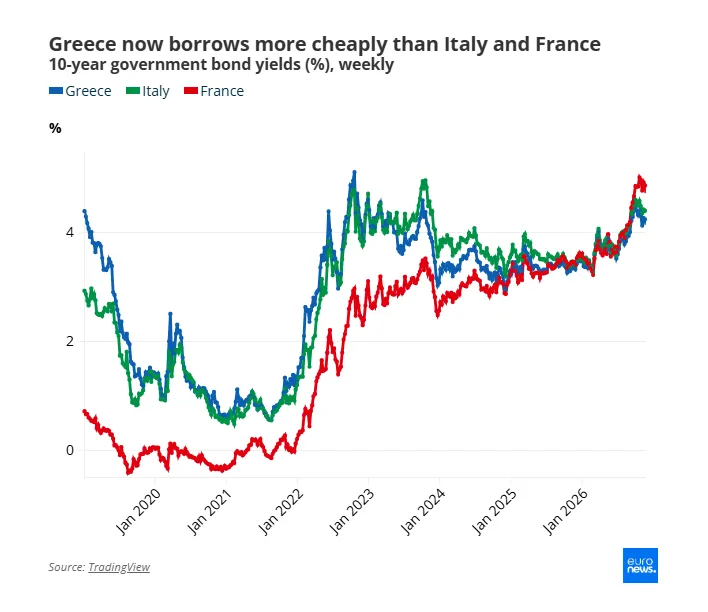
Fourteen years later, the ranking has been reversed.
On Wednesday, the yield on 10-year Greek bonds was 4.15%, below Italy’s 4.37% and significantly lower than France’s 4.73%.
The cost of Greece’s borrowing fell below that of Italy for the first time in November 2019 and has remained lower continuously since April 20. It dropped below France’s level for the first time in January 2025 and has stayed below it every day since June 15.
“Its debt is mostly at fixed interest rates and with very long maturities. “Financial markets value the Greek state much more positively than in the past, as evidenced by bond yield spreads,” said Ken Egan, senior director and head of the sovereign credit rating sector at KBRA, in an exclusive statement to Euronews.
On November 20, KBRA, a U.S. credit rating agency, upgraded Greece’s rating to BBB+ from BBB, placing it two notches above the lower boundary of the investment grade category, with a stable outlook.
“Credit ratings should be forward-looking rather than backward-looking, recognizing the moment when credit risks have diminished,” said Joan Feldbaum-Vidra, a senior director in KBRA’s sovereign debt rating division.
Budget surplus that changed history
Greece recorded a primary surplus of 5.1% of Gross Domestic Product (GDP) in 2025. This means that government revenues exceeded expenditures by that amount, before paying interest on the debt. According to the KBRA, this is the best result in Europe.
Tax collection has improved significantly.
The compliance gap for Value Added Tax (VAT), that is, the portion of VAT that should be paid but does not end up in the state treasury, narrowed from 24% in 2019 to around 9% in 2024, a level roughly equal to the European Union average.
“The outlook is completely different from the years of the sovereign debt crisis,” Egan said.
The economy has also followed the same trend. Real economic growth averaged 4.1% per year during the 2021–2025 period, significantly above the eurozone average.
Unemployment fell to 7.6% in September, from 8.8% a year earlier.
Even Greek banks, once the weakest link in the financial system, are in better shape. The share of non-performing loans fell from 6.9% in June 2024 to 3.4% in June of this year. /Adapted from Euronews, ekofin.al