



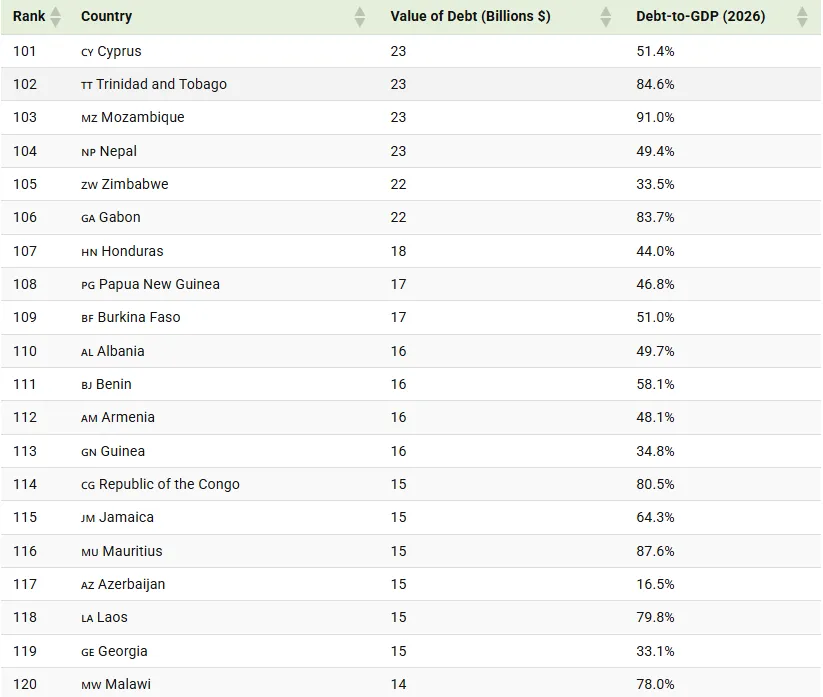
Albania’s public debt is projected to reach $16 billion in 2026, or 49.7% of Gross Domestic Product (GDP), according to International Monetary Fund (IMF) data published by Visual Capitalist. Albania ranks 110th in the world in nominal government debt, marking a further improvement compared to last year.
When compared to the countries in the region included in the ranking, Albania is in a more favorable position, with the exception of Kosovo, which, even as a new state, has a public debt that remains at low levels.
Montenegro has the highest debt burden relative to its economy, at 66.8% of GDP, although its nominal value is only $7 billion. North Macedonia has a debt of $11 billion, or 53.8% of GDP, while Kosovo registers the lowest level, with $3 billion, equivalent to 18.1% of its economy. The difference between Albania and Kosovo reaches 31.6 percentage points, while Montenegro’s debt is 17.1 percentage points higher than Albania’s.
The data are part of the global ranking for government debt in 2026, based on the IMF’s World Economic Outlook report from October 2026. The indicator includes gross general government debt and liabilities of various levels of government. The figures for 2026 are projections and not final results.
The US and China hold more than half of the world’s government debt
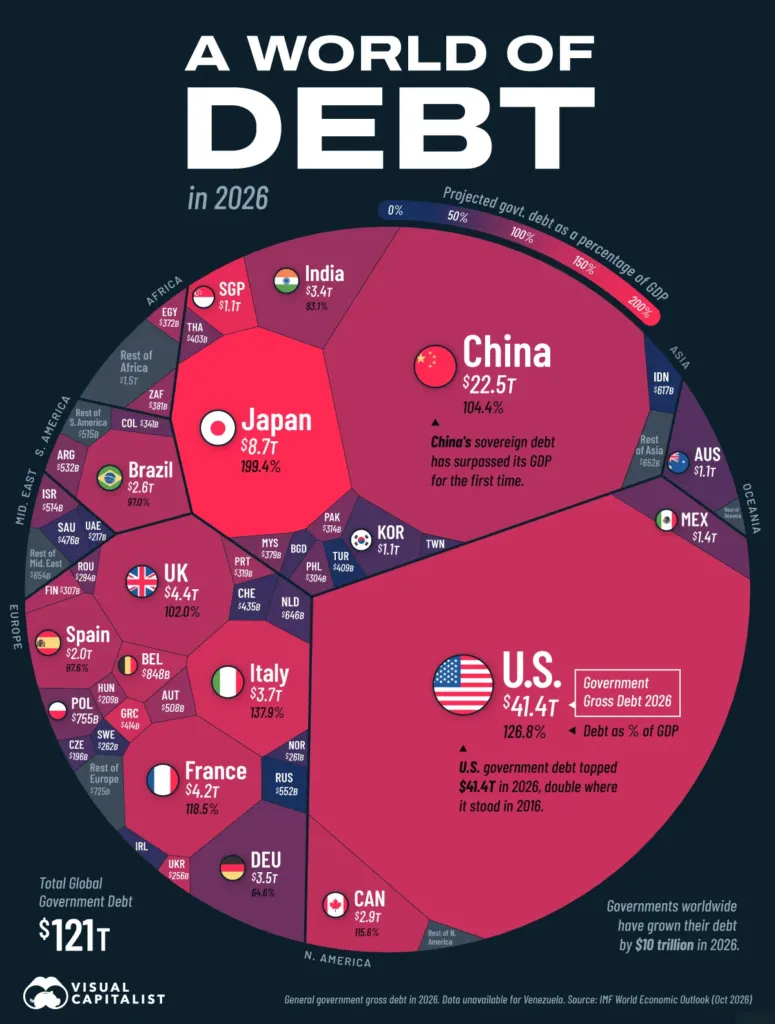
The United States leads the world ranking with $41.4 trillion in government debt, which represents about one-third of the global total.
Over the past decade, U.S. debt has risen from 107.5% of GDP in 2016 to 126.8% in 2026, as government borrowing has outpaced the pace of economic growth.
Alongside the rising debt, the cost of servicing it is also increasing. During fiscal year 2026, net interest payments in the U.S. reached about $1.1 trillion, exceeding military spending by $225 billion, according to data from the U.S. Congressional Budget Office (CBO).
China ranks second in the world, with $22.5 trillion in government debt, while its debt-to-GDP ratio is projected to exceed 100% for the first time.
Unlike the US, one of the main sources of pressure on China’s public finances is related to the local government financing system. For years, local authorities have relied on borrowing and revenues from land sales to finance infrastructure and development projects.
The weakening real estate market has curtailed this revenue source, adding to the financial difficulties of local authorities.
From Sudan to Japan, 20 economies with debt over 100% of GDP
The dollar value of debt doesn’t always show how heavy the financial burden is for a country. For this reason, the debt-to-GDP ratio is used to compare government obligations with the size of the economy.
In 2026, government debt is projected to exceed 100% of GDP in 20 economies.
Sudan tops the global ranking with debt reaching 334.4% of GDP, followed by Japan at 199.4%. High levels are also recorded in some of the most developed economies, including France, where debt is projected at 118.5% of GDP, and Canada, at 115.6%.
The group of countries where debt exceeds the size of the economy also includes Bolivia, at 100.2% of GDP.
However, even countries with a debt ratio below 100% can face significant financial pressures, especially when borrowing costs are high and budgetary revenues are limited.