



Tirana ranks second in Europe for the number of average net years of salary required to buy an apartment in the city center, reflecting the large gap between housing prices and citizens’ incomes.
Based on Numbeo data for November 2026, the Albanian capital requires 19.3 years of net income to buy a 50-square-meter apartment in the central area. This calculation assumes that the entire annual net salary is used for the purchase of the home, without any other living expenses.
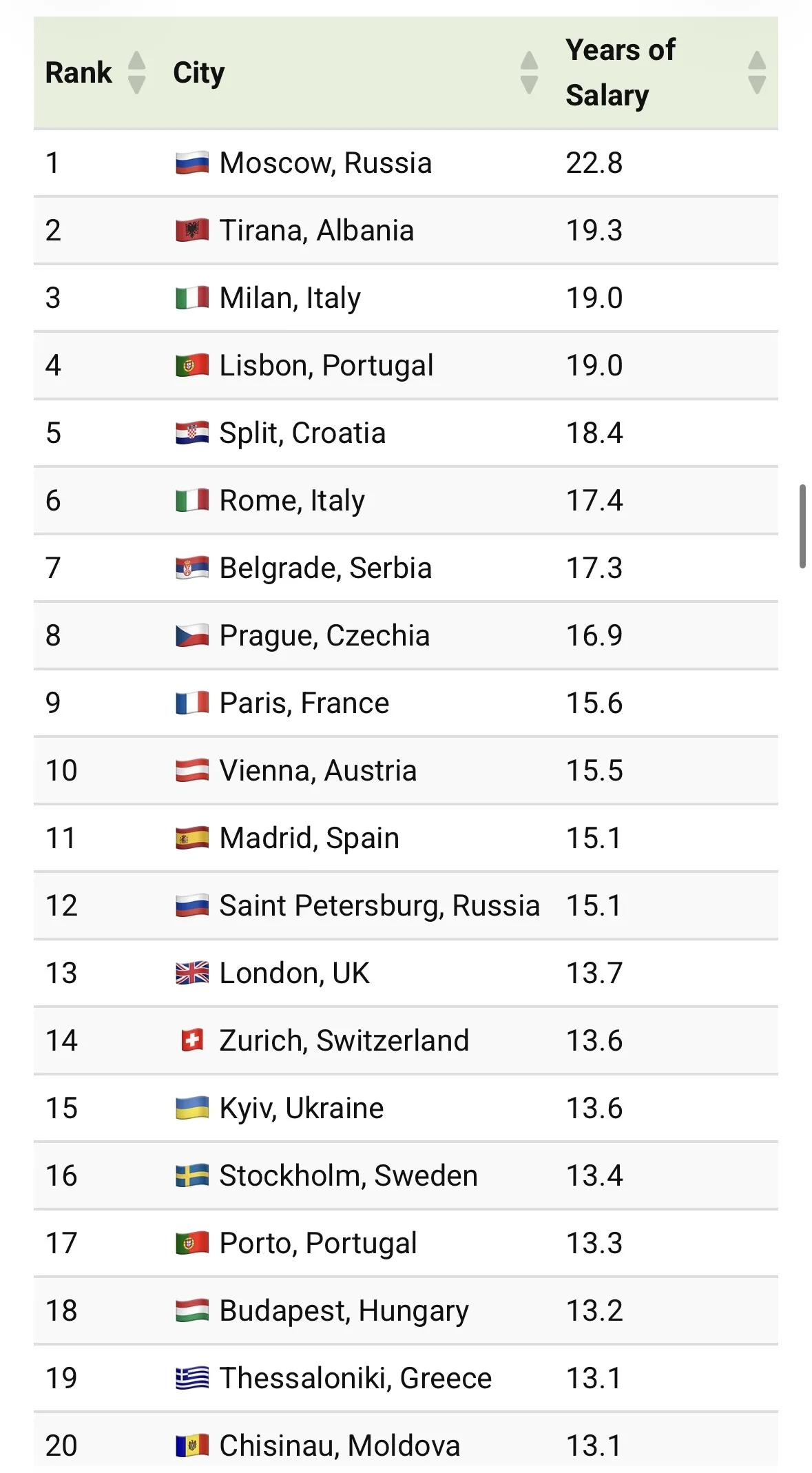
Tirana ranks behind Moscow, where 22.8 years of salary are needed, while surpassing cities like Milan and Lisbon, with 19 years each, Split with 18.4 years, and Rome with 17.4 years.
The ranking highlights the difficulty of housing affordability in the Albanian capital, where high real estate market prices are not compensated by the level of income.
Tirana, ahead of major European cities
In the list of 50 cities, Tirana ranks ahead of several well-known European centers for high property prices. In Paris, it takes 15.6 years of salary, in Vienna 15.5 years, in Madrid 15.1 years, and in London 13.7 years.
Even Zurich, one of the cities with the highest cost of living in Europe, ranks below Tirana, with 13.6 years of salary. Meanwhile, in Amsterdam it takes 9.6 years and in Berlin 9.9 years of net income.
At the other end of the ranking, Manchester is the most affordable city among the 50 analyzed, with five years of salary to buy an apartment in the city center. Brussels also ranks among the most affordable cities, with six years of salary.
Prices and salaries, an unfavorable report for Tirana
The ranking data estimates that a 50-square-meter apartment in the center of Tirana costs around 190,000 euros, while the average monthly net salary is about 818 euros.
For comparison, in Zurich an apartment of the same size is valued at around €1.2 million, but the average net monthly salary reaches €7,361. Although property prices are much higher, the ratio to residents’ incomes makes purchasing relatively more affordable in the Swiss city.
The ranking is based on property price and wage estimates collected by Numbeo. The indicator measures the ratio between housing costs and income, but does not represent a realistic savings plan, as it does not include living expenses, loan interest, taxes, and transaction costs. /ekofin.al