


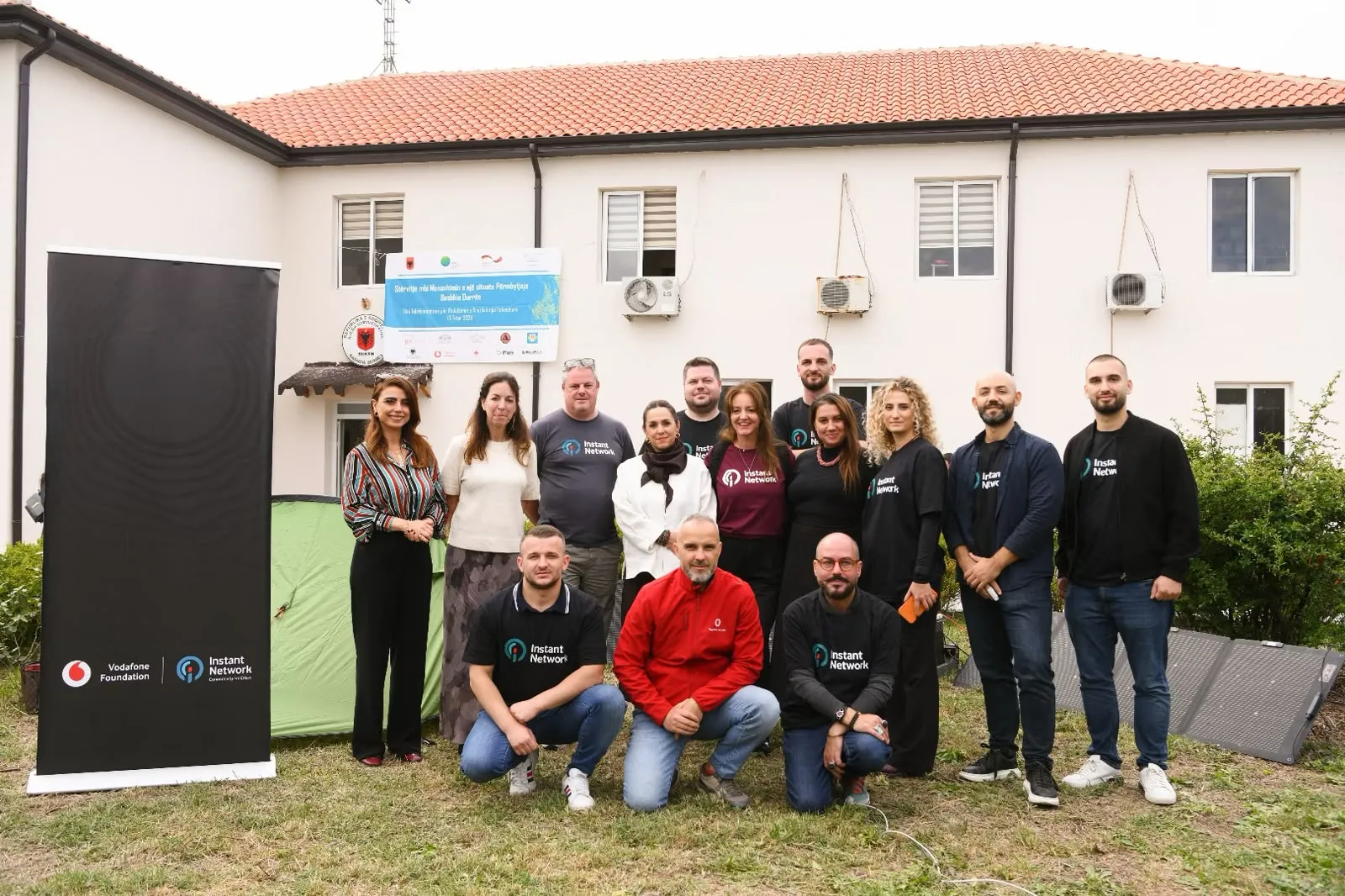
Albania becomes the first country in the Western Balkans to enable the restoration of communications in civil emergency situations through Vodafone Foundation’s Instant Network technology. As part of the International Day for Disaster Risk Reduction, The Municipality of Durrës organized a large-scale simulation exercise titled “Managing a Major Flood in the Municipality of Durrës,” with the aim of testing institutional readiness, coordination among responsible bodies, and capacities for responding to natural disasters.
The activity brought together central and local institutions, operational structures, international and local organizations, private-sector partners, and volunteers, creating a realistic scenario for managing a civil emergency. One of the most important elements of this exercise was the inclusion of Vodafone Foundation’s Instant Network technology, which enables the restoration of cellular communications in disaster-affected areas when the traditional telecommunications infrastructure is damaged or out of service. Through this capability, Albania marks a significant step in strengthening its technological readiness for civil emergencies, becoming the first country in the Western Balkans to incorporate this solution in support of communications during crisis situations.
Albania becomes the first country in the Western Balkans to enable the restoration of communications in civil emergency situations through Vodafone Foundation’s Instant Network technology.
On the occasion of the International Day for Disaster Risk Reduction, The Municipality of Durrës organized a large-scale simulation exercise, titled “Managing a Major Flood in the Municipality of Durrës,” with the aim of testing institutional readiness, coordination among responsible structures, and capacities for responding to natural disasters.
The activity brought together central and local institutions, operational structures, international and local organizations, private-sector partners, and volunteers, creating a realistic scenario for managing a civil emergency. One of the most important elements of this exercise was the inclusion of Vodafone Foundation’s Instant Network technology, which enables the restoration of cellular communications in disaster-affected areas when the traditional telecommunications infrastructure is damaged or out of service. Through this capability, Albania marks a significant step in strengthening its technological readiness for civil emergencies, becoming the first country in the Western Balkans to incorporate this solution in support of communications during crisis situations.
The exercise simulated a major flood scenario in the territory of Durrës Municipality, testing the entire emergency management chain: from early warning and institution activation, to information exchange, inter-institutional coordination, resource mobilization, and on-the-ground intervention. Participants acted according to their real roles and responsibilities, simulating decision-making under pressure, the evacuation of families, the protection of vulnerable groups, as well as the management of power outages, water supply, and communication services.
The activity was led and coordinated by the German Cooperation for Development (GIZ) in Albania, the National Civil Protection Agency, and the Municipality of Durrës, in partnership with the Vodafone Foundation in Albania and the Albanian Red Cross.
“When donors join forces under a joint program, they send a clear message: cooperation and coordination deliver more sustainable results. Instead of many fragmented projects, each with its own objectives and approach, an integrated and coherent early warning system is created, harmonized with national priorities and international standards. This approach not only contributes to the long-term strengthening of institutions, but also provides a common platform for Albanian partners, avoiding the overlap of efforts and the fragmentation of resources.” – stated Jule Petra Schulz, Director of GIZ in Albania.
A key moment of the exercise was the demonstration of the Vodafone Foundation’s Instant Network technology in Albania. Through the satellite link, the volunteer team enabled communication between operational structures and internet access in the simulated flood zone, demonstrating the importance of uninterrupted communication in emergency situations.
“Through Instant Network, we collaborate with government institutions, response structures, and local communities to strengthen preparedness, develop local capacities, and ensure the rapid restoration of communications when they are needed most. The establishment of the Instant Network center in Albania and the partnership with the National Civil Protection Agency represent significant steps toward integrating sustainable communication solutions into the national emergency response system. This will enable communities to respond more quickly, recover more easily, and be better prepared for future crises.” – said Lisa Felton, Executive Director of the Vodafone Foundation & Head of Sustainable Business and Human Rights at Vodafone.
The exercise served to test response capacities, identify needs for improvement, and strengthen inter-institutional coordination in civil emergency management.
As part of the activity, the National Civil Protection Agency and the Vodafone Foundation in Albania signed a Cooperation Memorandum to strengthen emergency response through technology and the global Instant Network volunteer network.