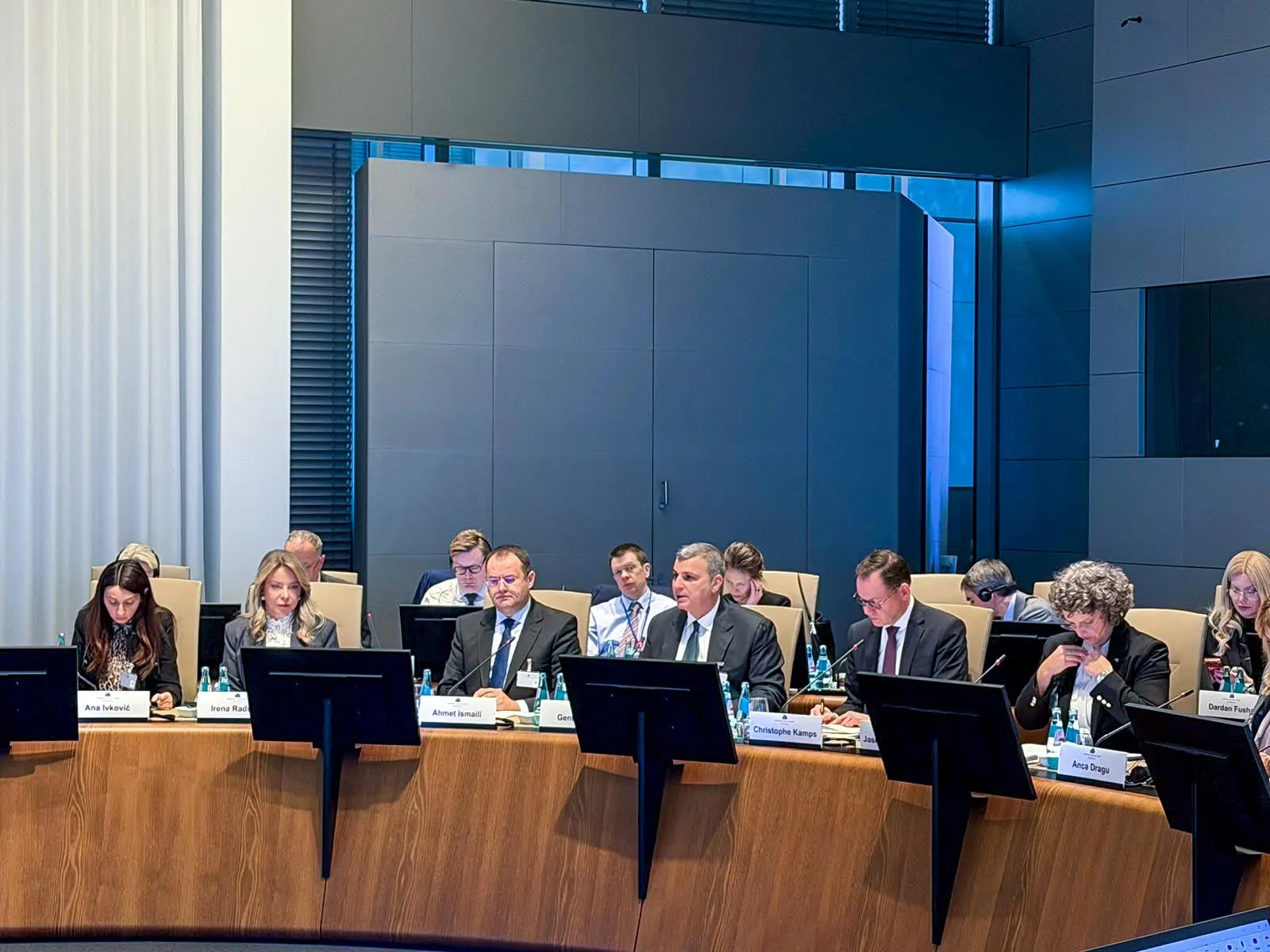
The strengthening of the lek has helped limit the transmission of imported inflation to domestic prices, while domestic electricity production from hydro sources has mitigated the impact of energy shocks on the Albanian economy.
These were some of the key messages of the Governor of the Bank of Albania, Gent Sejko, during the seminar of the General Council of the European Central Bank (ECB), held on November 26 in Frankfurt.
Sejko assessed that economic and financial integration with the European Union has contributed to the transformation of the Albanian economy, the expansion of employment, and convergence with European economies.
About 75% of Albania’s goods exports are destined for European Union markets, which also constitutes the main source of foreign direct investment in Albania. European banking groups, meanwhile, have a significant presence in the Albanian financial system.
However, the Governor pointed out that the intensification of international economic relations also increases exposure to external shocks, the impact of which depends on the structural characteristics of each economy.
Referring to the Albanian experience, Sejko underlined the importance of a free exchange rate regime and an inflation-targeting monetary policy. These two mechanisms have enabled the Bank of Albania to adapt its decision-making to domestic economic developments, while maintaining price stability as its primary objective.
Another important issue discussed was the independence of central banks, as a guarantee for decision-making based on economic analysis and for maintaining macroeconomic stability.
As part of the activity, Governor Sejko also participated in the meeting of the heads of central banks of the candidate and potentially candidate countries for EU membership with Piero Cipollone, a member of the Executive Board of the ECB.
The meeting focused on the modernization of payment systems, instant payments (TIPS), the Single Euro Payments Area (SEPA), the digital euro, and the Eurosystem’s projects for the settlement of large-value financial transactions.
The seminar, opened by ECB Vice President Boris Vujčić, brought together the governors of the central banks of EU member and aspirant countries. The discussions also addressed geopolitical uncertainties, developments in energy markets, and the impact of artificial intelligence on the economy.