Agritourism, waste management, and digital payments are the three sectors with high potential for new investments in Albania. In its latest published report, the World Bank Group assesses the country’s economic progress but notes that informality, a lack of skilled labor, and financing difficulties continue to limit private sector development.
Albania has the potential to mobilize up to $929 million in private investment and create between 13,000 and 18,000 jobs, including formalizing existing jobs, if a series of targeted reforms are undertaken in three strategic sectors of the economy.
The report analyzes the investment climate in Albania and identifies agritourism, waste management, and digital payments as sectors where public policy interventions can generate significant investments, new jobs, and productivity growth.
According to the report, the Albanian economy has maintained macroeconomic stability and recorded a decade of sustained growth, driven primarily by the private sector. During the 2015–2025 period, real economic growth averaged 3.7% per year, while investments in 2025 reached about 28% of Gross Domestic Product.
The World Bank also assesses progress in fiscal consolidation, with public debt falling to 52.9% of GDP in 2025 and the budget deficit at 1.8%.
Another positive indicator relates to the gradual convergence of income levels with the European Union. GDP per capita, measured by purchasing power parity, has risen from 24% of the EU average in 2008 to 41% in 2025.
The report emphasizes that the European integration process creates significant opportunities for institutional modernization and attracting investment, but the economic benefits will depend on businesses’ ability to increase productivity and competitiveness.
Agro-tourism, up to $476 million in investments and 7,700 jobs
Agro-tourism is identified as one of the sectors with the greatest potential for expanding private investment, especially in rural areas and off-coast destinations.
According to World Bank estimates, the implementation of the proposed reforms could generate between $318 million and $476 million in private investments in the medium term, as well as between 5,200 and 7,700 jobs, including the formalization of existing employment.
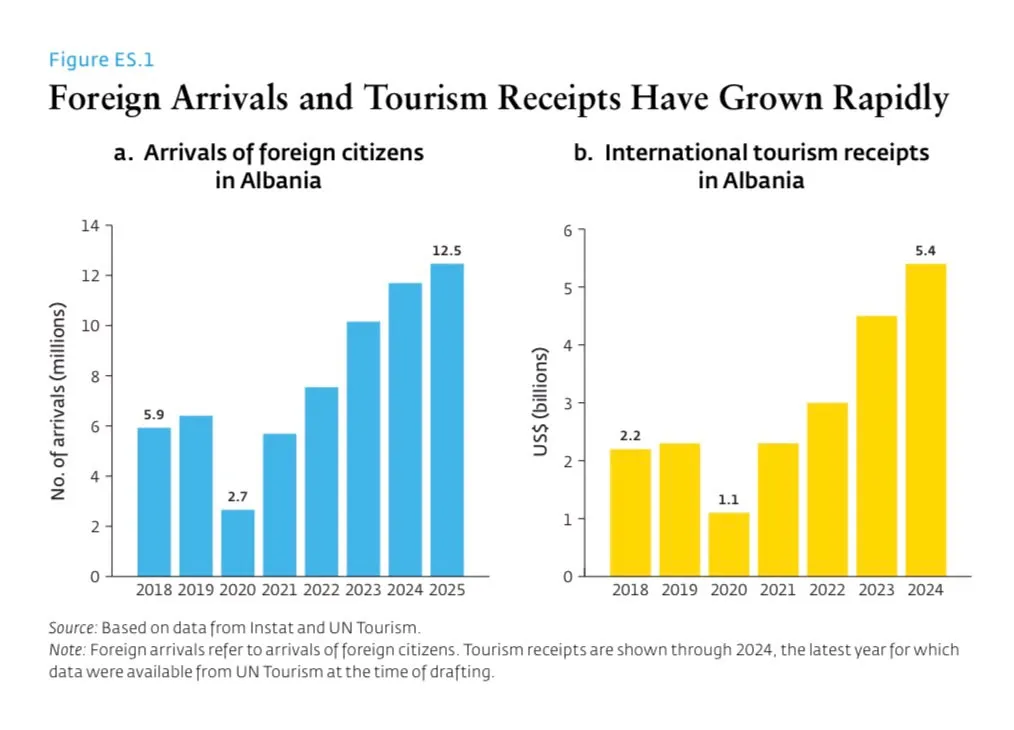
The report highlights that tourism has become the main driver of Albanian exports. The number of foreign arrivals has nearly doubled compared to 2019, while international tourism receipts reached approximately $5.4 billion in 2024.
However, the concentration of tourist activity during the summer season and in coastal areas limits the distribution of economic benefits across the entire territory.
The World Bank recommends strengthening the agritourism certification system, mandatory registration of short-term accommodation facilities, and the use of digital systems to ensure transparency and fair competition.
One of the concrete proposals is that every short-term accommodation facility be issued a unique registration number through e-Albania, which must be verified by online booking platforms before the listing is published.
Waste Management, Potential for $263 Million in Investments
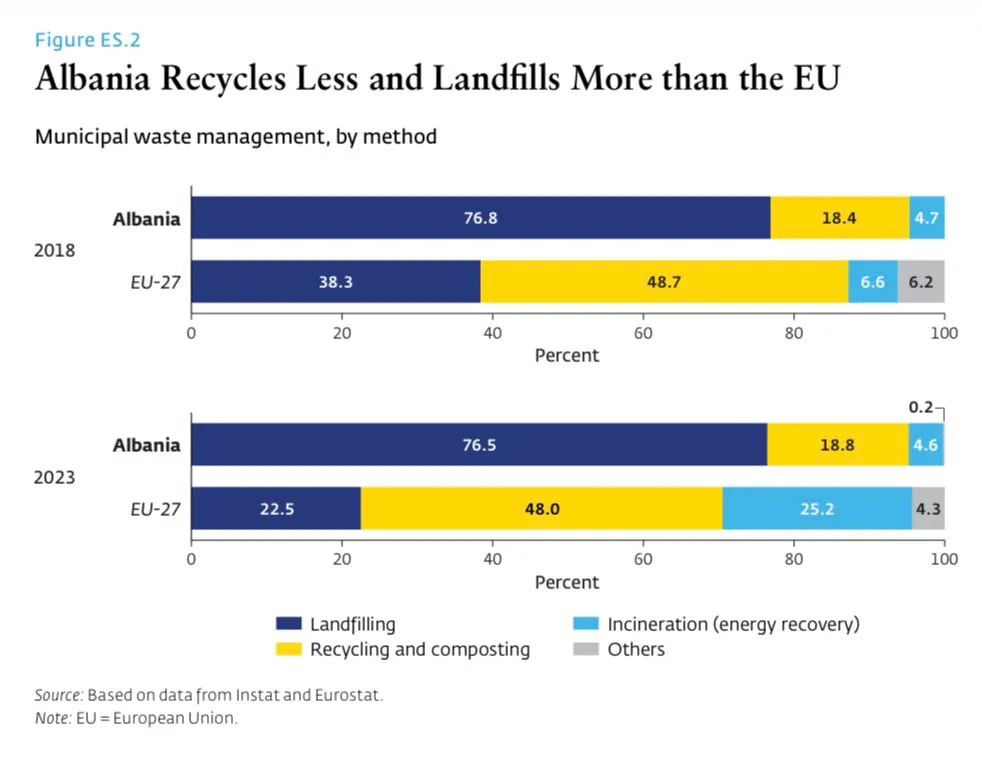
The waste management sector presents another significant opportunity for private investment, especially in recycling, organic waste treatment, and infrastructure modernization.
The World Bank estimates that reforms in this sector could attract up to $263 million in private investment over five years and support up to 5,300 jobs.
Growing tourism, urbanization, and consumption are increasing the need for modern collection, processing, and recycling capacities.
However, the report highlights issues with short-term contracts, tariffs that do not reflect real costs, a lack of reliable data, and limited source-separated waste.
In this regard, it is recommended to create more favorable conditions for the involvement of private operators through longer-term contracts, competitive procedures, and transparent financing mechanisms.
Also, it is proposed to implement digital systems for waste tracking and to link service payments to verifiable data on the quantities managed.
Digital payments, up to $190 million in new investments
The development of electronic payments represents the third sector with high investment potential.
According to the World Bank, implementing the recommendations could mobilize between $90 million and $190 million in private investment and create between 2,400 and 5,000 jobs.
The report estimates that Albania has a favorable foundation for expanding digital payments, thanks to its strong internet connectivity, widespread smartphone usage, and growing tourism.
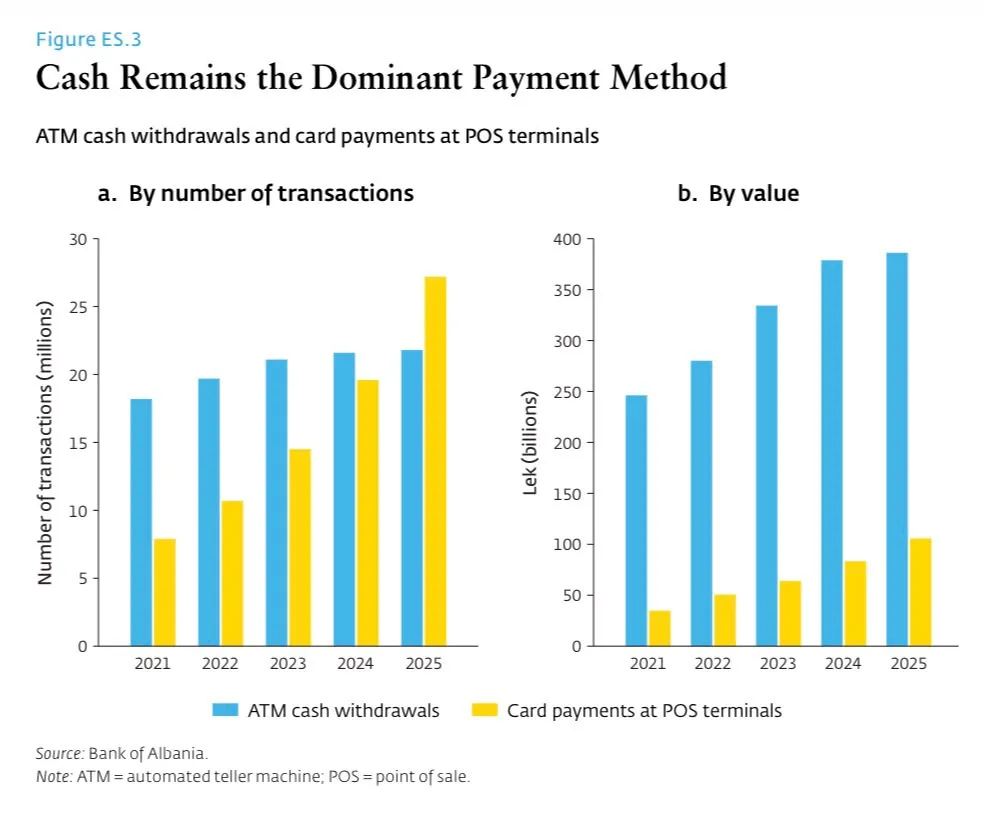
However, the use of physical cash remains high, while businesses’ acceptance of electronic payments is still limited compared to other countries.
The World Bank recommends the full digitalization of payments between the government, citizens, and businesses, expanding opportunities for electronic payments in commerce, and standardizing the implementation of the open banking system.
The report also proposes lowering the cash transaction limit for transactions between businesses and consumers, aligning it with the limit applied to transactions between businesses.
The development of electronic identification and the broader use of digital signatures in financial services are also considered important elements for reducing costs and expanding the market.
Informality and labor shortages, key obstacles for business
Despite positive developments, the report highlights several structural problems that continue to limit the potential for private investment.
About 99% of enterprises in Albania are micro, small, or medium, which creates a fragmented economic structure and limits businesses’ ability to invest in technology and boost productivity.
Another problem relates to access to financing. Domestic credit to the private sector represents about 34% of GDP, a level that remains significantly below regional averages.
Meanwhile, the shortage of skilled labor has become a significant concern for enterprises. According to the data included in the report, 40.2% of businesses identify an inadequately educated workforce as a major or very serious obstacle.
Emigration continues to affect the labor supply. The report highlights that in 2024, Albania had the highest net emigration rate in Europe, at 12.1 per 1,000 inhabitants.
The World Bank also emphasizes that, although the Albanian legal framework has been significantly aligned with European Union standards, shortcomings remain in the practical implementation of legislation and in strengthening control mechanisms.
Foreign investments are being directed toward logistics, energy, and services
A positive development highlighted by the report is the gradual shift in the structure of foreign direct investment.
While previously investments were mainly concentrated in the extractive industry and real estate, in recent years there has been growing interest in logistics, renewable energy, technology, and services.
According to data on newly announced investments for the 2020–2024 period, transport and storage account for 49% of the planned capital value, while renewable energy accounts for 15%.
Components for the automotive industry account for 7%, consumer products 6%, and hotels and tourism 6%.
Parallel to this, Albanian exports are increasingly shifting towards services. Travel and tourism accounted for over 45% of total exports in 2024, while business services, including information technology and financial services, represented nearly 20%.
This transformation, according to the World Bank, shows the opportunities that Albania has to gradually move from a low-cost-based economic model toward higher value-added activities.
The report assesses that Albania is at a significant moment in its economic development, where macroeconomic stability, the expansion of tourism, and the prospect of European Union membership create favorable conditions for a new investment cycle.