
Public hospitals that enjoy hospital autonomy are expected to gain broader powers in revenue management, setting fees for certain services, personnel management, and entering into contracts with private entities, both domestic and foreign.
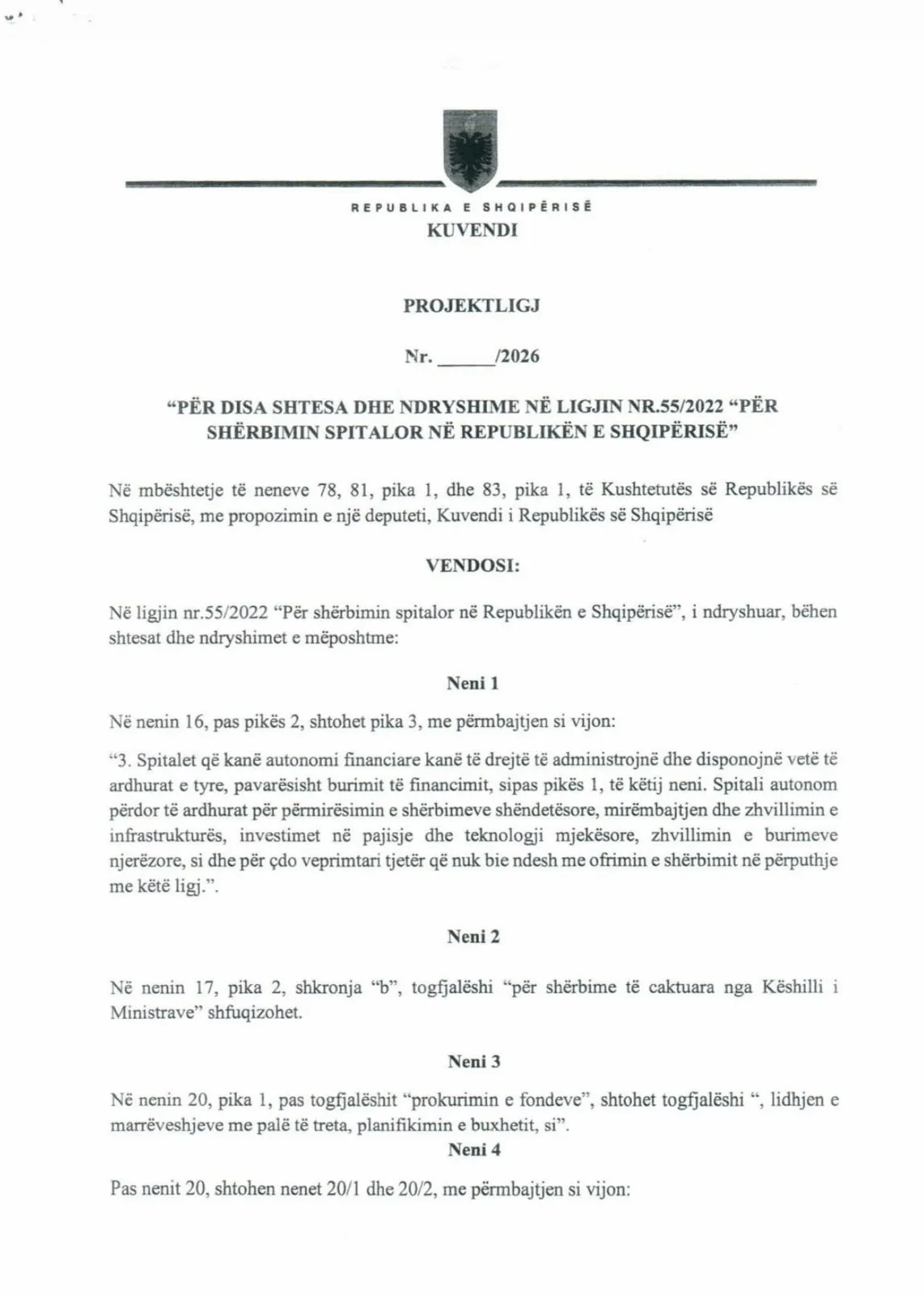
A bill submitted to Parliament by the Socialist Party parliamentary group, for certain additions and amendments to Law No. 55/2022 “On Hospital Services in the Republic of Albania,” aims to expand the financial, managerial, and contractual autonomy of public hospital institutions.
According to the accompanying explanatory memorandum, the current practice of implementing the law has revealed certain limitations that prevent the full utilization of the diagnostic, treatment, human, and infrastructural capacities of public hospitals.
Hospitals will administer their own revenues
The draft law provides that hospitals with financial autonomy have the right to administer and dispose of their own revenues, regardless of the funding source.
These institutions will be able to draft and implement annual and medium-term plans for their own revenues and expenditures, as well as to collect and record revenues in bank accounts at second-tier banks.
Additionally, autonomous hospitals will have the right to establish reserve and investment funds from their own revenues.
Funds allocated from the state budget and the Mandatory Health Care Insurance Fund will continue to be used only for the purpose for which they were allocated and will be accounted for separately.
Fees for services outside the insurance scheme
One of the most important changes concerns the right of autonomous hospitals to determine the types of medical services they offer outside the package covered by the mandatory health care insurance scheme.
Fees for these services will be approved by a decision of the hospital’s governing board, in accordance with the methodology set forth in the law.
The draft law also grants hospitals the right to set fees for services provided through the preferential lane, regardless of the referral system, even for services that are part of the package covered by the mandatory health insurance scheme.
Contracts with private companies and the development of health tourism
Autonomous public hospitals will be able to enter into agreements and contracts with natural or legal persons, domestic or foreign, for the provision of specific medical and non-medical services.
Potential partners include non-public hospitals, private health insurance companies, other healthcare institutions, and other private entities.
The draft law provides for the possibility of cooperation for: The use of diagnostic and treatment capacities, including infrastructure and medical equipment; The provision of health packages for employees of private companies; The provision of services for foreign patients and the development of health tourism; Development of joint diagnostic, treatment, and rehabilitation services; Development of telemedicine and digital health technologies; Scientific research, clinical studies, and testing of medical devices; Organization of training and professional activities.
Hospitals will also be able to enter into contracts with diplomatic missions, international organizations, and foreign corporations operating in Albania to provide health services to their personnel.
Also, the possibility is provided for contracting technical assistance, consulting, and support in hospital management, in whole or in part, from public or private entities, domestic or foreign.
Fees for the services covered by these agreements cannot be lower than the cost of providing the service.
Incentives for personnel based on performance
The draft law creates the possibility for a portion of the revenues generated by the activity of autonomous hospitals to be used for personnel incentives based on a performance-based payment model.
The hospitals’ own revenues may be used to cover service costs, invest in infrastructure, equipment, and medical technology, develop and train human resources, and pay contractual obligations.
Meanwhile, the use of these revenues for sponsorships or expenses unrelated to the hospital’s core activities is prohibited.
Another proposed change is to expand the dual practice of medical staff beyond outpatient consultations.
According to the explanatory memorandum, the aim is to utilize doctors’ professional capacities within public institutions outside their regular working hours, rather than having them shift to the private sector, while simultaneously generating additional revenue for the hospital and providing financial incentives for the staff.
Contracts with private entities will be published
To ensure transparency in relationships with the private sector, the draft law establishes special procedures for selecting partners.
Before signing the agreements, hospitals must conduct an assessment of needs, available capacities, economic interest, and the benefits that the collaboration brings to the institution and the public health system.
In cases where the agreement provides for the selection of a private entity, the hospital must publish a call for expressions of interest on its official website and in the Official Gazette.
Autonomous hospitals will be required to publish a register of contracts with private third parties, specifying the parties, the subject matter, the value, and the duration of the contract, within 15 days of its conclusion.
Additionally, every six months, a report on its revenues, contracts with private parties, and the use of the income will be submitted to the ministry responsible for health. /ekofin.al