


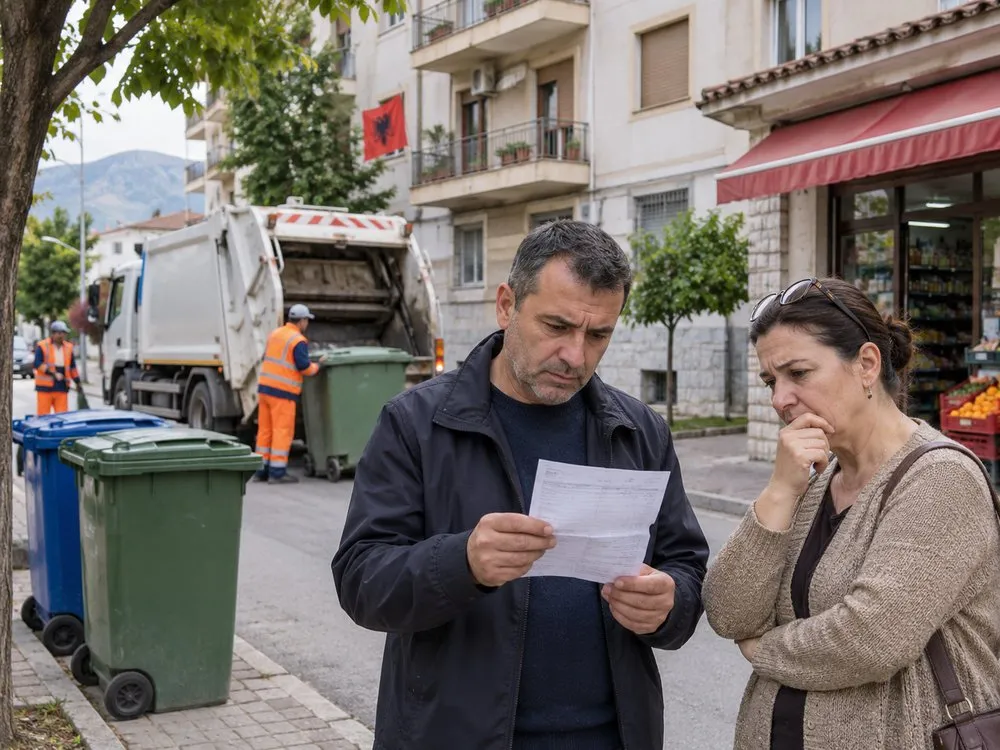
Collection fees in Albania cover on average only about 40% of service costs, while the remainder is financed by municipal budgets and government transfers.
The World Bank is calling for a change in the way these fees are calculated, linking them to the actual costs of waste collection, transportation, and treatment, and providing adjusted rates for tourist areas.
Inadequate funding is one of the main obstacles to modernizing waste management in Albania, according to the World Bank’s report on Albania.
The assessment that only 40% of costs are covered is based on 2021 data from the European Environment Agency (EEA), cited in the report.
According to the World Bank, the current tariff system varies significantly between municipalities and does not necessarily reflect the amount of waste produced or the actual costs of its treatment.
For households, the fee is generally based on the residential address, while for businesses, metrics like turnover or profit are used instead of the amount of waste they generate. This means that a business’s payment is not necessarily linked to the burden it places on the waste system.
The World Bank estimates that the lack of a unified methodology creates uncertainty about the revenues that can be generated from the service, limits investment, and makes it difficult to improve the quality of cleaning.
New fees based on real costs, support for families in need
To change the situation, the World Bank recommends that the government adopt a national methodology for calculating the sanitation fee, which would be gradually implemented by municipalities.
According to this proposal, the fee should take into account not only the daily costs of waste collection and transportation, but also the costs of infrastructure investments, capital recovery, and compliance with environmental standards.
Such a system aims to generate more sustainable revenue so that municipalities and operators can invest in modern vehicles, equipment, and facilities.
However, the World Bank acknowledges that an immediate shift to full cost coverage could create difficulties for citizens in affording the fees.
For this reason, it is recommended that the change be implemented in phases and accompanied by targeted social support for families in need. The report also suggests that municipalities publish annually how the fees are calculated, while the revenues collected should be used exclusively for waste services.
The World Bank does not specify a concrete rate level that households or businesses must pay, nor a predetermined percentage for its increase. The recommendation pertains to changing the methodology for calculating and financing the service.
Seasonal fees for tourist municipalities
One of the report’s proposals relates to municipalities where the influx of tourists significantly increases the amount of waste during the summer months.
The World Bank recommends that the new methodology allow these municipalities to implement seasonal fee adjustments or additional tourism-related fees when data show that the number of visitors significantly increases service costs.
According to the report, tourist municipalities face significant seasonal fluctuations that require additional capacity for waste collection and transportation. Meanwhile, the current financing system does not always reflect these costs.
For this reason, the World Bank requires that any seasonal fee be transparent and supported by documented data on increases in waste volumes and the corresponding costs.
This is a recommendation for the possibility of differentiating fees and not a decision to impose new payments in tourist areas.
Short contracts hinder investments in cleaning
Financing problems are also accompanied by the way the service is organized.
The World Bank notes that many private waste operators in Albania are contracted for relatively short periods, usually three years and, in some cases, five years.
These terms are considered insufficient to recoup investments in vehicles, containers, collection points, and digital management systems.
The report also finds that in some municipalities the service is provided by publicly owned enterprises contracted directly, while private operators participate in competitive procedures.
To create better conditions for investment, the World Bank recommends using open, competitive tenders and awarding contracts with terms that reflect the size of the investment and the time needed for its recovery.
For contracts requiring significant investments, the report estimates that periods of 10–15 years or even more may be needed, depending on the project’s characteristics.
However, long-term contracts must be accompanied by measurable service quality indicators, periodic reviews, and the publication of key financial terms, in order to avoid unjustified costs and poor operator performance.
Even with new tariffs, revenue collection remains a problem
The World Bank warns that changing the tariff formula alone does not guarantee the resolution of the sector’s financial problems.
Households and businesses may oppose higher payments, while municipalities may continue to face difficulties in billing and collecting payments.
If these issues are not addressed, operators may continue to face revenue shortfalls, negatively impacting service quality and the ability to finance investments.
For this reason, the World Bank recommends a gradual reform, accompanied by improvements to billing and fee collection systems, as well as supportive measures for categories that cannot afford the payments.
The report suggests that the changes be initially tested in one or two municipalities or areas with high tourist activity, including the Tirana–Durrës corridor or Vlorë, before being rolled out nationwide.
Results should be measured by improving fee collection, reducing illegal dumping, and increasing the amounts of waste collected separately.
According to the World Bank, without a more sustainable financial system, municipalities will continue to struggle with modernizing infrastructure, while private investors will face uncertainty about recovering their invested capital.
