


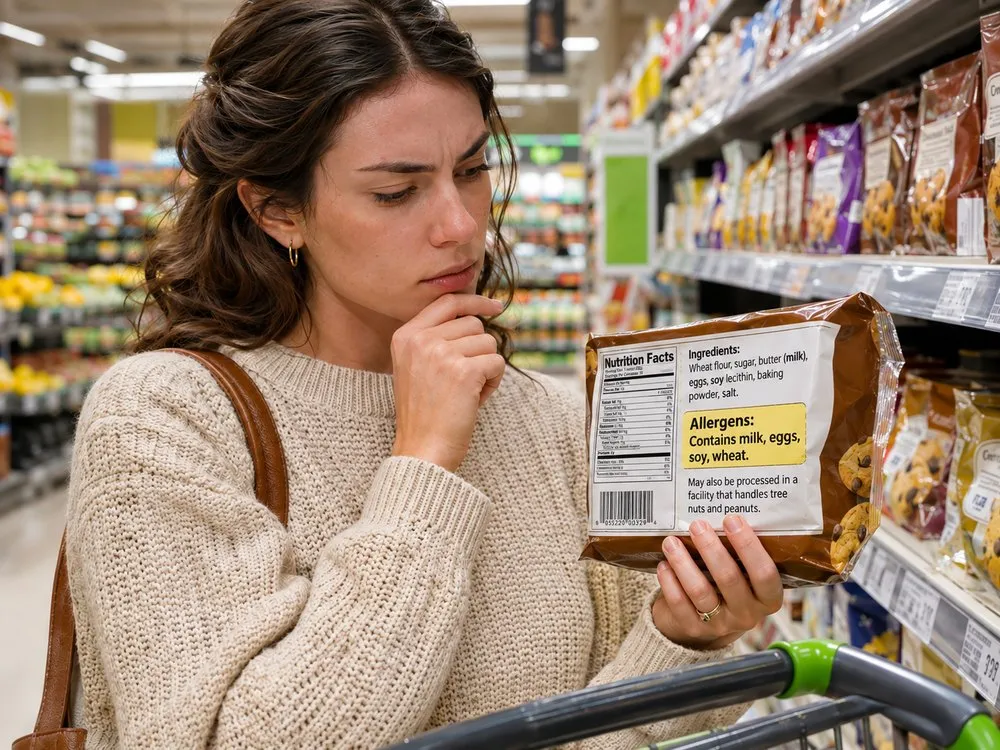
The new draft law “On Food” changes the way mandatory information is specified on food labels, explicitly including the declaration of substances that cause allergies or intolerances and of nutritional values, while linking the obligation to indicate origin to the cases defined in the relevant legislation.
The change is important for consumers and businesses that produce, import, or market food products, as the labeling information serves to identify the composition, characteristics, and conditions of use of the food.
The current Law No. 9863/2008 lists the country of origin among the mandatory information on the label, whereas the draft law provides for declaring the country of origin or provenance when required by consumer information legislation.
This does not mean that origin will no longer be declared, but that the obligation will be determined in accordance with the specific rules for the respective food categories.
Allergens and nutritional information in mandatory information
Article 29 of the draft law establishes a broad set of information that must accompany foods intended for the final consumer or for supply to mass food service operators.
The information includes the name of the product, the list of ingredients, the net quantity, the minimum shelf life date or the “use by” date, special storage and use conditions, as well as the name and address of the operator responsible for the food information.
Special attention is paid to ingredients that may cause allergies or intolerances. The draft law requires information on substances specified in the relevant legislation when they have been used in the production or preparation of food and are still present in the final product, even in a modified form.
This provision is particularly important for consumers who need to avoid certain ingredients for health reasons.
Another requirement set out in the draft law is the nutritional declaration, which provides the consumer with information on the product’s nutritional characteristics, in accordance with the relevant legislation.
For beverages with an alcohol content above 1.2% by volume, the mandatory information also includes the alcohol by volume.
The information must be in Albanian and legible.
The draft law retains the requirement that mandatory information be presented in the Albanian language, in a way that is understandable to the consumer, without prohibiting the parallel use of other languages.
For pre-packaged foods, the information must be directly on the packaging or on a label attached to it.
It must be placed in a conspicuous position, be easily distinguishable, legible, and, where appropriate, indelible.
In practice, these requirements affect both domestic producers and importers who place products with foreign-language labels on the Albanian market.
The draft law also prohibits misleading labeling, advertising, and presentation of foods. The ban covers not only written information but also the appearance, shape, packaging, and manner of displaying the product.
Fines for labeling violations
For labeling in violation of the law’s requirements, the draft law provides fines ranging from 80,000 to 100,000 lek.
Compared to the current law, where the fine ranges from 50,000 to 100,000 lek, the minimum threshold is increased by 30,000 lek, while the maximum fine remains unchanged.
Detailed rules for the labeling of specific categories of foods will be determined by directives from the responsible minister. /ekofin.al
