


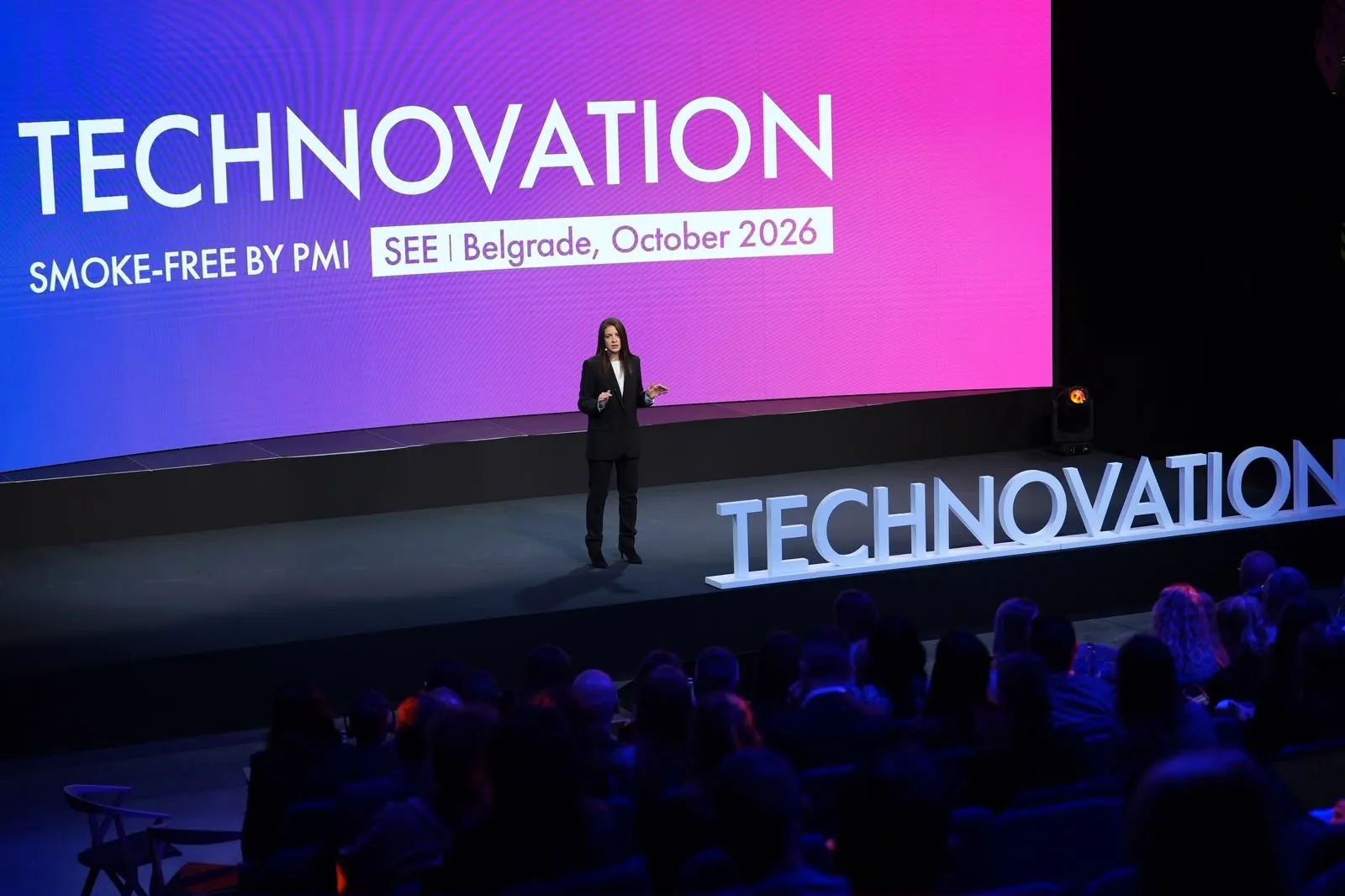
The TECHNOVATION SEE 2026 conference addressed company transformation, a realistic approach to reducing health risks, and shared responsibility for the protection of minors
What is needed for a company to influence the change of the future when its current business model already brings success? Is society willing to speak openly about difficult topics, even when the answers do not match what we know? These questions brought together the participants of the regional conference TECHNOVATION SEE 2026, organized by Philip Morris International in Ložinonica, Belgrade, under the slogan “Innovation. Responsibility. Impact.”
“Fifteen years ago, I started working at Philip Morris International. I entered a traditional and successful company, built around Marlboro, the world’s most famous cigarette brand. I was convinced that I understood well where I had come, what the company was doing, and in which direction it was headed. I was wrong,” said Tamara Milovanović, PMI’s general director for Southeast Europe, opening the conference by narrating four changes she could not even imagine at the time.
Her main message was that radical transformation does not only begin when the old model stops working. On the contrary, the greatest proof of willingness to change comes precisely when the company needs to reconsider what it has built its success on. She recalled the strategic turning point of 2016, when company leaders publicly announced their ambition to one day completely replace cigarettes with better alternatives. At that moment, she emphasized, there was no guarantee that such a decision would be successful.

“This was not a marketing slogan, although many thought so, but a major scientific challenge,” Milovanović stated. Speaking about the scale of the change, she emphasized that IQOS has surpassed Marlboro in many segments and markets – the brand that symbolized the company’s previous era. Behind this change lies not only the development of new products but also a fundamental transformation of the company, where science and research have taken a central role.
To illustrate this, she mentioned the 1,600 scientists engaged in the company’s research and development center. “The distinctive symbol of Philip Morris International is no longer the cowboy’s hat, but the white coat,” she said, explaining that research and development rely on scientific capacities and that one of the goals is to develop alternatives for adult smokers who would otherwise continue to smoke. She particularly highlighted Serbia’s role in this transformation. The factory in Niš, which has been developed since privatization in 2003, has expanded its role in the company’s global production network, including manufacturing tobacco units that are used without combustion.

From ideal rules to enforceable decisions
The discussion continued with the question “Is it enough to be less harmful?”, which moderator Ivan Zeljković posed to Dr. Peter Harper, oncologist and public health expert. Harper pointed out the paradox of today’s attitude toward health: the ever-increasing ability to access information does not necessarily mean it is easier to adopt healthier habits. As significant obstacles, he identified perfectionism, guilt, and recommendations that people find difficult to implement in everyday life.
At the center of the discussion was an approach that starts from people’s real capabilities and understanding the different levels of risk. In the context of smoking, Dr. Harper emphasized that the best choice is to quit smoking completely or not start smoking, taking into account the harm reduction principle for adults who continue to smoke. Such an approach does not imply a lack of risk nor does it change the need to protect young people. “No one can deny that quitting smoking is the best decision for any smoker, just as the best choice is never to start. However, we must be realistic. There are people who do not manage to quit smoking even after being diagnosed with lung cancer. Therefore, we need to talk about harm reduction. We know nicotine is addictive, but the carcinogenic substances produced by tobacco combustion are the main cause of the risk of smoking-related cancer. If someone cannot quit smoking, the next step is to understand what causes the harm and what we can do to reduce it. Harm reduction is not a new concept – we apply it every day, from using seat belts to sun protection. So why not think the same way about smoking?” emphasized Dr. Peter Harper.
Ministry of Health: Prevention does not end with bans
Dr. Ivana Stašević Karličić, State Secretary at the Ministry of Health of the Republic of Serbia, spoke about the importance of prevention and the role of institutions in protecting youth health during a special conversation with Ivan Zeljković. She emphasized that preventing harmful behaviors requires the involvement of the entire society, as well as continuous work on the education and awareness of young people.

“No preventive initiative can succeed if only a part of society participates. From individuals to institutions, everyone must be involved. The role of the Ministry of Health is not only to regulate access to tobacco products but also to raise awareness about the harms of smoking, especially during the sensitive growth period,” emphasized Dr. Ivana Stašević Karličić. She added that, within the framework of these initiatives, the Ministry of Health is currently conducting a campaign with the organizers of this conference, which aims to protect minors from the use of tobacco products and nicotine.
Precisely the way in which shared responsibility can be transformed into concrete measures was the focus of the panel “Protecting Minors: We All Must Act!” While institutions define the regulatory and preventive framework, its implementation requires an active role from companies, traders, families, and individuals who influence young people through their behavior.
The discussion included Radmilo Vlačić, PMI’s director of commercial operations for Southeast Europe, Iakovos Kargarotos, senior director of corporate affairs strategy at PMI, and Zorana Arunović, an Olympic, world, and European shooting champion. The panel emphasized the need for the protection of minors to be seen as a shared responsibility, requiring verifiable measures and not just agreement in principle.

“The protection of minors is not the responsibility of just one company, but of the entire society. As a company, we are taking concrete steps: we have trained more than 15,000 sellers and are ready to terminate cooperation with traders whom we find selling tobacco and nicotine products to minors. However, responsibility does not end at the point of sale. Parents, schools, the media, and institutions play an important role in explaining the risks to young people and setting an example of responsible behavior. When it comes to selling these products to minors, the answer must be clear and firm: NO,” said Radmilo Vlačić, senior director of trade affairs at Philip Morris for Southeast Europe.
While Serbia is working to prevent the sale to minors through training sellers and controlling points of sale, experiences from other countries show how digital solutions can further improve these mechanisms.
“Greece’s experience shows that no single measure alone is sufficient. A combination of clear rules, their consistent enforcement, reliable age verification, and responsibility of everyone is needed, from institutions and traders to parents and teachers. In Greece, a digital wallet is used for age verification, which allows simple and reliable confirmation of adult age during purchase. Sellers should not guess someone’s age but are obliged to verify it. However, technology alone is not enough. Our goal is not only to respect the law but to create a culture where responsible selling becomes common practice,” emphasized Iakovos Kargarotos, senior director of corporate affairs strategy at Philip Morris International.
While the regulatory framework, sales control, and technological solutions are important to prevent minors from accessing tobacco products, it is equally important to understand what influences their decisions. Peer pressure, the need to feel part of a group, and following the example of public figures can play an important role in shaping young people’s behavior. Olympic champion Zorana Arunović spoke precisely about the responsibility of those who take young people as examples.
“Sport has taught me that motivation comes and goes, but it is discipline that drives us forward. This is especially important when young people face peer pressure. In such situations, I advise them to stop and ask themselves two simple questions: Do I really want this, and what consequences might my decision have? Sport teaches us exactly this: to think with our own heads, make decisions, and take responsibility for them,” said Zorana Arunović, Olympic shooting champion.
From idea to story, from thrown materials to art
The second part of the conference addressed the question of how innovation travels from an initial idea to a product available on the market. The panel “Innovations in Focus” discussed support for startups, partnerships between the private and public sectors, as well as the StarTech program, developed in collaboration with NALED. The results of the RE:IMAGINE ŠkART 2 ART project, initiated by Philip Morris International and the American Chamber of Commerce in Serbia (AmCham), were also presented, during which ten young artists explored how they could add new value to the materials they produced. The program concluded with a lecture by futurist Dietmar Dahmen, “With Superpowers Towards Success.”
From business transformation and innovation development to responsibility towards health and future generations, TECHNOVATION SEE 2026 showed that changes do not begin when they become inevitable, but when we have the courage to initiate them ourselves.
