


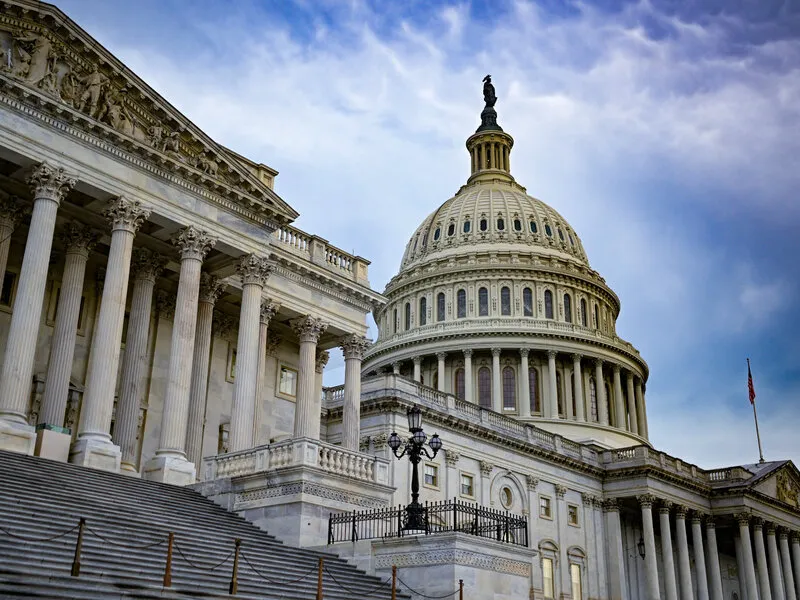
The Democratic Party is expected to take control of both chambers of the U.S. Congress, the Senate and the House of Representatives, after the 2026 midterm elections.
According to projections published by CNN, the Democrats have secured a majority in both chambers, shifting the political balance in Washington and limiting President Donald Trump’s room for maneuver during the remaining two years of his term.
The results remain preliminary, as vote counting continues in several states and electoral districts, but CNN’s projections show a significant shift in the balance of political forces in the United States.
According to data presented by CNN, the Democrats have so far secured 53 seats in the Senate, compared to 41 for the Republicans. In the House of Representatives, the Democrats have 207 seats, while the Republicans have 123. These numbers do not represent the final results, as some of the mandates are still to be determined.

A projected Democratic victory in both chambers would mark a rare shift in American politics. According to CNN’s analysis, control of the Senate and the House of Representatives has only changed simultaneously twice in the last 50 years during the same election cycle.
Democrats also win in traditional Republican strongholds
One of the most important developments in these elections is the expansion of support for Democrats in states that have traditionally voted Republican.
According to CNN projections, the Democrats have managed to win Senate races in South Carolina, Texas, Ohio, Kansas, and Iowa, securing mandates in territories where Donald Trump had secured decisive victories in the 2024 presidential election.
Particularly significant is the race in Texas, a state that had not elected a Democrat to a state-level office since 1994. Another historic result is that in Kansas, where a Democratic candidate had not been elected senator since 1932.
Even in South Carolina, where Trump won by a margin of 18 percentage points in 2024, projections indicate that one Senate term will pass to the Democrats.
These results suggest that dissatisfaction with the Trump administration has extended beyond states where Democrats have traditionally had strong support.
Inflation, trade tariffs, and the economy influenced the vote.
The economy appears to have been one of the main factors influencing the election results.
According to CNN’s analysis, inflation, tariffs imposed by the Trump administration, the war with Iran, and voters’ concerns about how presidential power is exercised have contributed to weakening support for the Republicans.
CNN’s voter poll shows that more than 6 in 10 voters disapprove of how Trump is carrying out the presidency, while more than half express strong opposition to him.
According to this same poll, about two-thirds of voters believe that Trump’s policies have worsened the state of the American economy.
These perceptions are especially important at a time when the U.S. administration has undertaken major changes in trade policy, through tariffs on imports and a review of economic relations with international partners.
The election result can also be interpreted as a signal of dissatisfaction among a portion of the electorate with the economic effects of these policies, although voting motives vary according to countries and categories of voters.
Trump faces an opposition-controlled Congress
The change of majorities in Congress is expected to have direct consequences for the Trump administration over the next two years.
So far, Republicans have controlled the White House and both chambers of Congress, giving the president greater opportunities to advance his political and economic agenda.
With the Democrats taking control, the administration will face a more difficult process for passing laws, especially on issues related to the federal budget, taxes, public spending, and economic policies.
Democrats will also have the opportunity to initiate parliamentary investigations into the administration and request documentation and evidence from federal officials.
Senate control also gives the Democrats the ability to block appointments proposed by Trump in the federal judicial system, including potential appointments to the Supreme Court.
However, Congressional oversight does not mean that the Democrats can pass their program without obstacles. The President retains the right of veto, while most bills in the Senate require 60 votes to overcome procedural obstacles.
What could change in economic and trade policies?
Beyond political influence, the election result could also have consequences for the direction of American economic policies and international trade relations.
A Democrat-controlled Congress could exert greater pressure on the administration to review some of its policies, especially those related to customs tariffs, the cost of living, and federal spending.
However, the president’s powers in trade and foreign policy remain considerable, so changing the parliamentary majority does not automatically imply changing tariffs or international agreements.
Another important element will be the process of approving the federal budget. Clashes between the White House and Congress could create difficulties in financing the administration and increase uncertainty about fiscal policies.
For international financial markets, attention will focus on the possibility of blocking new legislative initiatives, the progress of the federal deficit, and the U.S. trade relations with key partners.
Final results are expected after the counting is completed
CNN’s projections for Democratic control of the Congress have also been reported by other American media. The Associated Press has confirmed the Senate’s shift to the Democrats, while in its available report, control of the House of Representatives had not yet been definitively declared.
Although the counting continues and the final size of the majorities remains to be determined, the projected result represents a significant shift in the institutional balances in Washington.
For Donald Trump, the last two years of his presidential term are expected to be characterized by a more difficult relationship with the legislative branch, while the Democrats gain new tools to control and oversee the administration. /Adapted from CNN, ekofin.al
