


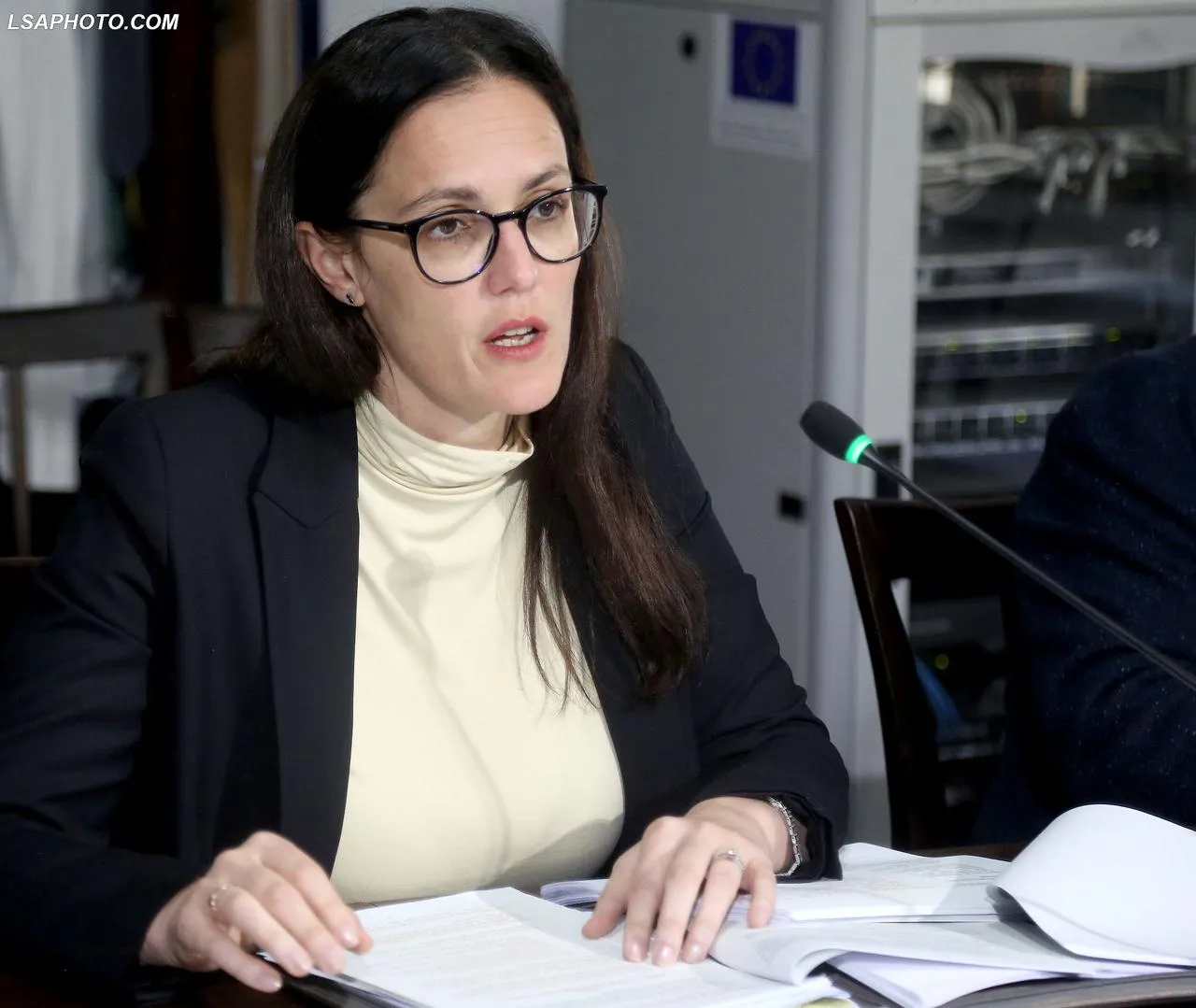
The Ministry of Economy and Innovation has allocated a fund of 4 billion lek in the 2027 draft budget for pension indexation and bringing this process closer to April.
During the presentation of the 2027 draft budget to the Commission for Economy, Employment, and Finance, the Minister of Economy and Innovation, Delina Ibrahimaj, announced that the goal is for the pension indexation to be carried out in April, following changes made in recent years regarding its implementation period.
Ibrahimaj said that after the necessary interventions in 2022, the indexing was postponed from April to October, and then moved closer to July.
According to her, the 2027 budget aims to complete this process as early as April.
“Also, the budget foresees doubling the monthly bonus for pensioners, in accordance with the commitment set out in the government’s program. For this purpose, a fund of 20 billion lek has been made available,” said Ibrahimaj.
1.25 billion lek for housing in 2027
Regarding housing, Ibrahimaj said that in the field of housing, the 2027 draft budget foresees funding of 1.25 billion lek, of which 745 million lek are for direct support of families and 500 million lek for investments.
For 2027, Ibrahimaj added, we continue financing existing housing programs, but at the same time, we have also planned new interventions aimed at expanding opportunities for social and affordable housing.
“Specifically, 448 million lek have been allocated for subsidizing the interest on conceived loans. Through this financing, support will continue for about 7,000 beneficiary families, while we aim to include around 1,000 new families during 2027. To illustrate the progress of this scheme, around 700 families benefited from soft housing loans during 2026. Another support instrument is the rent subsidy, for which we have allocated 262 million lek, with an objective of about 2,000 beneficiary families. Meanwhile, 35 million lek will be used to support families affected by the Great Ring Road project, as well as families in special vulnerable situations, through immediate grants,” Ibrahimaj emphasized.
Regarding investments, Ibrahmaj informed that 350 million lek have been allocated for improving living conditions.
“In this context, interventions will continue for 663 families in 26 municipalities, while over 100 million lek have also been allocated for new interventions. These investments extend across a number of municipalities, including Mati, Librazhd, Gramsh, Devoll, Dibra, and Tropoja, where the needs for improving living conditions remain considerable. For 2027, a new direction in housing policy is the gradual creation of a public fund of social rental housing. For this purpose, we have allocated 150 million lek for adapting public buildings owned by municipalities into social rental housing. This intervention aims to create a more sustainable housing capacity, enabling local government to offer long-term solutions for families in need, beyond temporary subsidy instruments,” said Ibrahimaj.
New programs and a National Housing Fund
At the same time, she added, they are working to expand housing policy to include categories that do not necessarily qualify for traditional social housing programs but face real difficulties in securing housing at current market prices.
Minister Ibrahimaj announced that work is also underway to establish the National Fund for Social and Affordable Housing, which aims to create an integrated financing mechanism by combining state budget resources, contributions arising from the legal obligations of construction developers, donations, and international financing.
“This is a direction where we aim to gradually shift from support mainly through individual subsidies towards creating a more sustainable and affordable supply of social housing,” said Ibrahmimaj.
1.22 billion lek investments in vocational education schools
During her speech, Ibrahimaj emphasized that one of the main priorities remains the development of vocational education and the improvement of employment services.
“Investments in vocational schools will reach 1.22 billion lek, of which 742 million lek will be funded by the state budget and 480 million lek within the framework of cooperation with the German KfW,” she said
Minister Ibrahimaj announced that investments will continue at the “Pavarësia” school in Vlora, for which 158 million lek have been allocated, at the new “Karl Gega” school in Tirana with over 114 million lek, as well as at the Technical School of Korça with 87 million lek.
According to her, interventions are also planned in Shkodër, Lushnjë, Kukës, and Pogradec, while the investment program includes new projects in Fier and Tirana.
“For equipping schools with laboratories, machinery, and teaching aids, 68.8 million lek have been allocated, aiming to improve practical training and expand cooperation with businesses, especially through dual education,” said Ibrahimaj.
Minister Ibrahimaj stated that 168 million lek will be invested in the infrastructure of employment and vocational training services.
“Among the main projects are the ‘Hermann Gmeiner’ Multifunctional Center, with 80 million lek, and the campus of the Vocational Training Center, with 45.8 million lek,” said Ibrahimaj.
1.64 billion lek for entrepreneurship and innovation
Regarding support for entrepreneurship and innovation, Ibrahimaj announced that 1.64 billion lek have been allocated for 2027.
“In this context, the fund for startups will be 600 million lek, with an objective of around 170 beneficiaries,” she said.
Ibrahimaj announced that during 2026, 1,219 applications were registered under this scheme, of which 163 startups were funded and 42 products managed to enter the market.
“Another development is the expansion of the TUMO model outside of Tirana, for which 160.7 million lek have been allocated, aiming to expand opportunities for young people in technological education and the development of digital skills. Meanwhile, for micro, small, and medium enterprises, a fund of 100 million lek has been allocated, aimed at modernizing production processes, improving standards, and certifying products. During 2026, 280 applications were registered under this scheme and 62 enterprises were declared beneficiaries,” Ibrahimaj emphasized.
A new project, Ibrahimaj continued, starting in 2027, is the Research Laboratory and Experimental Winery, in cooperation with the Agricultural University of Tirana, with funding of 25 million lek.
“This project aims to strengthen the link between university research, innovation, and the manufacturing sector,” said Ibrahimaj.
A pro-investment and export-boosting policy
Regarding the promotion of investments and exports, Minister Ibrahimaj stated that “124.9 million lek have been allocated. The objectives include holding 140 meetings with companies with foreign capital, identifying at least 70 potential investors, organizing 18 promotional activities, and reaching 14 cooperation agreements,” said Ibrahimaj.
Regarding European integration and the modernization of services, Ibrahimaj said that “another priority of the draft budget is the preparation of the Albanian economy for integration into the European common market. Albania has currently adopted 94.8% of the harmonized CEN standards and 99.3% of the CENELEC standards, while by 2027 the goal is to adopt 2,578 additional standards and provide at least 43,000 metrological services.”
“10 million lek have been allocated for equipping laboratories, while work continues to expand the international recognition of accreditation services. Currently, 123 accredited organizations benefit from the relevant international recognition mechanisms. To facilitate trade, 100 million lek have been allocated for the continuation of the Trade and Transport Facilitation project in the Western Balkans, in cooperation with the World Bank. Meanwhile, 145.8 million lek have been allocated for the National Business Center, focusing on modernizing the Trade Register in cooperation with InfoCamere and improving electronic services,” said Ibrahimaj.
The establishment of the National Chamber of Commerce is planned
Minister Ibrahimaj stated that “the draft budget also foresees 46 million lek for the National Chamber of Commerce, as well as the expansion of the structure responsible for the reform of concessions and public-private partnerships from 12 to 30 employees.”
“The planned investments and reforms aim to increase the competitiveness of the Albanian economy, improve the business climate, and prepare entrepreneurship for European market standards,” said Ibrahimaj. /ekofin.al
