



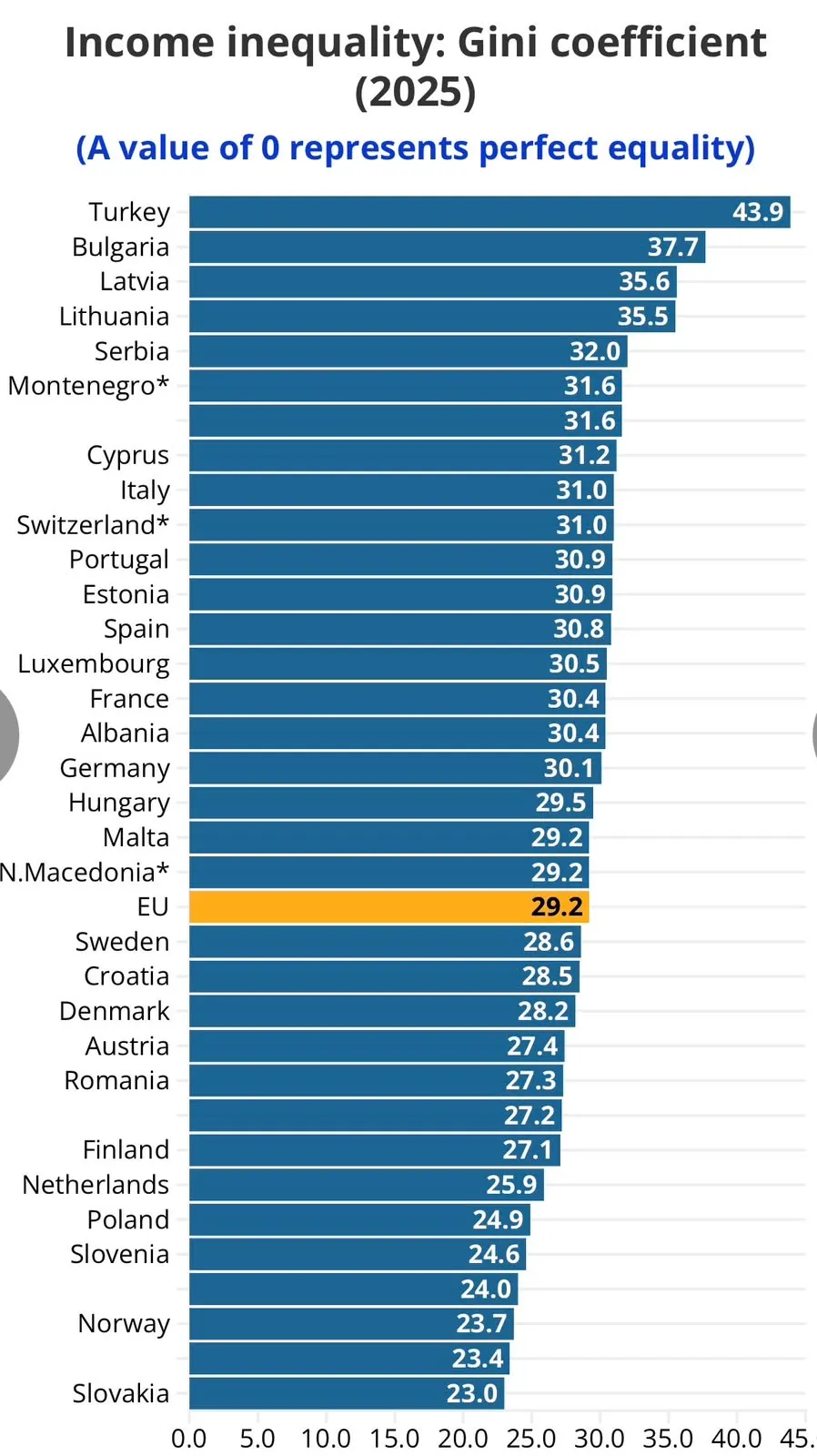
Albania is better positioned than a number of European countries, including Italy, Spain, Portugal, as well as Serbia and Montenegro, in terms of income distribution equality. According to the latest Eurostat data for 2025, the Gini coefficient for Albania stands at 30.4 points, placing the country on the same level as France and with a more favorable indicator than some of the largest European economies.
The published data show that Albania has a more equal distribution of income compared to Italy, where the Gini coefficient reaches 31 points, Spain with 30.8 points, and Portugal with 30.9 points.
Even when compared with countries in the region, Albania is in a relatively favorable position. Serbia registers a Gini coefficient of 32 points, while Montenegro has 31.6 points, both with higher levels of income inequality. North Macedonia, with 29.2 points, has a lower indicator than Albania. For Montenegro and North Macedonia, the most recent data included in the comparison are from 2024.
Another positive element is Albania’s positioning at the same level as France, one of the largest economies in the European Union. Both countries record a Gini coefficient of 30.4 points, while the difference with Germany, where the indicator is 30.1 points, remains relatively small.
In the ranking of the 34 European countries included in Eurostat’s statistics, Albania stands far from those with the highest levels of inequality, such as Turkey, Bulgaria, Latvia, and Lithuania.
The Gini coefficient measures how disposable income is distributed among households, taking into account their size and composition. The lower the indicator, the more equal the income distribution is considered.
In this sense, Albania’s result shows a competitive position compared to some countries in the region and developed European economies, although the indicator remains slightly above the European Union average, at 29.2 points.
Turkey and Bulgaria top Europe for income inequality
According to Eurostat, differences in income distribution remain considerable among European countries.
Turkey registers the highest Gini coefficient, at 43.9 points, while Bulgaria ranks second with 37.7 points and is the country with the greatest inequality among European Union members.
Following them are Latvia with 35.6 points, Lithuania with 35.5 points, and Serbia with 32 points.
In comparison with these countries, Albania shows significant differences in favor of a more equal distribution of income. Albania’s Gini coefficient is 7.3 points lower than Bulgaria’s and 13.5 points lower than Turkey’s.
The high inequality in Bulgaria is linked to several factors, including the tax system, the limited capacity of social transfers to redistribute income, informality, and economic disparities between regions.
Equality in the European Union at its lowest level since 2010
At the European level, the data show a general trend toward a more equal distribution of income.
In 2025, the EU’s Gini coefficient fell to 29.2 points, from 29.4 points in 2024, marking the lowest level in the statistical series dating back to 2010.
For the period 2010–2024, the average of this indicator was 30.2 points, which shows that the current level is one point lower than the average of the previous 15 years.
Romania is one of the most significant examples of improved income distribution. Its Gini coefficient has fallen to 27.3 points, or 6.4 points below the historical average of 33.7 points.
Significant improvements have also been recorded in Poland, North Macedonia, Serbia, and Montenegro.
Some developed economies have higher inequality than Eastern European countries
Eurostat data also highlight that the level of economic development does not automatically determine the degree of equality in income distribution.
For example, Sweden registers a Gini coefficient of 28.6 points and Denmark 28.2 points, while Poland has a lower indicator, at 24.9 points.
Meanwhile, Slovakia is the country with the most equal income distribution, with a Gini coefficient of 23 points, followed by Belgium with 23.4 points, Norway with 23.7 points, and the Czech Republic with 24 points.
