


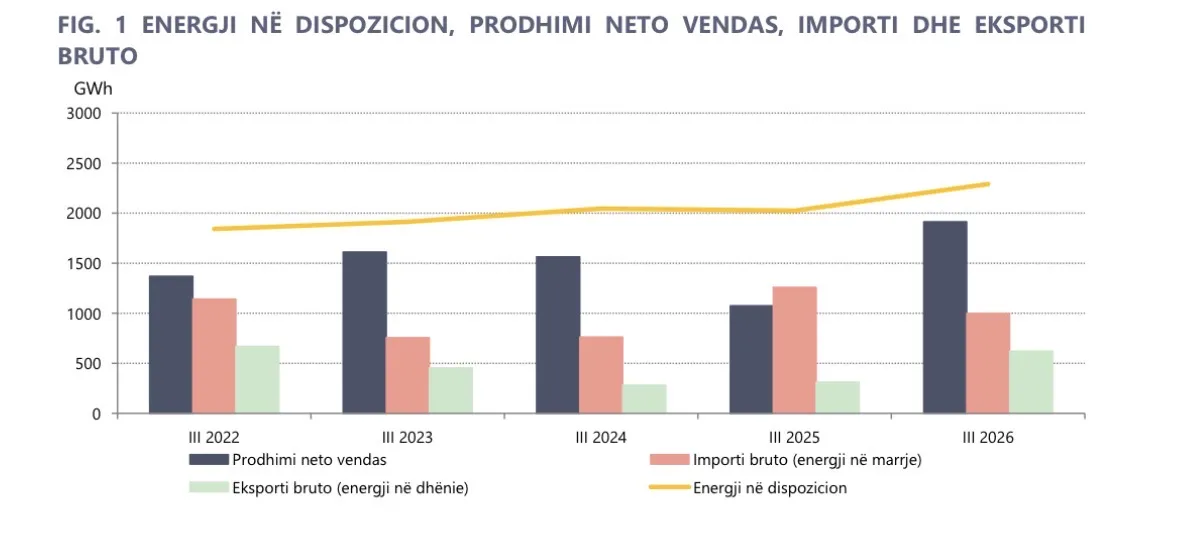
Albania has recorded a significant improvement in its electricity balance during the third quarter of 2026, with a strong increase in domestic production, a reduction in imports, and nearly a doubling of exports. At the same time, electricity consumption has also increased, especially among households.
According to data published by the Institute of Statistics (INSTAT), During the July–September 2026 period, net domestic electricity production reached 1,913 GWh, up from 1,075 GWh in the same period a year earlier, marking a 77.9% increase.
The available electricity reached 2,291 GWh, with a year-on-year increase of 13.2%.
Public hydroelectric plants lead the production increase
Public hydroelectric plants made the largest contribution to the increase in domestic production, producing 1,107 GWh of electricity during the third quarter, up from 586 GWh a year earlier, an increase of 89%.
Production from private and concession hydroelectric plants reached 305 GWh, up from 178 GWh in the third quarter of 2025, marking an increase of 71.6%.
Production from other renewable sources, including photovoltaic plants, also saw a significant increase, reaching 501 GWh from 311 GWh a year ago, an increase of 60.8%.
In the structure of domestic production, public hydroelectric plants contributed 57.9%, private and concession hydroelectric plants 15.9%, while other renewable sources 26.2%.
This means that more than a quarter of the electricity produced in the country during the third quarter came from other renewable sources, beyond hydroelectric power plants.
Imports fell by 20.8%, while exports increased by 98.8%.
The increase in domestic production has been accompanied by a significant improvement in the electricity trade balance with foreign countries.
Gross electricity imports, including exchanges, reached 998 GWh, down from 1,260 GWh in the third quarter of 2025, marking a 20.8% decrease.
Conversely, gross electricity exports reached 620 GWh, up from 312 GWh a year earlier, an increase of 98.8%.
However, Albania remained a net importer of electricity during the July–September period. The negative trade balance was reduced to 377 GWh, from about 948 GWh in the same period last year.
The energy deficit in foreign trade was thus narrowed by about 60.2% year-on-year.
Household consumption increases by 18.3%
Electricity consumption by consumers during the third quarter of 2026 reached 1,942 GWh, from 1,700 GWh a year earlier, marking an increase of 14.3%.
The increase in consumption was more pronounced among households, which used about 994 GWh of electricity, up from 840 GWh in the same period of 2025, a 18.3% increase.
Meanwhile, consumption by non-residential customers, which includes businesses, industry, institutions, and other sectors of the economy, reached approximately 949 GWh, with an annual increase of 10.4%.
Households accounted for about 51.2% of final electricity consumption during the third quarter.
Reduced share of network losses
Electricity losses in the network reached 348.3 GWh during the third quarter of 2026, up from 323.4 GWh a year earlier, marking a 7.7% increase.
However, as a percentage of the total available electricity, the loss rate was reduced from 16% to 15.2%, an improvement of 0.8 percentage points.
Losses and self-consumption in transmission increased by 16.9%, while distribution losses increased by 6.2%.
Within the distribution network, technical losses reached 246.3 GWh, from 223.4 GWh a year earlier. Meanwhile, non-technical losses were reduced to 49.1 GWh from 54.8 GWh, marking a decrease of about 10.4%./ekofin.al
