


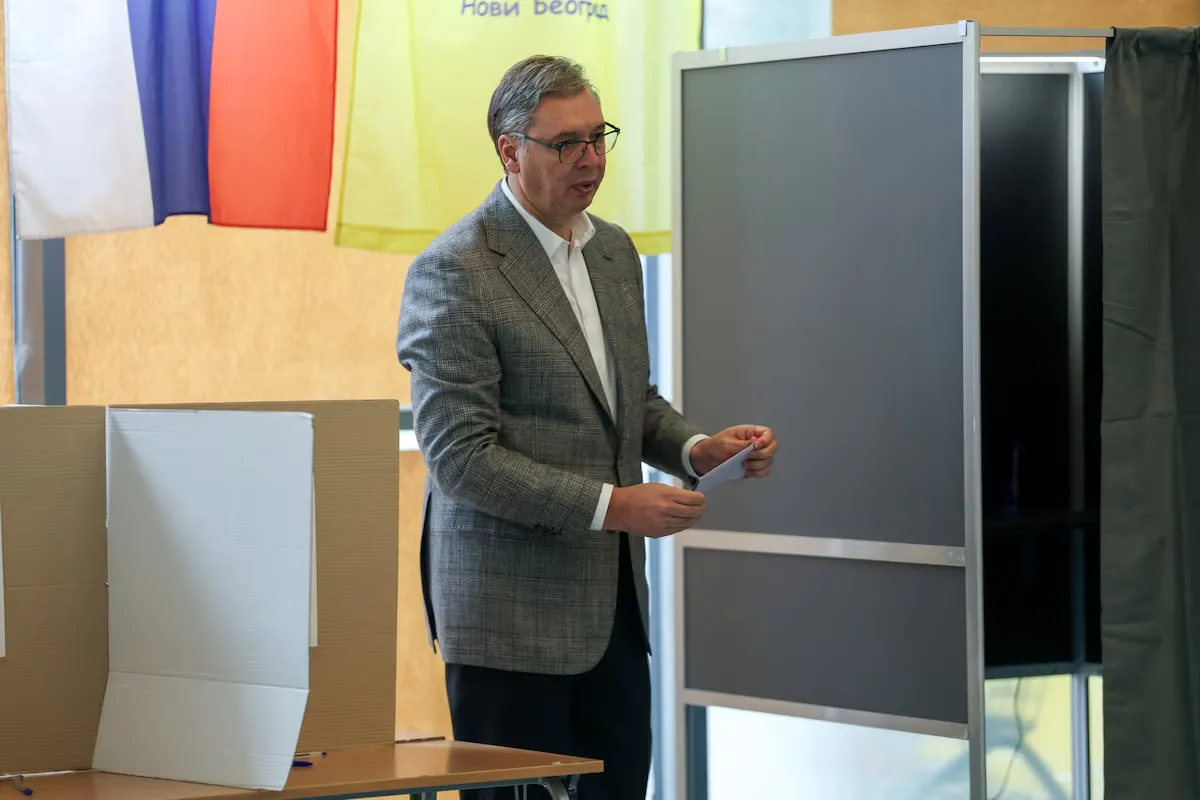
Serbia is heading towards a major political change after more than a decade of dominance by Aleksandar Vučić and the Serbian Progressive Party. Vučić himself has conceded defeat in the early parliamentary elections held this Sunday, October 25, confirming that the student-led movement has secured a majority in parliament, according to preliminary results.
In a statement after the voting closed, Vučić admitted that the Student List emerged as the winner, while his political force remained behind in the number of mandates.
“We do not yet have the final results, but based on a sample, it is clear that we lost these elections. The Student List has won. They will have between 135 and 140 mandates, while we will have around 105,” Vučić declared, according to the Reuters agency.
The Serbian parliament has a total of 250 seats, and at least 126 mandates are needed to form a parliamentary majority. This means that if the results announced by Vučić are confirmed, the Student List will have the necessary numbers to form the government without needing a coalition with other political forces.
However, the official final results have not yet been published.
From street protests to the parliamentary majority
The early elections, announced by Vučić in September, were held after nearly two years of continuous student protests against alleged corruption and the way the country is governed.
The movement began after the November 2024 tragedy in the city of Novi Sad, where the collapse of a concrete shelter at the railway station caused the death of 16 people.
The incident sparked strong public reactions, while students demanded transparency, institutional accountability, and a full investigation into the circumstances of the tragedy.
Over the months, the protests transformed into a broader civic movement, attracting support from various social groups and becoming the biggest political challenge for Vučić since coming to power.
The Student List included candidates from various professional fields, including academics, doctors, artists, and representatives of civil society. Its electoral program focused mainly on the fight against corruption, strengthening institutions, and improving public accountability.
High voter turnout
Sunday’s elections were characterized by high citizen turnout. According to estimates by Ipsos and CeSID, by 7:00 PM about 67.6% of voters had cast their ballots, one of the highest turnout levels in recent decades.
The process was also accompanied by reports from monitoring organizations of irregularities, pressure on voters, and incidents at several polling stations.
A new political chapter for Serbia
The preliminary result marks an important turning point for Serbia, where the Serbian Progressive Party has dominated the political scene since 2012.
Vučić has been one of the main figures of power in the country, first as prime minister in 2014 and then as president from 2017. In September 2026, he cut short his presidential term to run for the position of prime minister.
During his governance, Serbia pursued a foreign policy aimed at maintaining relations with the European Union, as well as close ties with Russia and China. Economically, his government has emphasized infrastructure investments, increasing wages and pensions, as well as attracting foreign investments.
The expected change in the parliamentary majority opens a new era for economic policies, international relations, and Serbia’s European integration process. The concrete direction of these policies will depend on the program and decisions of the next government.
At the moment, the most important political outcome remains the shift of the student movement from massive protests in the streets of Serbia to a possible governing majority, while the country awaits the official certification of the election results. /Adapted from Reuters, ekofin.al
