


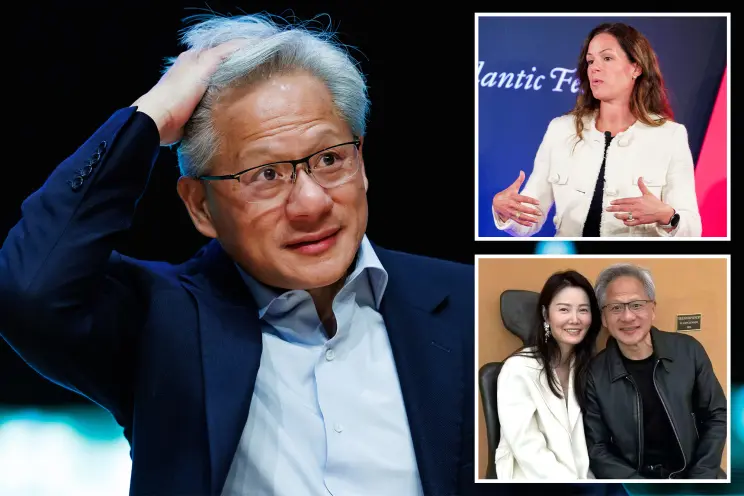
Jensen Huang, Nvidia’s CEO and one of the most important figures in the artificial intelligence revolution, has stepped down from the company’s leadership following news of two extramarital affairs, one of which involved a woman suspected of spying for China.
In his place, the interim management of the company will be taken over by the CFO, Colette Kress.
The news triggered an immediate reaction in financial markets, where Nvidia’s shares fell by about 10% in trading before the stock market opened.
Huang, 63 years old, was one of three engineers who founded Nvidia in 1993 and led the company since its inception. He faced immense pressure since Sunday, November 8, when he admitted to having an extramarital affair with Alice Huang, a former executive at Megaspeed International, based in Singapore and operating in the data center sector.
His departure deepens the crisis at Nvidia, a company that did not have a clear plan for Huang’s successor. For more than three decades, he has been not only the main leader but also the central figure around whom the company’s operating and management methods have been built.
Who is the executive that will temporarily take over Nvidia?

Colette Kress joined Nvidia 13 years ago, after having worked at well-known companies such as Microsoft and Cisco. She built her career in the financial sector and represented Nvidia in meetings with investors and Wall Street analysts.
However, its public role has been mainly focused on the company’s finances, while the main communication with financial markets has so far been led by Huang itself.
One of the largest increases in the history of technology
Under Huang’s leadership, Nvidia experienced extraordinary growth. Since its IPO in 1999, the company’s stock value has increased by more than 700,000 percent.
At certain times, its market value has exceeded 5 trillion dollars, ranking it among the largest companies in the world. This growth has even surpassed the achievements of companies led by figures like Apple’s Steve Jobs, Microsoft’s Bill Gates, and Amazon’s Jeff Bezos.
Huang’s departure could shake the entire artificial intelligence industry
The impact of his departure is expected to go beyond Nvidia itself. Through its financial power, the company has supported dozens of major artificial intelligence companies, including OpenAI and Anthropic.
Huang has also invested in cloud infrastructure companies, such as CoreWeave, and has supported financial deals that have helped expand the entire artificial intelligence ecosystem.
However, these agreements have also raised questions. Some well-known investors on Wall Street have warned that financial relationships between companies in the same industry could create an artificial demand for AI technology and inflate market value.
“As a student of economic history, I don’t know if there has ever been such an important person on whom such a large part of an industry depends,” said Thomas Ferguson, an investor in Blue Bear Capital, during a conference in Houston, before Huang’s departure.
Relations with Trump and the two connections that shook the
 company
Huang has been one of the leading figures who promoted the expansion of data centers worldwide. He has regularly traveled to attend international conferences and meetings, where he stood out for his distinctive leather jackets and enthusiastic reception from the audience.
He had also developed a close relationship with U.S. President Donald Trump, attending meetings at the White House, official dinners, and trips on the presidential plane Air Force One. Trump publicly supported him even after the scandal broke, describing him as “a very honest man.”
However, revelations about Huang’s relationship with Alice Huang raised serious questions about his judgment and possible ties to China.
On Wednesday, The New York Times reported that the Nvidia CEO had also had a relationship with Kimberly Powell, the company’s vice president and head of the healthcare sector.
Megaspeed, the company where Alice Huang worked, is one of Nvidia’s largest clients in Southeast Asia. It has been under investigation by U.S. authorities for months over suspicions that it may have helped smuggle advanced artificial intelligence chips to China. Both Nvidia and Megaspeed have denied any wrongdoing.
Who can replace Jensen Huang?
According to sources cited by the media, Nvidia’s board has engaged an external company to identify potential candidates for the next direction.
Board members have also gathered through an online meeting to discuss Huang’s future.
Among the names mentioned in the technology industry as possible candidates are:
Lisa Su, CEO of AMD, one of Nvidia’s main rivals
Rene Haas, head of Arm Holdings
Sanjay Mehrotr, head of Micron Technology
However, there is still no confirmed name for the company’s future leadership.
Bernstein analyst Stacy Rasgon assessed that despite the management crisis, Nvidia’s business remains strong and that the company can continue normal operations while searching for a new leader.
Independent investigation and pressure from the American Congress
The case has also drawn the attention of American lawmakers. Some of them have called for Huang to appear before Congressional committees, even warning of his mandatory subpoena if he refuses to testify.
Meanwhile, Nvidia’s board has engaged attorney Joon H. Kim, a former federal prosecutor and partner at the law firm Wachtell, Lipton, Rosen & Katz, to conduct a full and independent investigation.
Market analysts have also begun to revise expectations for the company’s shares. Bernstein downgraded Nvidia’s valuation to “market-performance” and set the stock price target at $200, expressing concern that it is still not fully known what the investigation might reveal.

A leader who controlled almost everything
One of Huang’s most well-known management features was direct control over almost every aspect of the company. He was known as a leader involved in details and had up to 60 executives reporting directly to him.
Each employee had to compile a list of the five most important tasks and publish it within the company. Huang personally reviewed these lists to ensure everyone was focused on the main objectives. He also sent advice and guidance to lower-level employees.
According to a source within the company, in recent days Huang had appeared less engaged than usual. He had not immediately responded even to the usual emails in which managers and employees reported their top five priorities.
Huang was also known for his personal involvement in employee pay decisions.
“In a way, my management style is what made the company’s growth possible,” he stated in a recent interview with Bloomberg. According to him, the goal was to create an organization that could continuously adapt to changes and be able to bring innovation to the industry itself.
Huang’s departure marks an important moment for Nvidia, which for decades has been identified with his figure. Now, the company’s biggest challenge is to maintain the extraordinary pace of growth without the person who built and led it from the very beginning. /voxnews.al
