


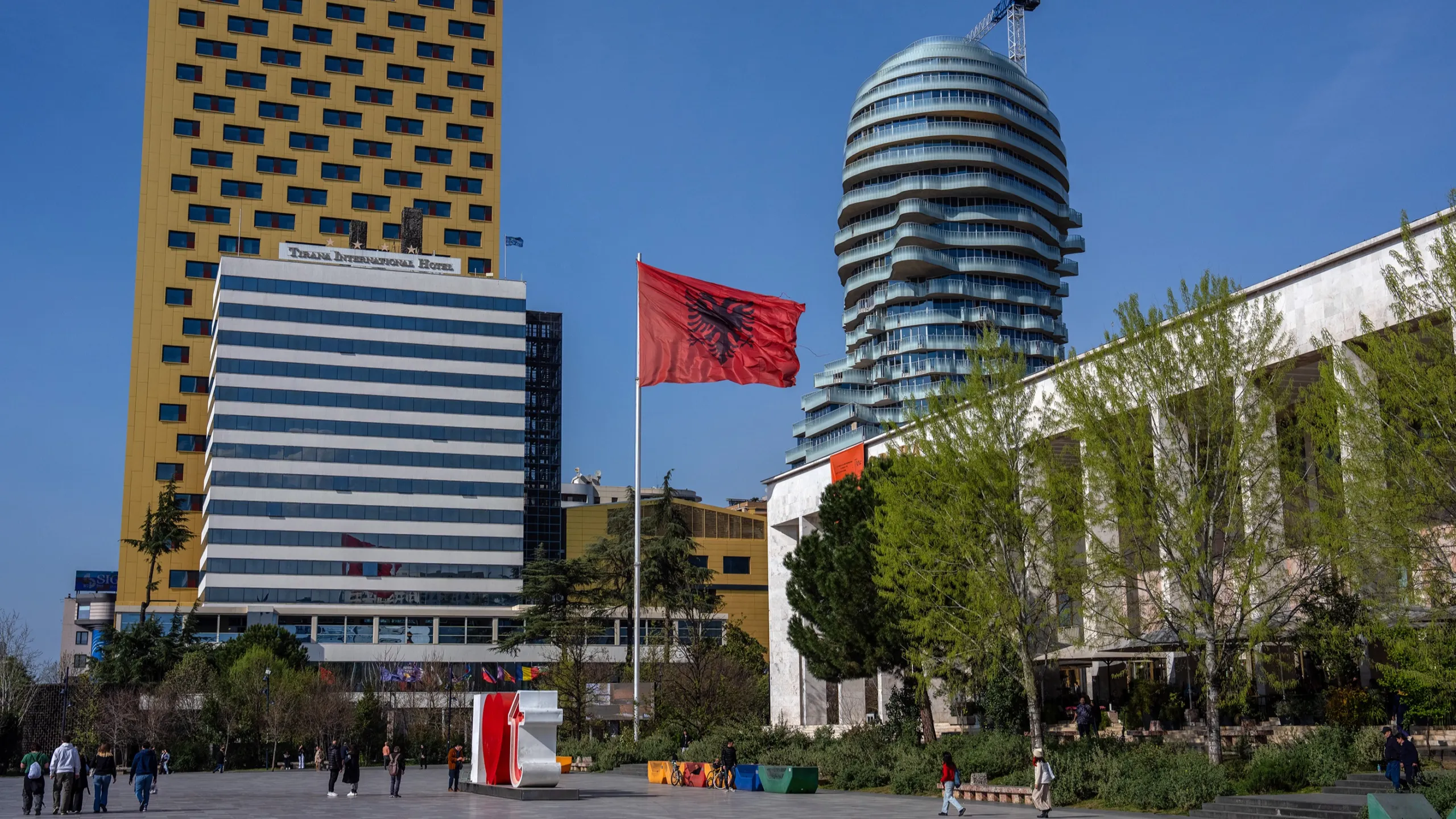
Membership in the European Union remains the ultimate goal, while Albanians seek more transparency and economic opportunities.
Albania has managed to withstand a series of shocks in recent years, becoming one of the fastest-growing economies in Europe, although it continues to face longstanding structural challenges on the path toward European Union membership.
Since the devastating earthquake of 2019, Albania has overcome the Covid-19 pandemic, the energy crisis following Russia’s invasion of Ukraine, and new tensions in the Middle East, recording an average annual economic growth of around 4% during the period 2022–2025.
This pace continued throughout 2026, with the economy expanding by about 3.7% in the first half of the year, supported by strong domestic demand, tourism, and investments, according to the Bank of Albania.
“In a highly unstable and uncertain international environment, this development demonstrates the increased capacity of our economy to withstand shocks,” says Holta Zaçaj, First Deputy Governor of the Bank of Albania.
The International Monetary Fund (IMF) partly attributes Albania’s economic growth in recent years to a generally appropriate combination of macroeconomic policies, although it warns of future risks due to an increasingly uncertain external environment.
However, questions remain as to whether Albania’s current economic growth model can create enough quality jobs and support the development of higher value-added industries.
“Albania is growing, but the most important question is what kind of economy it is building,” says Isilda Mara, an economist at the Vienna Institute for International Economic Studies (wiiw).
According to her, tourism, construction, and real estate have driven economic growth but have not created enough stable and attractive jobs, nor have they sufficiently strengthened the country’s productive base.
Dissatisfaction with the tourism-based development model has also emerged through the “Flamingo” protests in Albania, which began in May against a luxury project near the environmentally sensitive Vjosa-Narta area and later expanded to demand greater transparency and accountability.
“The protests raise a fundamental economic question: development for whom?”, Mara states.
She suggests that the protests may also reflect the desire of some Albanians to seek change within the country, rather than emigrate. However, retaining more young people in Albania will depend on the opportunities the economy can offer.
In mid-October, students clashed with police during protests against poor conditions in educational institutions, rising living costs, and alleged corruption in the government.
Public debt is declining
For the moment, however, economic conditions remain favorable. In September, the credit rating agency Moody’s upgraded Albania’s outlook from stable to positive.
Daniela Re Fraschini, vice president at Moody’s Ratings, says this change partly reflects “the strengthening of Albania’s fiscal and external position.”

In recent years, authorities have implemented a sound combination of fiscal and monetary policies, which have helped control inflation, reduce public debt, and ensure successive primary budget surpluses.
As a result, according to the IMF, the government’s overall debt is expected to fall to around 50% of Gross Domestic Product (GDP) by 2027, down from 75% in 2020.

This improvement has been supported by continuous economic growth, driven by strong domestic demand, construction, real estate, and the rapid development of the tourism industry.
Zaçaj from the Bank of Albania says that unemployment has dropped to historically low levels, while wage growth and favorable financing conditions have supported household consumption.
“Domestic demand is likely to remain the main driver of growth, supported by rising incomes and the continuous expansion of lending,” she states.
Tourism has also contributed to the growth of income from exports and investments in accommodation and construction structures.
According to INSTAT, the number of foreign nationals entering Albania has more than doubled, from 5.7 million in 2021 to 12.5 million in 2025.
Moody’s expects tourism to benefit from the extension of the season and a shift towards higher-value services, although Re Fraschini warns that “growth is likely to slow as the sector reaches a more mature stage of development.”
Albania narrows the income gap with the EU
Albania has made some progress in narrowing the income gap with the European Union.
Zaçaj says the country “has made considerable progress in bringing income levels closer to the European Union.”
Eurostat data show that GDP per capita, adjusted for purchasing power, increased from 31% of the EU average in 2021 to an estimated level of 43% in 2025.
However, improving the standard of living has not solved the problems of the Albanian labor market.
Mara draws attention to the increase in employment of foreign nationals, at a time when youth unemployment remains high.
“There are jobs, but some of them are seasonal, paid little, or offer limited opportunities for professional development. Young Albanians may prefer to leave the country rather than accept these jobs,” she says.
The European Bank for Reconstruction and Development (EBRD) identifies improving professional skills, increasing labor market participation, encouraging the return of emigrants, and combating informality as priorities for boosting productivity.
“With an aging population and emigration shrinking the workforce, the priority is to increase productivity through professional skills, higher labor market participation, return of emigrants, and formalization of the economy,” says Hannes Takacs, head of EBRD in Albania.
He also sees opportunities for economic diversification through higher value-added agriculture and tourism, manufacturing industries linked to European supply chains, renewable energy, and technology-based services.
At the heart of these ambitions is Albania’s long-standing goal of joining the European Union, a process that has gained momentum in recent years and could accelerate economic reforms and integration with the European market.
Albania has opened all 33 negotiation chapters, temporarily closing the first three in July, and aims to complete the negotiations by the end of 2027.
“The EU accession process is a crucial pillar for Albania’s reform agenda and an important supporting factor for its credit profile,” says Re Fraschini.
However, Moody’s expects full membership to take longer than currently forecasted by the Albanian authorities.
Reforms bring economic benefits
The economic opportunities related to the European integration process are considerable.
Albania has a guiding fund of 922.1 million euros under the EU Reform and Growth Instrument for the period 2024–2027, the benefit of which is conditional on the implementation of agreed reforms.
Takacs from the EBRD says that eventual EU membership “would bring larger European funds, a lower risk premium, and deeper integration into the single market.”
It identifies particular opportunities in “the processing industry linked to EU supply chains, renewable energy and interconnection, year-round tourism with higher value, the agro-food industry, information and communication technology, business services, and logistics.”
However, exploiting these opportunities requires strengthening contract enforcement, transparent procurement, reducing informality, improving education and professional skills, as well as closer integration with the European Union’s energy market, according to Takacs.
“If the reforms are implemented in practice, membership can accelerate economic growth and place Albania on a credible path to align with the EU’s development levels,” he says.
As the Albanian economy continues to transform, Zaçaj from the Bank of Albania believes the country is in a more favorable position to face future challenges.
“Albania enters this period from a significantly stronger position than in the past,” she concludes. / Adapted from The Banker, ekofin.al
