


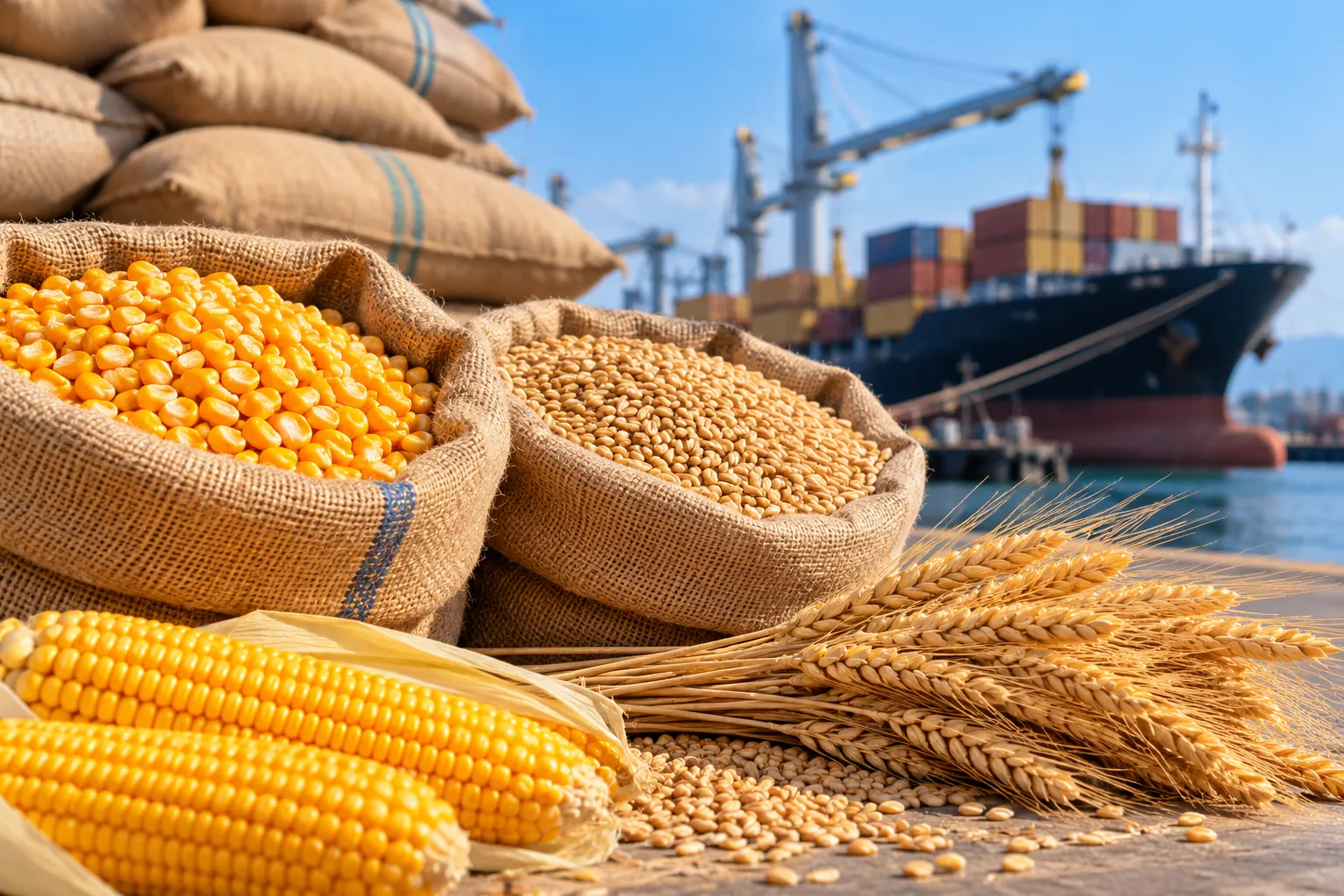
Over 1.5 million tons of grain were imported from Serbia and Russia during the 2020–2025 period, making these two countries the main suppliers to the Albanian market. But while imports reach hundreds of thousands of tons every year, the National Food Authority (AKU) does not have the necessary capacity to guarantee effective controls at border points. Inspectors work with paper documents, lack the proper equipment for physical inspection of shipments, do not independently verify import certificates, and do not have direct access to the electronic customs system.
According to data processed by the Supreme State Audit and consulted by ekofin.al, over six years, Serbia has supplied the Albanian market with 890 thousand tons of grain, ranking first on the list of countries of origin. Russia ranks second with 637 thousand tons.
Together, these two countries exported over 1.52 million tons of grain to Albania, or about 60% of the total imports for the period.
Following them are North Macedonia with around 183 thousand tons, Ukraine with 128 thousand tons, and Greece with 72 thousand tons.
Kosovo supplied the Albanian market with 59 thousand tons, Italy with about 56 thousand tons, Montenegro with 35 thousand tons, France with 18 thousand tons, and Canada with 17 thousand tons.
The dominant weight of Serbia and Russia in supplying the Albanian market becomes even more significant in the context of audit findings, according to which the control mechanisms for grains coming from outside the European Union present significant weaknesses.
On average, about 255,000 tons of grain are imported annually from these two countries alone. However, the origin of the products alone does not constitute proof of issues with their quality or safety. The problem identified by the Supreme State Audit (KLSH) relates to the ability of Albanian institutions to reliably verify the safety of these imports.

Over 427 thousand tons of grains per year, but inspections remain mostly manual
According to the report, during the period 2020–2025, an average of 7,591 grain shipments were allowed to enter border inspection points per year, with an average quantity of 427,422 tons.
The main imported categories include wheat for human consumption, wheat for animals, flour, maize for human consumption and for animals, barley, spelt, and other cereals.
However, the audit at the border inspection points of Durrës, Vlorë, and Hani i Hotit revealed that documentary control continues to be carried out entirely manually.
Sanitary and phytosanitary certificates, customs documents, import declarations, inspection reports, and documentation for sample collection are administered physically, in files and registers.
Data on grain inflows are recorded in Excel tables, without an integrated and standardized database.
KLSH assesses that this practice increases the risk of errors, information loss, and the inability to track imported shipments in real time.
Import certificates are not independently verified.
One of the most serious findings of the audit relates to the lack of cross-checks of the documentation accompanying imported grains.
According to the Supreme State Audit (KLSH), inspectors did not conduct independent checks to verify the authenticity, validity, and content of laboratory reports and certificates submitted by importers.
In practice, the documentation was considered without documented procedures for comparing it with the information held by the competent authorities.
This creates the risk that shipments will be accepted based on documents submitted by the economic operators themselves, without sufficient verification of their accuracy.
According to the auditors, the issue is especially significant for imports from countries outside the European Union, which make up the largest part of the grain supply in the Albanian market. /ekofin.al
