


Polling stations opened today on Sunday in Serbia for the early parliamentary elections, where 6.45 million registered voters have the right to elect the 250 new deputies of the National Assembly.
There are 18 electoral lists competing, with more than 2,400 candidates, while voting is taking place in nearly 8,400 polling stations across the country.
Polling stations opened at 07:00 local time and are expected to close at 20:00. The electoral process is being monitored by domestic and international observers, including representatives from the OSCE Office for Democratic Institutions and Human Rights (ODIHR), the Parliamentary Assembly of the Council of Europe, and the European Parliament.
Serbian citizens living abroad can also vote at 93 polling stations in 37 countries. Over 102,000 citizens have registered to vote outside Serbia.
Meanwhile, four Serbian municipalities have also designated 60 additional polling stations for citizens registered in Kosovo, where ethnic Serbian communities live in some areas.
The ruling party faces the challenge of the students
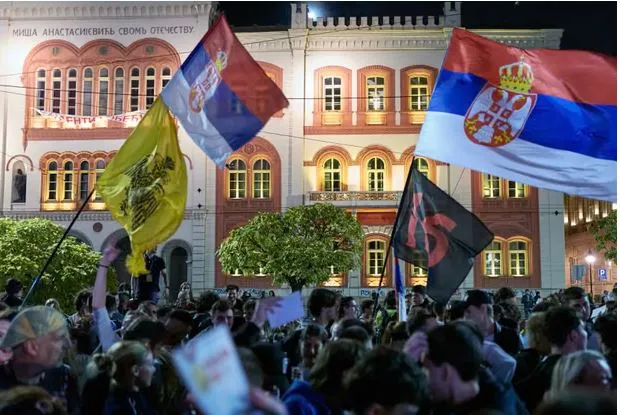
The elections are taking place after several months of protests led by students and a political crisis that led to the resignation of President Aleksandar Vučić in September.
Vučić aims to return to government as prime minister through the Serbian Progressive Party (SNS), which has dominated Serbian politics since 2012.
SNS is running with the electoral list “Aleksandar Vučić – United Serbia.”
One of its main opponents is the student-backed list, “Student List – Students Win,” which appeared after protests triggered by the collapse of a railway station tent in Novi Sad in November 2024, where 16 people lost their lives.
The student movement has demanded accountability for the tragedy, greater transparency, and reforms that strengthen the rule of law and public institutions.
Also in the race are the Socialist Party of Serbia (SPS), led by Ivica Dačić, the pro-European coalition “European Serbia,” and the nationalist bloc “Authentic Right.”
How the 250 parliamentary mandates are distributed
Serbia uses a proportional representation system to elect 250 deputies, while mandates are distributed among electoral lists according to the D’Hondt method.
In general, parties and coalitions must receive at least 3% of the votes to enter parliament. Lists representing national minorities are excluded from this threshold.
To secure a parliamentary majority and form a government, a party or coalition must win at least 126 mandates.
The Election Commission is responsible for summarizing and announcing the final results after receiving reports from the polling stations.
The new parliament must be constituted within 30 days from the publication of the final results, while the new government must be formed within 90 days from the parliament’s constitution.
The political direction of Serbia is at stake
The elections are taking place in a politically polarized climate, where key issues include Serbia’s European integration, relations with Russia and China, as well as the unresolved dispute with Kosovo, which declared independence in 2008.
Serbia is a candidate country for European Union membership but has maintained close ties with Moscow and has not joined Western sanctions against Russia for the war in Ukraine.
The election result will determine the composition of the next parliament and the political forces that will have the necessary support to form the new government. Sunday’s vote marks the 15th parliamentary elections in Serbia since the establishment of multiparty democracy in 1990, as well as the 10th early parliamentary elections.
The last parliamentary elections in Serbia were held in December 2023.
