


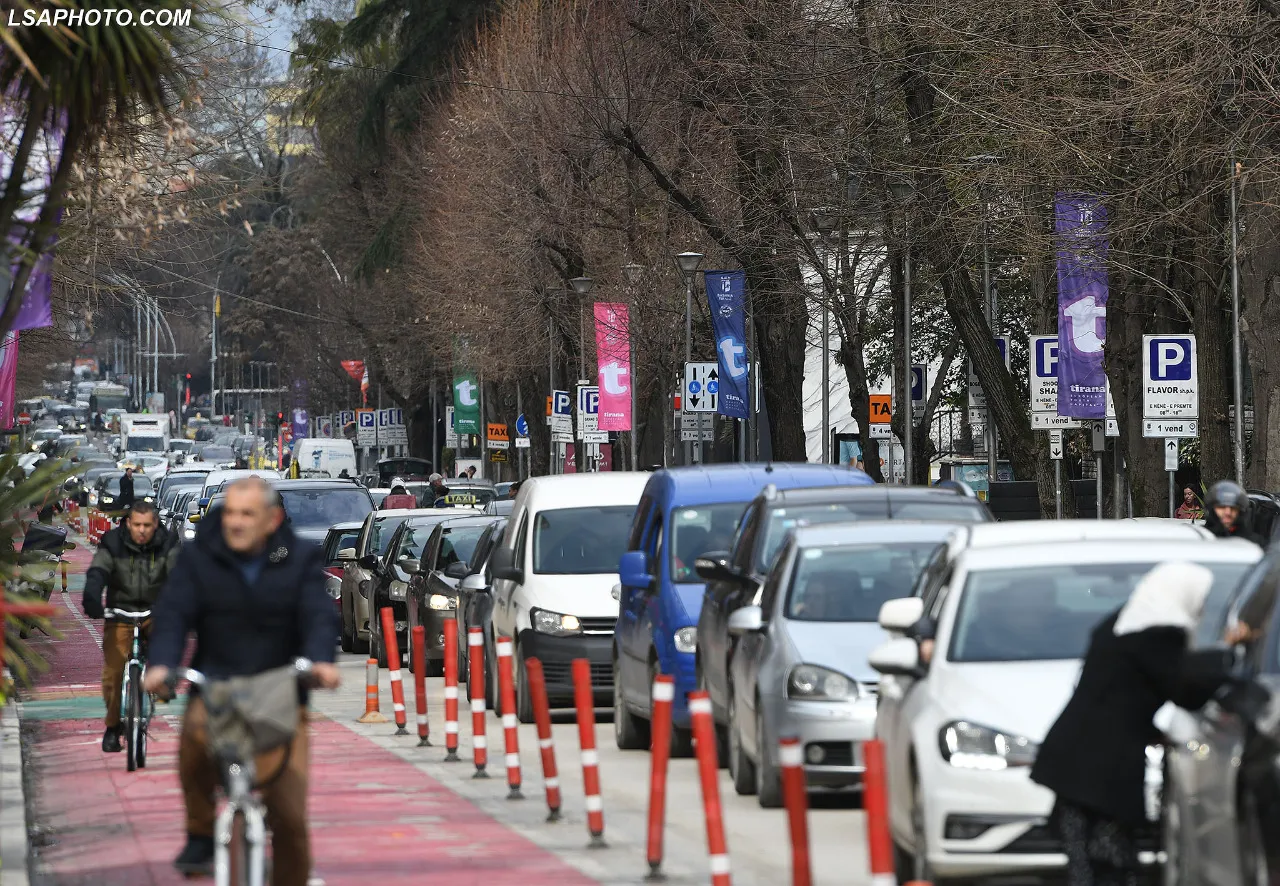
Traffic jams, delays in urban buses, and overloaded roads continue to be part of everyday life in Tirana, despite investments made to improve circulation. During the years 2023–2025, the Municipality spent around 209 million lek on projects related to public transport, pedestrian and bicycle movement, as well as traffic management. However, the audit by the Supreme State Audit shows that a large portion of the planned interventions have not been carried out, while the systems intended to support traffic are not fully functioning.
The problem becomes even more apparent in the face of the high number of vehicles. About 35% of active vehicles in Albania are concentrated in Tirana County, while in 2025 alone, this county absorbed 41% of the new vehicle registrations in the country. At the same time, over 55% of the capital’s residents use the car as their primary means of daily commuting, according to a 2023 European study cited by the Supreme State Audit.
This means that a large portion of trips are made by private vehicles, while public transport still does not offer the conditions to become a sufficiently attractive alternative. Only 22% of residents use urban buses on a typical day, and only 29% express satisfaction with the service, according to the same study.
One of the problems is that buses remain stuck in the same traffic as cars. Of Tirana’s main urban roads, only 11% of their length is equipped with dedicated lanes for urban buses. The absence of these lanes and stops at stations affect bus delays, making public transport less reliable for citizens who have to commute to work, school, or provide services every day.
Investments are not progressing according to the city’s needs.
Faced with these problems, data from the Supreme State Audit (KLSH) show that investments to improve mobility have remained far below plan.
In the three audited years, the Municipality had allocated 739.3 million lek for projects related to buses, pedestrians, bicycles, and traffic management, but spent only 209 million lek. Thus, only 28.3% of the planned funds were converted into actual expenditures, while about 530 million lek remained unrealized.
In fact, annual investments have declined. From 79.6 million lek in 2023, expenses dropped to 64.6 million in 2024 and remained around 64.7 million lek in 2025.
The traffic monitoring infrastructure also presents problems. During the July 2026 verification, the Supreme State Audit found that 40 out of 71 cameras installed in the city were not transmitting footage. Eleven of them had been out of operation for two to seven years, while the central platform that was supposed to enable operators to simultaneously monitor traffic conditions was not functional.
This deficiency limits the ability to identify roadblocks and accidents in time, as well as the response to situations that complicate traffic, the report concludes./ekofin.al
