


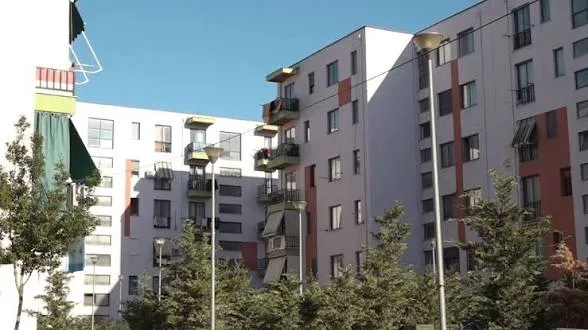
The government aims to expand housing programs beyond families in economic need, including citizens who have income but cannot afford the purchase prices or rents of apartments on the free market. One of the main innovations is the “Lease with the right to purchase” program, which allows beneficiaries to live in a residence in exchange for periodic payments, part of which can be calculated in the final purchase price.
This is one of the changes foreseen in the draft law for some additions and amendments to law no. 22/2018, “On Social Housing,” submitted for consideration in the Assembly. The initiative aims to create a broader support system for housing, combining social housing, affordable rents, eased lending, and the involvement of the private sector in housing financing.
For the first time, the legal framework aims to make a clearer distinction between social housing and affordable housing. The latter will include individuals and families who do not necessarily qualify for social assistance but for whom the cost of housing is excessively high relative to their income.
The draft law introduces the concept of the affordability threshold, which aims to determine how much a family can spend on housing without compromising other basic living needs.
Rental with the right to purchase, how does the new program work?
The “Lease with the right to purchase” program is one of the main proposed instruments. It foresees that individuals and beneficiary families will use a dwelling owned by the National Agency for Territorial Affairs and Social Housing (AKTSS), in exchange for periodic payments.
Depending on the terms of the contract, part of the payment can be credited towards the purchase price of the apartment. This creates the possibility for families to gradually transition from tenant status to owner.
The draft law also allows certain social rental housing units to fall under this program, but only if the change does not compromise the existing needs for social rental housing in the respective municipality. The detailed eligibility criteria and procedures will be determined by subordinate acts.
Young people up to 29 years old and young families, among the beneficiaries
An important change is the expansion of the categories that can benefit from affordable housing programs.
The draft law includes middle-income families who cannot afford market prices, young people up to 29 years old who are in the first five years of their professional career, as well as young families where the oldest member is no older than 45.
The support also aims to extend to single-parent families with minor children, public service workers and priority professions, persons with disabilities and their caregivers, as well as citizens returning from emigration.
However, inclusion in these categories does not automatically guarantee the benefit of housing. Applicants must meet the conditions of ownership, access to the free market, and income, while the financial limits and categorization method will be determined by a decision of the Council of Ministers.
Social housing and market-priced apartments in the same projects
Another innovation is the combined purpose housing development program.
According to the draft law, AKTSS will be able to develop projects that simultaneously include social rental housing, low-cost housing, and apartments sold at free market prices.
The income generated from the sale of apartments on the market will be used solely for financing, expanding, and maintaining social housing programs. The sale of these apartments will be carried out through transparent and competitive procedures.
The model aims to create additional financing sources for housing, without relying solely on state budget funds for the construction of social housing.
The draft law also foresees the development of integrated residential areas, where, alongside apartments, roads, water supply and sewage networks, public infrastructure, and social services can be financed.
Guaranteed loan combined with financing for home purchase
The draft law also creates opportunities for new financial instruments aimed at facilitating the purchase of affordable housing.
Financing can be provided through a combination of family financial contributions, loans from financial institutions, guarantees, and public support in the form of grants or subsidies.
The draft law foresees the possibility of approving standard financing schemes, including models of the 30-40-30 type, while the specific percentages and conditions will be determined by the government.
Public support will be conditioned on the use of housing as the main residence and may be accompanied by restrictions on its sale or rental for a certain period.
This aims to ensure that the benefits from housing programs are used for real housing needs and not for investment purposes.
Builders will contribute 3% of the area.
Changes are also planned in the mechanism for the private sector’s contribution to social housing.
According to the draft law, private entities applying for development and construction permits for residential buildings with a construction area over 2,000 square meters will have to pay a monetary contribution to the Housing and Social Cohesion Fund equivalent to the sale of 3% of the functional area, according to market price at the time the permit is obtained.
Payment can be made in installments but must be completed no later than the moment of applying for the usage certificate.
The builder must enter into an agreement with AKTSS regarding the payment method within 30 days from the confirmation of meeting the conditions for the building permit. Without this agreement or full payment, the permit cannot be issued.
In case of refusal, the entity is considered to have withdrawn the application for the permit.
Forgiveness of debts for some families who have purchased homes from the NHE
Another provision of the draft law foresees the forgiveness of outstanding obligations for a certain category of families who have benefited from low-cost housing from the National Housing Entity.
The measure is intended for families who have settled their obligations for at least 10 years but, due to family misfortunes such as death or serious illnesses causing disability to work, have lost the economic ability to continue payments.
The forgiveness will not be general for all beneficiaries of EKB housing, but is related to the fulfillment of these conditions.
The Fund for Housing and Social Cohesion is created, and the institutional organization is also changing
The draft law foresees the reorganization of housing financing through the Fund for Housing and Social Cohesion, which will be administered by AKTSS.
The fund will be used for the construction, purchase, reconstruction, and improvement of social and affordable housing. It can also finance the purchase of housing on the open market, when this proves economically more favorable than their construction.
This fund may also include confiscated real estate, which, by decision of the Council of Ministers, may be made available to housing programs.
For the orientation and distribution of resources, the creation of the Board for Social Housing and Affordable Housing is foreseen, led by the minister responsible for housing.
The Board will set priorities and approve the projects to be financed, while the AKSS will handle the administration of the fund and the implementation of decisions.
Another institutional change is the transformation of the National Housing Entity into the Albanian Social Housing Society, sh.a., which will have a role in the development, administration, maintenance, and expansion of the housing stock.
Selection of beneficiaries by scoring
The draft law also revises the method of selecting beneficiary families, introducing a 100-point evaluation system.
Each of the four criteria defined in the law will carry a weight of 25 points, while the detailed distribution of points will be approved by the local self-government units.
Municipalities will prepare preliminary lists of beneficiaries and forward them to AKTSS, which will plan the implementation of the programs taking into account the number of applicants, financial resources, and national housing policies.
Another convenience is the possibility that an applicant who does not meet the conditions for a certain program can be directed to another program if they meet the relevant criteria.
However, individuals and families will not be able to benefit simultaneously from more than one social housing program. /ekofin.al
