


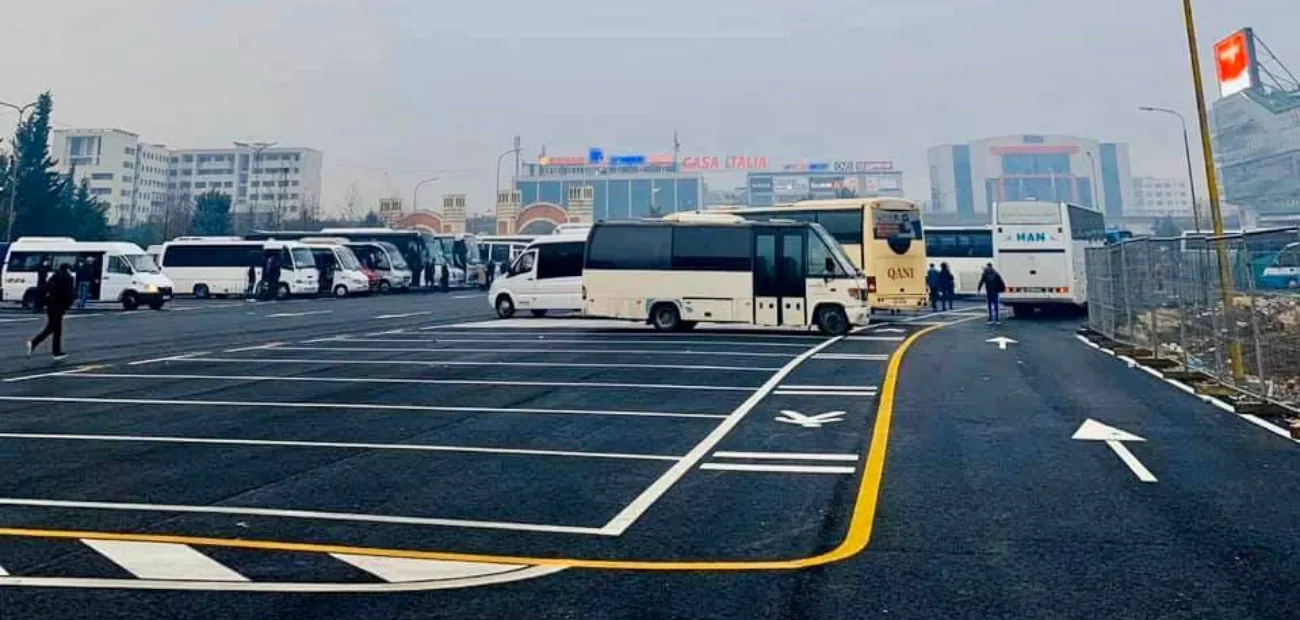
The intercity transport network in Albania will undergo a reorganization, which foresees the elimination of overlapping lines, the merging of those with poor performance, and the opening of new routes in areas where citizens do not have sufficient access to public transport.
The Sectoral Transport Strategy and the 2030 Action Plan, approved by the government on October 28, 2026, also foresee electronic ticketing, coordinated schedules, and the modernization of bus terminals.
For the optimization of the intercity line network, the government has planned 700,000 euros during the period 2027–2030. The reorganization will be based on a national analysis of transport demand, taking into account the population size by counties and municipalities, passenger flows, regional development needs, and connections to main road corridors.
The strategy acknowledges that the current intercity transport system is fragmented and that the line network is mainly determined by operators’ offers, rather than integrated planning according to citizens’ needs.
As a result, some routes overlap and inefficient services, while other areas, especially rural ones, remain with limited access to public transport. The document also highlights the outdated fleet, lack of uniformity in service quality, informal practices, and poor connection of buses with urban transport, railways, ports, and airports.
According to the strategy, these issues contribute to traffic congestion, increased pollution, and lowering safety standards, while simultaneously limiting citizens’ mobility opportunities.
New lines for areas without transport, coordinated schedules for passengers
According to the document, one of the main objectives of the reform is to improve public transport coverage in areas where service is currently insufficient.
The plan foresees the elimination of repeated, inefficient, and informal lines, the consolidation or merging of low-performance lines, as well as the approval of new routes according to movement demand.
The changes will be accompanied by a revision of stops and departure and arrival stations, formalization of stopping points along routes, and the establishment of more coordinated schedules. The goal is for the buses to operate at frequencies and intervals more suitable for the needs of passengers.
This reform is especially important for students, workers, and residents of rural areas, for whom intercity transport often represents the main opportunity to travel to urban centers, educational institutions, or workplaces.
However, the strategy does not yet specify which existing lines will be removed or merged, nor the specific areas where new services will be opened. These decisions are expected to be based on the national assessment of transport demand.
Electronic tickets, times, and prices published online
In addition to reorganizing the routes, the strategy foresees the development of a national electronic ticketing system for intercity transport.
Operators will be guided towards publishing data on schedules, tariffs, and service quality, while passengers are intended to have real-time access to information through online platforms and information systems at terminals.
The document foresees that intercity electronic ticketing will also be interoperable with urban, suburban, international, and rail transport systems.
Some information about routes, schedules, and terminals is now provided through the e-Transport platform, administered by DPSHTRR. The reform aims to expand these services and integrate them with other transport systems.
In the Action Plan, the installation of real-time information systems and the piloting of multimodal tickets are scheduled for the period 2029–2032, with a cost of 150,000 euros. This means that part of the digital changes extend beyond the horizon of 2030.
Modernized terminals and better connections to trains and airports
The modernization of intercity terminals is also a focus. The strategy foresees improving standards of security, accessibility, comfort, and digital services, as well as better management of passenger flow.
For feasibility studies and the preparation of projects for the construction or modernization of terminals, 300,000 euros are planned during the years 2027–2028.
Meanwhile, the national investment program in multimodal hubs has a projected cost of 20 million euros and extends over the period 2027–2032.
The strategy also aims to coordinate intercity bus schedules with urban transport, rail services, connections to airports, and port terminals, with the goal of reducing waiting times and facilitating travel that requires the use of certain means of transport.
To implement the reform, strengthening the role of MobAl, the national public transport company, as well as the capacities of the Ministry of Infrastructure and Energy and DPSHTRR for planning, monitoring, and controlling services, is foreseen. /ekofin.al
