


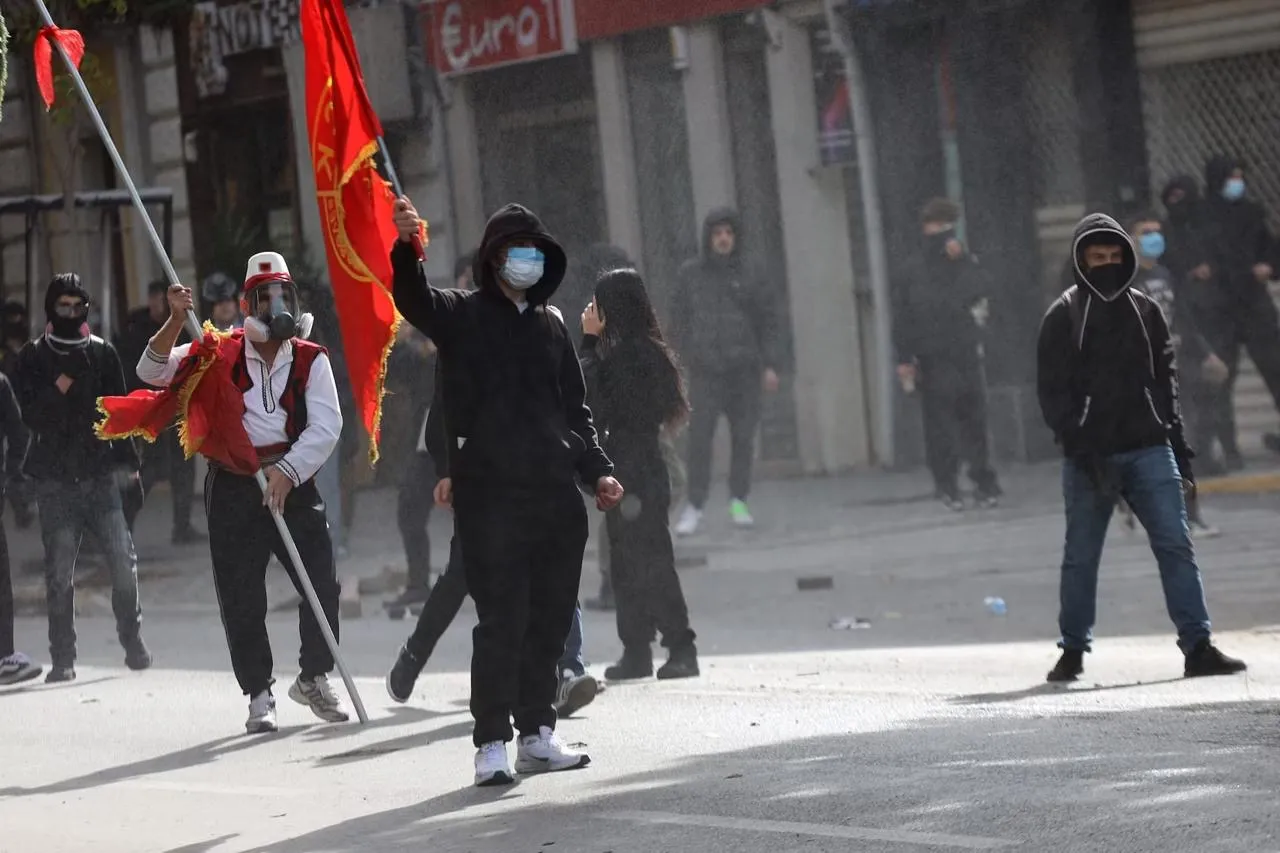
Prime Minister Edi Rama has presented the new legal package against violence and urban anarchy, which includes six instruments aimed at preventing violent acts during protests, punishing perpetrators, and compensating for damages caused to businesses and property.
According to the Prime Minister, the package has been drafted in cooperation with European partners, taking as a reference the jurisprudence of the European Court and the experience of Italy and France.
Rama emphasized that the principle on which the measures are based is that peaceful protest is protected, violence is punished, and the damage is paid by the perpetrator.
1. Compensation for businesses – The state covers up to 100% of the damages
The first instrument is a normative act for the financial compensation of businesses damaged during the protests.
According to the government’s proposal, the state will cover:
100% of the damages for small businesses.
70% of the damages for large businesses.
Meanwhile, those responsible for the violent acts will be required to pay the corresponding portion of the damage they have caused.
In cases where damages are caused by minors, the responsibility for compensation will pass to the parents.
2. Special law on individual liability – Fines up to 500,000 lek
The second instrument is a special law that defines individual responsibility for damages and violent acts during public gatherings.
According to Rama, no one will be punished just for participating in a peaceful protest.
However, individuals who choose to stay in a group, being aware that destruction or acts of violence are taking place around them, may face administrative liability.
For these cases, fines of up to 500,000 lek are foreseen, while responsibility will be determined individually.
The Prime Minister stated that the law will apply to all gatherings and does not aim to restrict the freedom of assembly or expression.
3. Amendments to the law on assemblies – Security perimeters, control of online calls, and fines
The third instrument includes amendments to the law on assemblies, which dates back to 2001.
The changes aim to grant the State Police new preventive powers, especially for the protection of sensitive objects and responding to calls for violence on social networks.
The proposed measures include: Establishing security perimeters around institutions and sensitive facilities.
The announcement to delete calls for violence published on social networks.
Criminal prosecution in cases where calls for violence are not removed and legal conditions are met.
Fines of up to 500,000 lek for participating in unauthorized gatherings, disregarding distribution orders, and hiding identity, according to the presented proposal.
A fine of 5,000 lek for blocking traffic.
Rama stated that the changes aim to ensure that the exercise of the right to protest does not hinder the freedom of movement, work, and activities of other citizens.
4. Electronic register for persons referred or under investigation for violence
The fourth instrument is the creation, through a decision of the Council of Ministers, of a special electronic register for persons referred or under investigation for criminal offenses against the state.
The register will be managed by the State Police and will contain the identifying data of the individuals involved.
According to the Prime Minister, the planned measures also include:
Restricting travel abroad for persons who aim to evade criminal liability.
Notifying foreign authorities about the dangerousness of the identified individuals.
The exchange of information also with air, sea, and rail transport companies.
Rama stated that individuals involved in violent acts should not be able to evade Albanian justice by traveling to European countries.
5. Amendments to the Teachers’ Code of Ethics – Suspension or exclusion for involving students in illegal protests
The fifth instrument concerns the amendment of the Code of Ethics for pre-university education teachers.
According to the proposal, teachers will not be allowed to use their authority to encourage or organize students’ participation in illegal protests.
In case of violation of this provision, disciplinary measures are foreseen, which may range from suspension to dismissal from duty.
The Prime Minister emphasized that the goal is to protect minors from being involved in situations that could endanger their safety.
6. Amendments to the Penal Code – Prison for violence, masking, online incitement, and the use of AI to harm individuals
The sixth instrument includes a package of amendments to the Penal Code aimed at toughening penalties for violence during gatherings and for certain new forms of threats and incitement to violence.
The presented changes foresee:
Possession of weapons or illegal items during gatherings: punishable by up to 2 years in prison.
Covering one’s face during protests where violence is used: a fine or up to 6 months in prison. A person who reveals their face immediately after a police order is not punished.
Destruction of property: harsher penalties, especially when damages affect schools and other institutions.
Assaulting police officers or citizens: an increase of one third of the penalty when the perpetrator is masked.
Incitement of violence on social networks: criminal penalties for calls that incite violence, looting, or destruction. Penalties are harsher when calls are directed at minors or when acts of violence occur afterward.
Online threats and stalking: expansion of criminal provisions for threats in the digital space.
Publication of personal data: criminal liability when publication exposes individuals to attacks.
Use of artificial intelligence: criminalizing the use of AI to create content that causes harm to individuals, excluding satire and other protected forms of expression.
Threats against officials and public persons: extended criminal protection also to their family members, including online threats.
According to the prime minister, the new provisions are based on the practices of European Union countries and explicitly exclude from punishment peaceful protests, political criticism, satire, and journalism. /ekofin.al
