


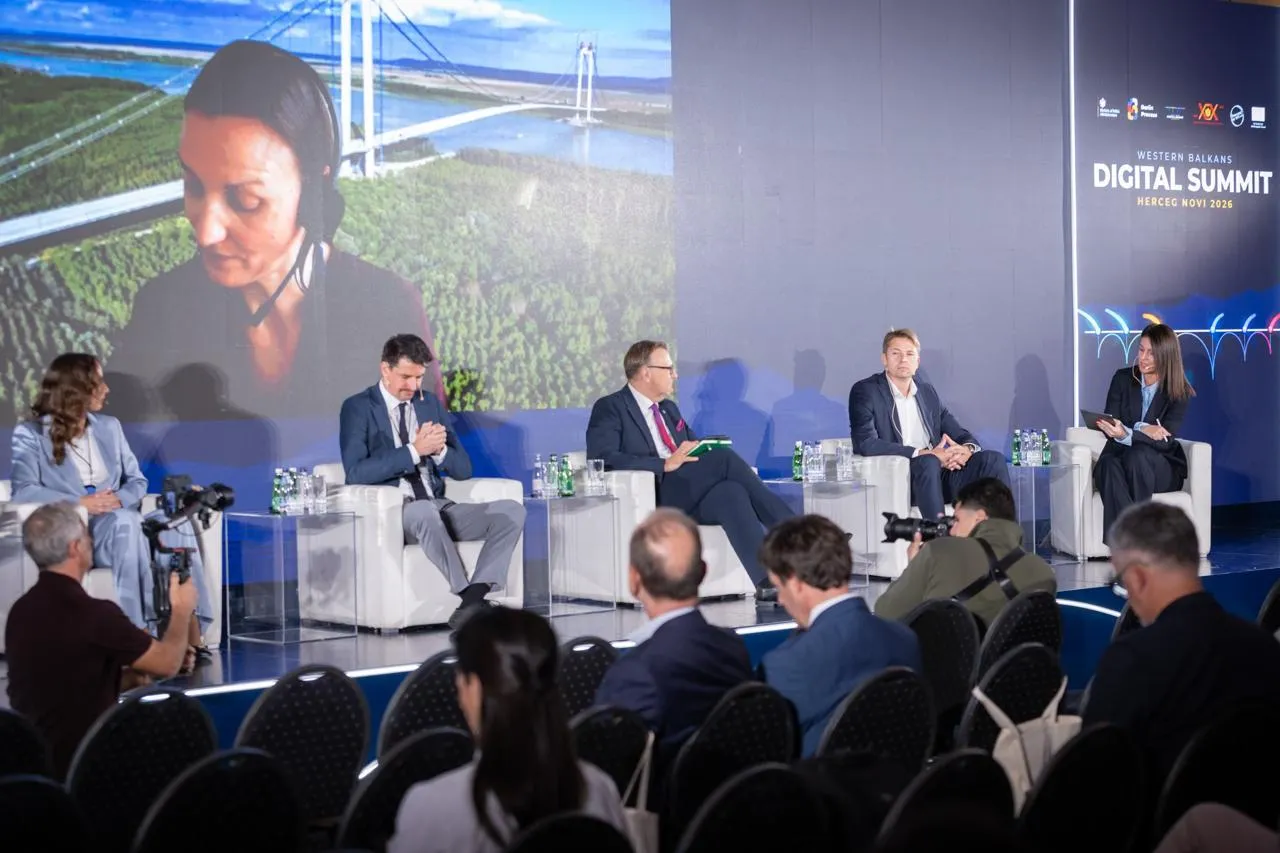
The agreement between 4iG, One Albania’s investor, and SpaceX brings satellite communication closer to the Albanian and regional markets in the cellular industry.
“4iG Group aims to be the first operator in the Western Balkans region to enable direct satellite communication with terminal equipment.” – stated Pál Zarándy, Director of Mobile & 5G Strategy at the 4iG Group, during the 8th Western Balkans Digital Summit in Herceg Novi.
As he emphasized, an important step in this direction is the agreement that 4iG signed with the American company SpaceX in September. This agreement aims precisely to enable direct satellite communication with end devices.
This ambition is part of the Group’s broader strategy, which focuses on developing next-generation digital infrastructure and deploying advanced technologies. Zarándy also spoke about how satellite communications and artificial intelligence will impact the future of telecommunications.
“At 4iG Group, we have a well-established tradition of innovation and aim to be at the forefront of the new wave of technological changes. Our collaboration with SpaceX creates the opportunity to enable direct satellite communication with end devices. This makes us the first in the Western Balkans to introduce this technology to the region’s markets. At the same time, through partnerships with leading technology companies and cooperation with universities, we aim to contribute to the development of new digital solutions in the region.” – said Zarándy.
4iG plans to soon begin testing direct satellite communication with terminal equipment in Hungary and Albania, involving universities. As Zarándy emphasized, the technical conditions are already met and the technical aspect does not pose an obstacle. Meanwhile, our companies are cooperating with Regulatory Authorities to enable initial testing of this service and then to provide the service to consumers.

The development of satellite communications is part of a broader transformation of digital infrastructure, where artificial intelligence is also playing an increasingly important role. Today, the use of the latter is mostly linked to generative tools and automation. The next phase will include the development of autonomous drones and so-called physical artificial intelligence, which will require new connectivity and communication capabilities.
“Traditional infrastructure is beginning to change. Artificial intelligence places different demands on digital infrastructure, especially with the development of autonomous systems and devices that need to communicate reliably. For this reason, satellite connectivity, or extraterrestrial communication, will become increasingly important. The industry is already discussing data centers for artificial intelligence in orbit, which shows how quickly the boundaries of technological development are expanding,” said Zarándy.
In this context, the 4iG Group is developing its technological capacities in the markets where it operates. In addition to Hungary, Montenegro, and Albania, the Group is also developing a new mobile operator in North Macedonia.
His experience includes introducing 5G technology in Albania, as well as testing 6G technology prototypes in Hungary, in collaboration with universities. This experience also includes launching cellular operations in Montenegro, where, as Zarándy pointed out, 4iG through One was the first operator in the entire Western Balkans to introduce the roaming service “Roam Like at Home” on its own initiative. In Montenegro, 4iG Group has recently announced cooperation with the government to build a data center.
Zarándy emphasized that international partnerships, including collaboration with SpaceX and Ericsson, will play an important role in the transfer of technological knowledge and the development of innovation in the region.
“We aim to rely on strong industrial partnerships and bring to Montenegro, Albania, and then North Macedonia the experience of technologies we develop together with our partners. By connecting universities, industry, and our infrastructure capacities, we can create space for testing new solutions and further developing innovation.” – concluded Zarándy.
