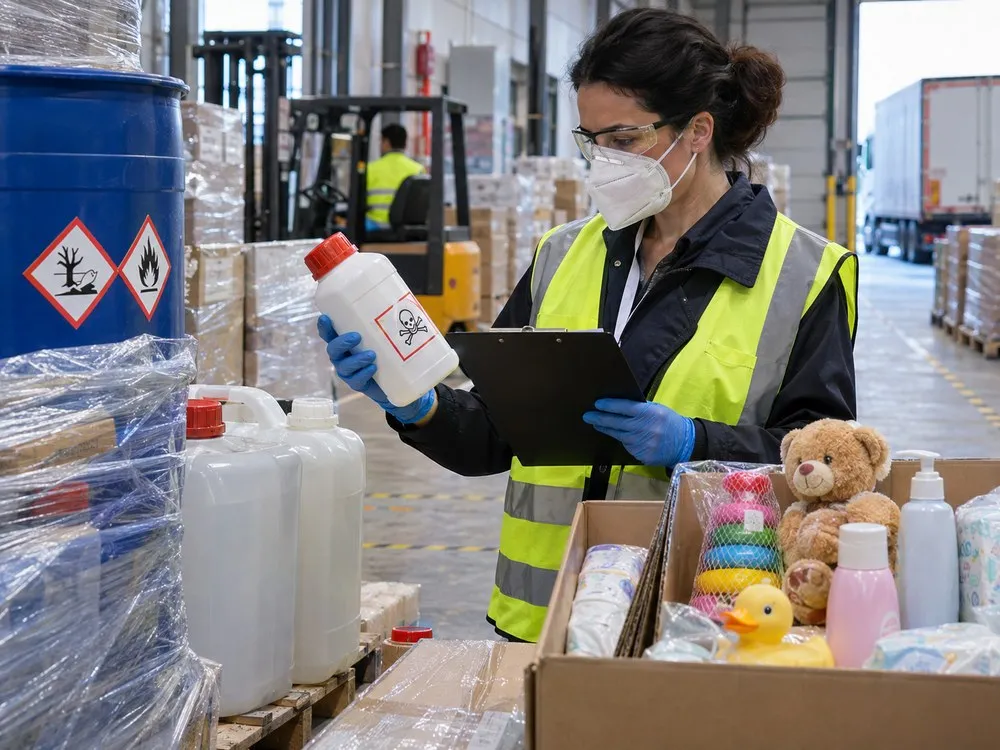
The Ministry of the Environment proposes a new regulatory framework to ban the import, production, trade, and use of persistent organic pollutants. The draft decision establishes a list of 33 substances or groups of substances that will be subject to bans, with specified exceptions for specific cases.
The revised draft decision of November 27, 2026 provides for concentration limits of hazardous substances in toys, children’s care products, recycled materials and industrial products, as well as obligations for businesses to declare stocks, customs controls and the management of contaminated waste.
The document aims for the full alignment of Albanian legislation with the European Union Regulation 2019/1021 on persistent organic pollutants, substances that can remain in the environment for long periods, accumulate in living organisms, and pose a risk to human health.
Stronger restrictions on toys and children’s products from May 2027
One of the measures with a direct impact on consumers concerns the presence of certain brominated chemical substances, used as flame retardants, in toys and children’s products containing recovered materials.
By May 16, 2027, the combined concentration limit for the five substances in this family will be 350 mg/kg, while as of May 17, 2027, it will be reduced to 10 mg/kg, making the allowable limit 35 times lower.
The measure covers toys, products used for sleep, hygiene, feeding, transportation, protection, and general childcare, when they contain or are made from recovered materials. Food-contact materials are regulated by specific legislation.
For mixtures and other articles containing these recovered materials, the limit will be 350 mg/kg until December 29, 2027, and 200 mg/kg from December 30, 2027.
The list of substances subject to bans also includes pesticides such as DDT and chlorpyrifos, as well as certain members of the PFAS family, also known as “forever chemicals,” due to their persistence in the environment.
Transformers with high PCB content, a 12-month deadline for decommissioning
The draft decision also provides specific obligations for the energy sector and industrial entities that own equipment containing polychlorinated biphenyls (PCBs).
Transformers, capacitors, and other equipment containing more than 0.005% PCB and have a volume greater than 0.05 dm³ must be taken out of service as soon as possible, but no later than 12 months from the decision’s entry into force, without prejudice to earlier deadlines under existing legislation.
Owners of these devices will be responsible for their decontamination or destruction, while the National Environmental Agency (NEA) and inspection bodies will be tasked with identifying the devices.
Businesses required to declare stocks over 50 kilograms
Entities holding stocks of more than 50 kilograms containing persistent organic pollutants, the use of which remains permitted, will be required to declare them to the National Environmental Agency.
The declaration must be made within 12 months from the date the decision becomes applicable to the respective substance and thereafter annually, until the end of the permitted use period.
Businesses must report the stock quantity, chemical concentration, location, storage conditions, and intended use.
In cases where the use of the substances is no longer permitted, stocks must be managed as waste, subject to special treatment and disposal procedures.
Customs will suspend suspected imports
The General Directorate of Customs will be required to suspend customs procedures for goods suspected of containing substances in violation of the bans or restrictions set out in the decision.
In these cases, customs must immediately notify the responsible inspection bodies and the National Environmental Agency to carry out further verifications.
Inspections will not be limited to the import of chemicals as raw materials but will also include finished products and mixtures containing the prohibited substances.
Hazardous waste will be exported if treatment facilities are lacking.
The draft decision prohibits recycling or recovery operations that could reintroduce the listed polluting substances into use. Wastes must be treated in such a way that the pollutants are permanently destroyed or irreversibly transformed.
Treatment will be carried out only at facilities equipped with environmental permits and by licensed operators.
If Albania does not have suitable facilities, the waste will be exported for disposal or recovery, based on the relevant authorizations.
The rules also apply to the management of waste contaminated from the metallurgical industry, incinerators, construction and demolition, as well as soils excavated from polluted sites.
For waste containing pollutants below the limits set in the draft decision, other treatment methods may be allowed, but owners must prove this through analyses conducted by accredited laboratories.
Additionally, the waste will be subject to traceability from the moment of generation until its final destination, with data reported in the electronic waste register.
National Inventory of Air, Water, and Soil Pollution
The National Environmental Agency will compile inventories of emissions of persistent organic pollutants into air, water, and soil, as well as an action plan for their reduction.
Within six months of the decision’s entry into force, the National Environment Agency must adapt the Integrated Environmental System for the electronic management of data on the production, import, use, stocks, and emissions of these substances.
The first emission inventories and the first national report must be published or prepared, as appropriate, within two years.
The national report will also include data on inspections, violations found, and administrative measures taken against entities./ekofin.al