


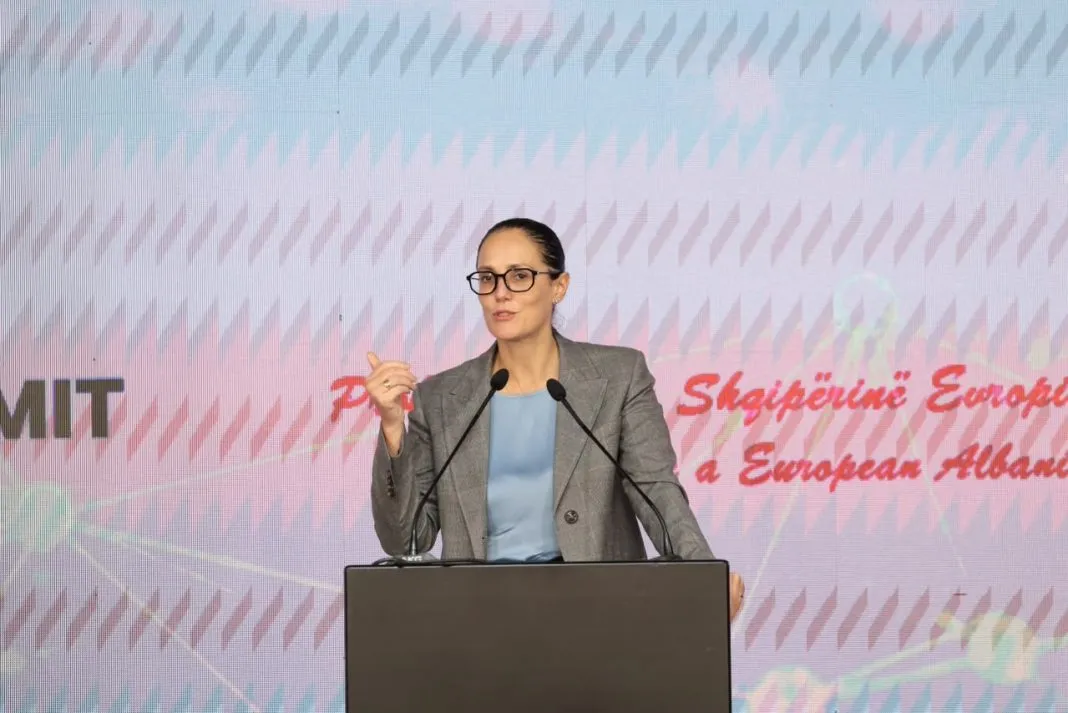
The Centralized Procurement Operator plans to procure a total of 179 investments during 2027, with a value of around 63 billion lek. The figure was announced by the Minister of Economy and Innovation, Delina Ibrahimaj, during the event “Procurement for European Albania!”, where she presented the impact of the centralized procurement reform on businesses and the economy.
According to the minister, the scale of planned investments shows that improvements in planning, timing, and cost can bring significant benefits to the state budget. The reform aims for procurement to be evaluated based on the quality of goods and services, compliance with deadlines, and the economic impact of public expenditures.
Ibrahimaj approached procurement from the perspective of entrepreneurship, describing the state as the main client of the business. She reported that during 2025, 5,766 procedures were conducted, with 109 billion lek procured, while the total procurement market accounted for, according to her, 7.6% of the Gross Domestic Product.
For this reason, the minister emphasized that public procurement should be used as an instrument of economic policy, to promote competition, improve standards, and create new opportunities for entrepreneurship.
The proposed change foresees a shift from fragmented treatment of institutional needs to an integrated system. WBS will be involved throughout the entire procurement cycle, from needs identification and market analysis, to standardization of technical specifications, organization of procedures, and evaluation of results.
The needs of institutions will be identified during budget planning and will be included in a consolidated procurement register prepared by the WBO. According to Ibrahimaj, this will enable businesses to become familiar with the state’s demand earlier and plan production capacities, supplies, and the necessary employment for contract implementation.
Another objective is the standardization of catalogs and requirements for goods and services. The minister argued that clearer rules will help businesses invest in standards and productivity, creating opportunities for broader participation even for small and medium enterprises.
Meanwhile, combining the needs of institutions aims to create economies of scale, reduce administrative costs, and ensure better purchasing conditions.
Ibrahimaj particularly focused on the economic consequences of delays in procurement. According to her, an investment that is not made on time leads to a lack of liquidity for businesses, postponement of job openings, and delays in services for citizens. Better planning aims to reduce repetitive procedures, cancellations, and unnecessary costs.
For the year 2025, the minister reported that the difference between the limit fund and the procured fund was 17 billion lek, or 13% of the limit fund. She emphasized that, alongside price competition, quality, deadlines, and the real impact of every expenditure on the economy must also be measured.
The transformation of WBS is being carried out in cooperation with UNOPS, aiming to adapt the structure and European procurement practices. Ibrahimaj described this as the preparatory phase for the next step: the use of artificial intelligence throughout the entire public procurement process.
According to her, artificial intelligence is planned to be used for technical specifications, calculation of the limit fund, market analysis, automatic completion of business documentation through state registers, bid control, and monitoring of contracts up to final payments.
The minister said that this approach aims for less bureaucracy and paperwork for businesses, reduction of errors, and more transparent and traceable processes. Decision-making, she emphasized, will remain humane, supported by more complete data. /ekofin.al
