


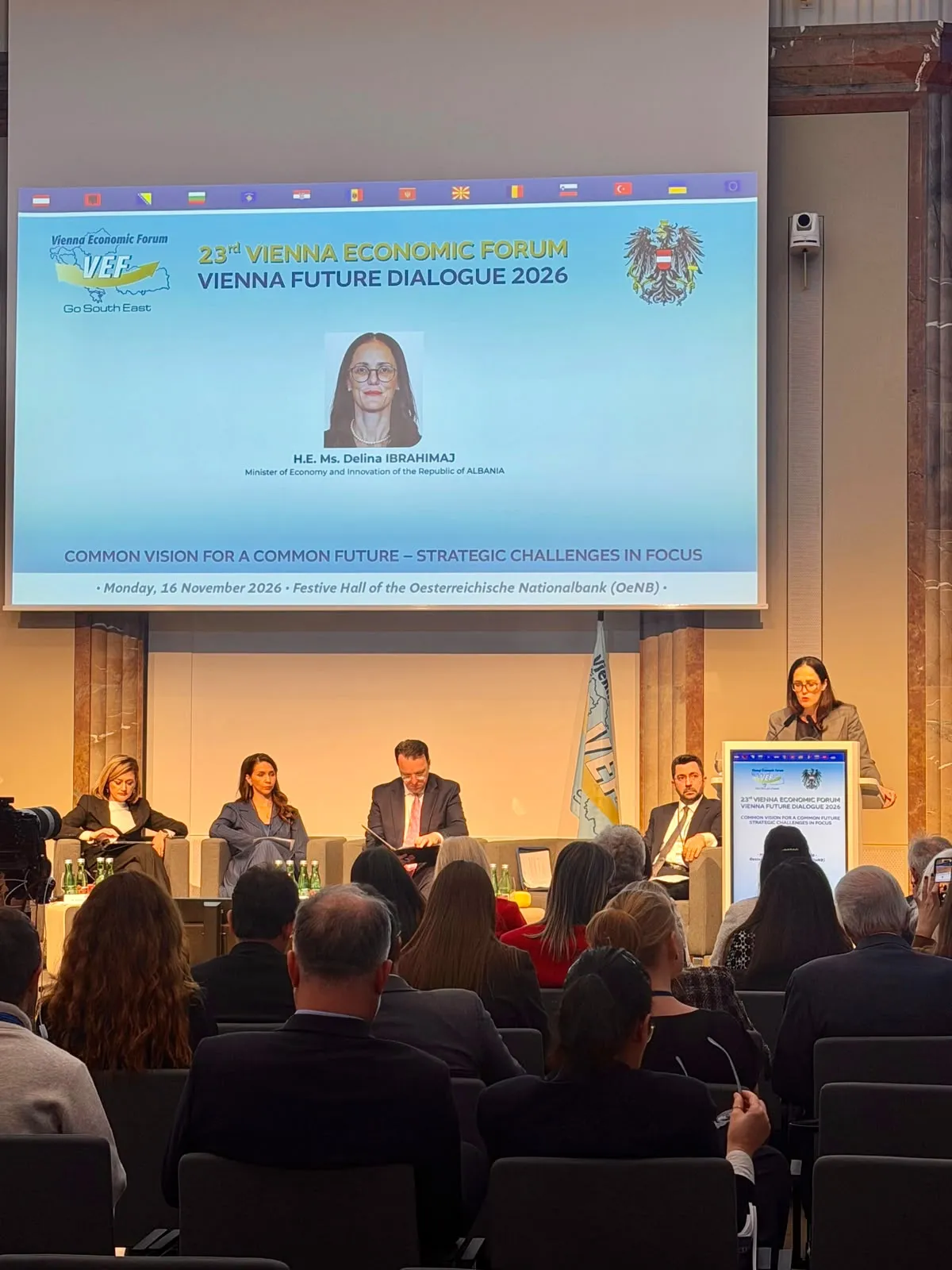
Albania aims to attract more foreign investments that bring technology, innovation, and quality jobs, gradually moving towards an economic model based on productivity and value-added sectors. This was one of the main messages from the Minister of Economy and Innovation, Delina Ibrahimaj, during her participation in the 23rd Vienna Economic Forum, “Vienna Future Dialogue 2026.”
In the panel “Common Vision for a Longstanding Economic Cooperation,” Ibrahimaj presented developments in the Albanian economy, the perspective of European integration, and opportunities to expand economic cooperation with Western Balkan countries and international partners, with a special focus on Austria.
The minister emphasized that the Albanian economy recorded growth of about 3.8% during 2025, while foreign direct investments reached around 1.6 billion euros. However, according to her, the main challenge for the coming years remains the transformation of the economic model by increasing productivity, investments in human capital, and the development of sectors that create more value in the economy.
In this regard, Ibrahimaj considered European integration as an opportunity to modernize the Albanian economy and strengthen the competitiveness of local enterprises.
She announced that Albania has opened all 33 chapters of negotiations with the European Union and has temporarily closed four of them, including Chapter 20 on Enterprise Policy and Industry. According to the minister, the objective remains to complete the accession negotiations by the end of 2027.
Ibrahimaj emphasized that integration should not be seen only as a process of aligning legislation with European standards, but also as a preparatory process for Albanian businesses, which must be able to compete in the European Common Market.
“This requires improving the investment climate, legal certainty, simplifying administrative procedures, and supporting companies aiming to meet European standards. Membership will create opportunities for Albanian businesses to enter a larger market, establish new partnerships, and be involved in European production chains,” Ibrahimaj stated.
Another important issue discussed at the forum was strengthening regional economic cooperation. The Minister assessed that the Western Balkan countries need to accelerate the removal of trade barriers, improve customs cooperation, and facilitate the movement of goods and services.
According to her, the CEFTA agreement, the Regional Common Market, and the European Union’s Growth Plan have created the necessary instruments for the region’s economic integration, but concrete results depend on the speed of implementing commitments.
“Through CEFTA, the Regional Common Market, and the EU Growth Plan, mechanisms have been created to reduce the obstacles faced by businesses, but the implementation of commitments must proceed faster so that results translate into shorter procedures, lower costs, and greater security for enterprises,” the minister stated.
Ibrahimaj emphasized that economic cooperation among the countries of the region should extend beyond trade, including joint investments, industrial development, and greater integration of companies into European production chains.
Energy, manufacturing, technology, and sustainable industries were identified as some of the sectors with potential for expanding economic partnerships and attracting foreign capital.
In this context, the minister also presented the new draft law “On Investments in the Republic of Albania,” which is currently under public consultation.
According to Ibrahimaj, the initiative aims to create a more favorable environment for domestic and foreign investors by simplifying administrative procedures, strengthening legal certainty, and increasing the transparency and predictability of the regulatory framework.
“The initiative aims to simplify administrative procedures, strengthen legal certainty, and create a more transparent and predictable framework for domestic and foreign investors. Albania aims to attract investments that bring capital, technology, and knowledge, create quality jobs, and help Albanian businesses increase their competitiveness,” Ibrahimaj stated.
The minister also addressed supportive policies for innovation, mentioning fiscal incentives for investments in technology, research, and development, as well as public financing programs for startups.
The discussions also focused on expanding economic relations with Austria, as a partner with potential for investment and cooperation in strategic sectors. Ibrahimaj expressed Albania’s readiness to build long-term partnerships with Austrian companies and international investors, especially in technology, innovation, and industrial development.
The 23rd Vienna Economic Forum was held under the patronage of Austria’s Federal Chancellor, Christian Stocker, under the theme “Common Vision for a Common Future – Strategic Challenges in Focus,” bringing together representatives of governments, international institutions, and company leaders to discuss economic challenges and opportunities for cooperation in Europe and the region.
