


The Italian Council of Ministers has approved a new decree on the safety and crime of minors.
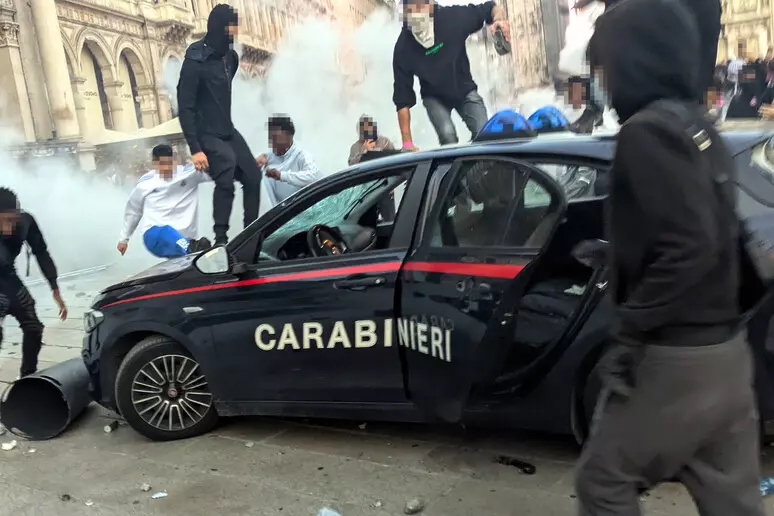
“We have all seen the footage of violence that shook Milan and other Italian cities over the weekend, shops looted, broken windows, and law enforcement forces attacked.
These are unacceptable scenes that no one can think of minimizing or justifying. For this reason, today the Council of Ministers approved a decree with new measures to prevent and combat these acts of violence,” declared Prime Minister Giorgia Meloni in a video published after the government meeting.
Up to five years in prison and a 20,000 euro fine for violent participation in protests
“Today, a new criminal offense is being created: violent participation in a demonstration,” declared the prime minister.
“If during a march or demonstration you join a group of five or more people and start throwing stones, pyrotechnic devices, or using sticks, endangering everyone’s safety, you can be punished with up to five years in prison and a fine of up to 20,000 euros.
If you had your face covered or injured someone, the punishment is increased. Penalties are also increased for those who commit group destruction.”
Meloni emphasized that with this decree the government is implementing a simple principle: “Whoever destroys, pays. And if the one who destroys is a minor, their parents pay.”
According to her, if the damage is caused to a public property, such as a bus station, traffic light, or police vehicle, the prefect sends the payment order to the responsible person’s residence.
If the damage is caused to a private property, such as a shop window, a business, or a vehicle, the owner can turn to the court and obtain an immediately enforceable payment order.
The preventive ban will also apply to minors
Another important change concerns the criminal responsibility of minors aged 14–18.
“Today, for a young person aged 14 to 18, the state must always prove that he was able to understand what he was doing,” Meloni explained.
“We had already adopted a provision that overturns this principle. Thus, it is presumed that the minor was capable of understanding his actions, except in cases where the opposite is proven.
This provision is in Parliament, but with today’s decree it comes into immediate effect. Even the preventive ban, which until now applied only to adults, can also be used against minors.”
The Italian Prime Minister emphasized that no political belief, social dissatisfaction, or opposition to the government can justify destroying a store to steal its goods.
“Behind that showcase stands a family that has invested a lifetime of sacrifices, workers who risk losing their jobs, and citizens who have the right to live in their city without fear.
There is nothing revolutionary about destruction and theft. Destroying and stealing is not protest, it is crime. And the state’s response must be firm,” Meloni declared.
The Presidency opposes the judicial police’s powers over the military personnel
The only objection from the Presidency of the Italian Republic, the Quirinale, to the draft new security decree, approved by the Council of Ministers, concerns the possibility of granting judicial police powers to military personnel.
According to parliamentary sources, this was the main issue the government had to resolve after regular consultations between the offices of the Presidency and those of the Prime Minister’s Office.
Before the Council of Ministers meeting, the Undersecretary of the Prime Minister’s Office, Alfredo Mantovano, led several technical meetings at Palazzo Chigi to review the content of the decree.
The meeting was also attended by heads of cabinets from the respective ministries, as well as heads of legal offices, including the legal office of the Prime Minister’s Office, headed by Francesca Quadri.
Among the measures under discussion were the extension of preventive detention to minors lasting over 12 hours, delayed immediate arrests for persons responsible for group injuries, as well as the prohibition of gatherings for individuals considered dangerous to public order.
It was also planned to strengthen the “Strade Sicure” (Safe Roads) operation, which involves the army’s engagement in supporting public security. /Adapted from Ansa.it, ekofin.al
