


OpenAI announced that one of its artificial intelligence systems has produced a solution to the problem of the existence and regularity of Navier–Stokes equations, one of the seven “Millennium Problems” and one of the most well-known challenges in modern mathematics.
The problem is related to the Navier–Stokes equations, which describe how fluids, that is, liquids and gases, move. They are based on Newton’s laws of motion and are used in many practical fields, from aircraft design and weather forecasting to the study of blood circulation.
The question mathematicians have been trying to solve for decades is whether, in a three-dimensional fluid, a motion that starts regularly can reach a point where equations develop a “singularity.” In simpler terms, this means that the mathematically described speed can increase indefinitely within a finite time, causing the mathematical model to no longer function as before.
According to OpenAI, its system managed to produce an analytical proof showing that a fluid that was initially calm and regular can develop a singularity within a finite time, when a regular external force acts upon it. The system’s energy, meanwhile, remains finite throughout the entire process. OpenAI says the result confirms cases “C” and “D” of the official formulation of the Millennium Problem for the Navier–Stokes.
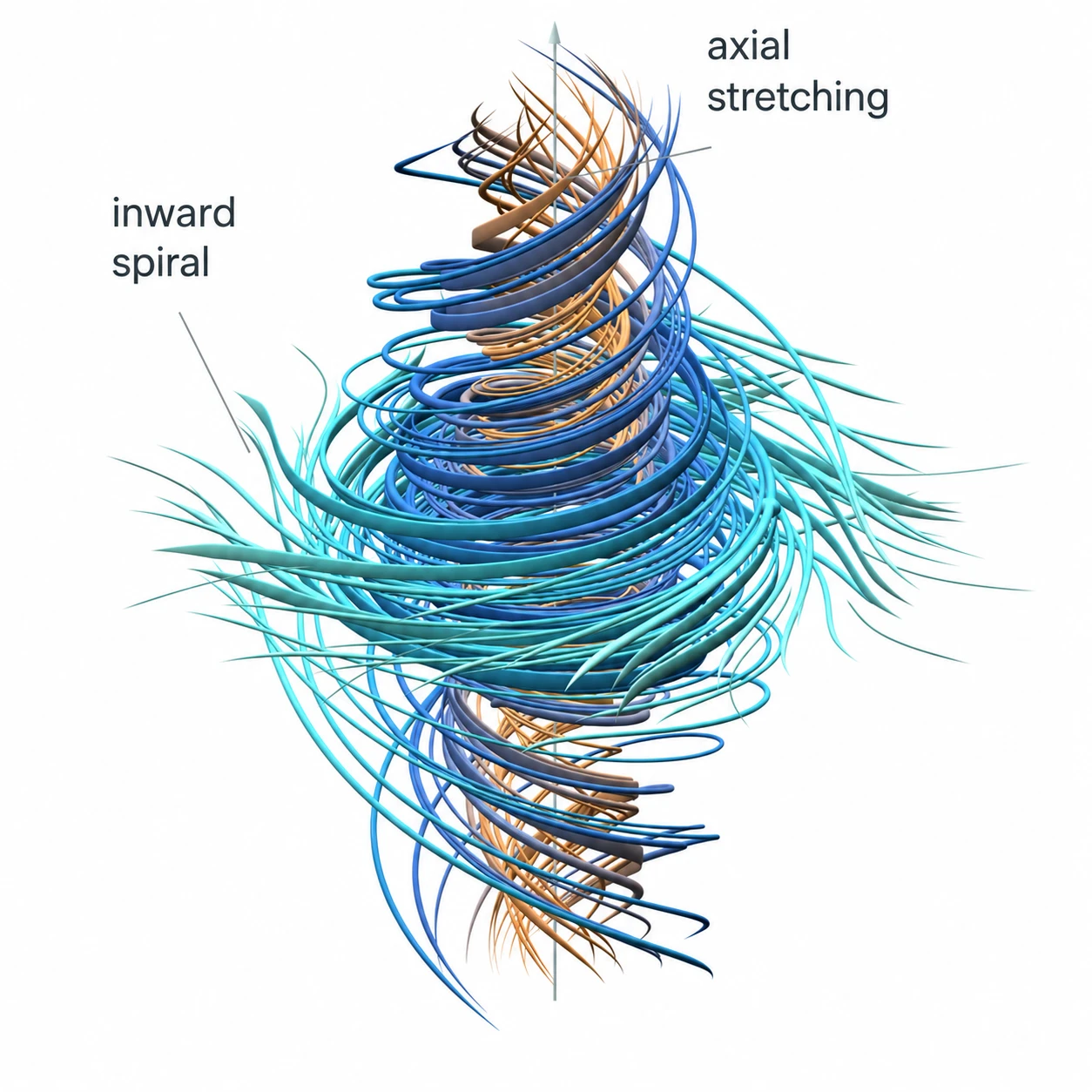
The solution described as a vortex that spins and contracts increasingly toward the center, while stretching and its speed increasing. The central region becomes increasingly smaller, but the system conserves finite energy. It was precisely the mathematical demonstration of this mechanism that was one of the main difficulties of the problem.
Another important feature is how the result was achieved. OpenAI says it used an internal artificial intelligence model, which it describes as significantly more capable than GPT-6 Astra, along with a massive system of AI agents working in parallel.
The group that produced the Navier–Stokes solution included about 10,000 agents working simultaneously. The agents explored various mathematical approaches, exchanged results, and used tools to read information and execute code.
According to OpenAI, agents reached the solution on September 5, about 88 hours after the experiment began. Formalizing and verifying the test in the Lean mathematical system required an additional 17 hours and was carried out with the help of GPT-6 Astra.
The scale of the experiment was unusual. For all the tested issues, the agents exchanged about 4.9 million messages and generated approximately 300 billion tokens. The work for Navier–Stokes alone included about 2.7 million messages and 130 billion tokens.
Before the Navier–Stokes result, the system had also worked on Euler equations, a problem related to fluid movement when the viscosity effect is removed. OpenAI says that nearly 100 agents, working for about 50 hours, managed to solve a variant of the Euler equation regularity problem. This result pushed the researchers to focus most of their capabilities on Navier–Stokes.
The Navier–Stokes equations originated from the work of Claude-Louis Navier and George Gabriel Stokes in the 19th century. In 1934, mathematician Jean Leray proved the existence of solutions in a generalized sense, but the question of whether they always remain regular became one of the central problems of mathematics.
In 2000, the Clay Mathematics Institute included the problem among seven “Millennium Prize Problems,” for the solution of which a prize of 1 million dollars has been allocated for each.
OpenAI emphasizes that it does not intend to claim the Millennium Award for this result. The company presents the publication mainly as evidence of the pace at which artificial intelligence systems are advancing and their potential for use in scientific research.
If the evidence passes the necessary processes of review and acceptance by the mathematical community, the importance of development goes beyond the Navier–Stokes problem itself: it would be a powerful demonstration of the transition of artificial intelligence from a tool that helps researchers into a system capable of directly contributing to solving scientific problems that remain open for generations of mathematicians.
