


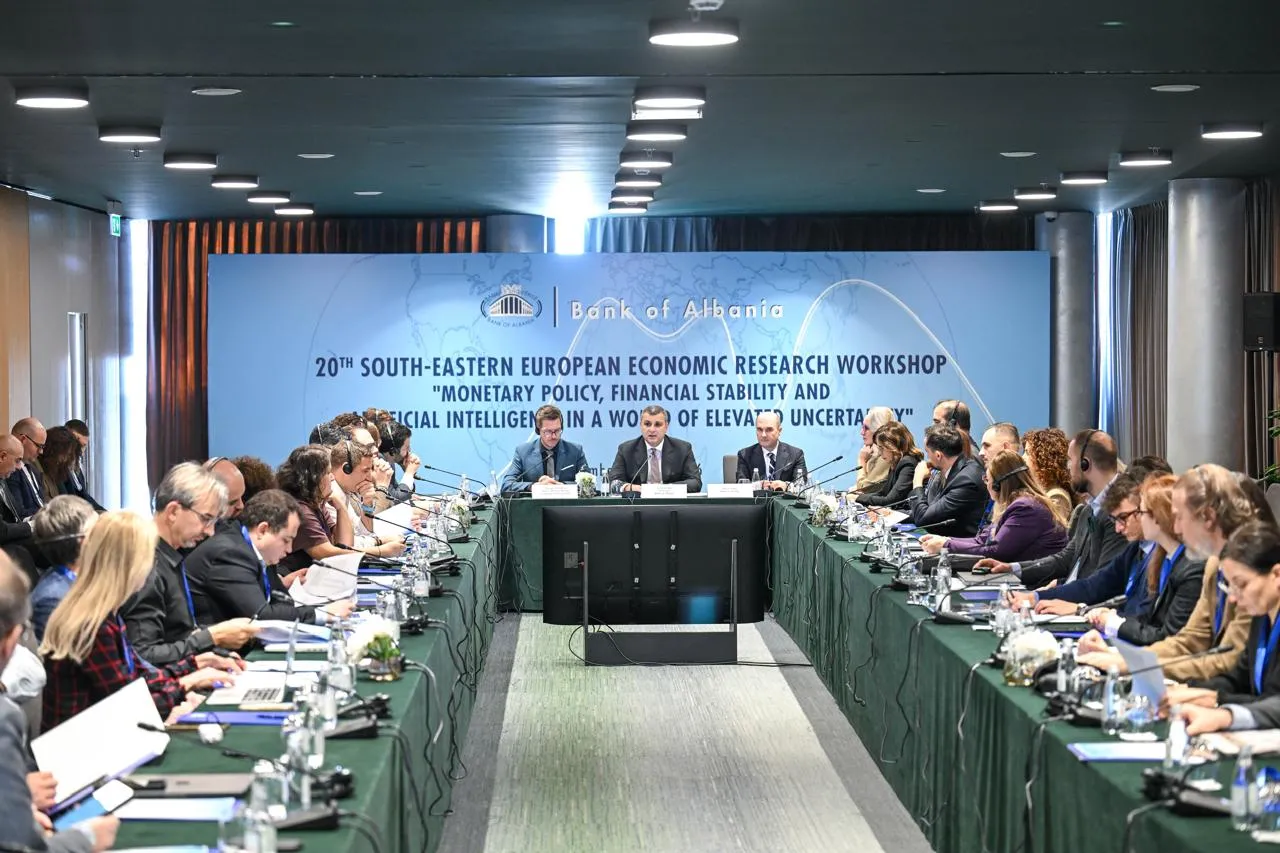
The 20th Workshop for Southeast Europe introduces two new initiatives for economic research: a joint publishing platform and researchers’ access to the Bank of Albania’s microdata. Over two days, 40 studies will be presented, focusing on monetary policy challenges, financial stability, and technological transformation.
The Bank of Albania aims to move into a new phase of economic research development, transforming academic cooperation from an exchange platform for ideas into a mechanism for producing joint studies and expanding the empirical basis for economic analysis. This is one of the key developments of the 20th edition of the Economic Research Workshop for Southeast Europe, which will be held in Tirana on November 24–25, 2026.
Under the theme “Monetary Policy, Financial Stability, and Artificial Intelligence in a World of High Uncertainty,” this year’s event takes on a broader dimension than a traditional academic conference. In addition to discussing the latest developments in economics and finance, the Bank of Albania is presenting two initiatives aimed at creating a more sustainable infrastructure for scientific research: a joint research publication series (Working Paper Series) and a structured framework for researchers’ access to the institution’s microdata.
These developments come at a time when central banks face growing challenges in identifying the nature of economic shocks, forecasting inflation, and assessing the transmission of monetary policy in an environment characterized by geopolitical uncertainty, structural changes, and digital transformation.
Two innovations to turn research into a more direct instrument of policymaking
The most concrete innovation of this edition is the proposal to create a joint Working Paper Series linked to the workshop. Through this platform, the studies presented will not remain confined to the discussions during the event but will have a dedicated channel for publication and further scholarly development.
The initiative aims to create continuity in collaboration among central bank researchers, universities, and research institutions, while also fostering joint projects focused on the economies of Southeast Europe.
Another significant development is the creation of a framework for researchers’ access to the Bank of Albania’s microdata, in compliance with confidentiality and data protection requirements.
From a methodological perspective, this initiative can expand opportunities for more detailed empirical analyses of the financial behavior of households and firms, access to credit, developments in the banking market, and the mechanisms through which economic changes affect different sectors of the economy.
The use of more detailed data creates opportunities to move from analyzing aggregate indicators to identifying differences among various categories of economic agents. This is particularly important for understanding how changes in interest rates, inflation, or lending conditions affect households and businesses differently.
Both initiatives were presented by Governor Gent Sejko in his opening remarks at the event, where he emphasized the ambition for the workshop to become a space for developing joint research projects rather than just presenting studies.
Artificial Intelligence and the Challenge of Economic Models in Uncertain Conditions
One of the main focuses of discussions this year is the role of artificial intelligence in economic analysis and in the activities of central banks.
Unlike traditional approaches, which rely mainly on econometric models and historical series, the use of artificial intelligence methods and machine learning techniques (machine learning) creates opportunities to process larger volumes of information, identify nonlinear relationships, and improve forecasting tools.
The agenda for this edition includes issues related to the impact of artificial intelligence on productivity and economic growth, the labor market, innovation and investment, as well as the use of alternative data in macroeconomic analysis.
However, the challenge for central banks is not only the adoption of new technologies but also ensuring the reliability of analytical results. For this reason, Governor Sejko emphasized that artificial intelligence should be used in service of research questions, without compromising methodological standards, professional expertise, and institutional responsibility.
In this context, the ability of central banks to assess uncertainty through alternative scenarios, to improve economic forecasts, and to identify risks that could affect macroeconomic and financial stability earlier also becomes important.
From inflation to financial stability: new research priorities
In his speech, Governor Sejko identified three areas where the Bank of Albania’s future research agenda should focus.
The first relates to the analysis of structural changes in the economy and the transmission mechanisms of shocks. For a small, open economy like Albania’s, identifying the impact of international developments, exchange rate movements, and changes in the labor and goods markets is essential for assessing inflationary pressures.
The second pillar is to strengthen forecasting and uncertainty assessment capacities through the use of alternative scenarios. This approach aims to improve risk assessment and create a more comprehensive basis for monetary policy decision-making.
The third priority relates to analyzing the interaction between monetary policy, macroprudential policy, and financial stability. In practice, this entails a more integrated assessment of the impact that decisions on interest rates, lending conditions, and regulatory instruments have on the financial system and the real economy.
These directions also reflect the need to better understand the interaction between price stability and financial stability, two objectives that require ongoing analysis and increasingly sophisticated instruments.
The Governor recalled that the institution’s economic research has, over the years, supported monetary decision-making, the identification of financial risks, and the design of measures that have contributed to improving the quality of the credit portfolio and reducing non-performing loans. /ekofin.al
