


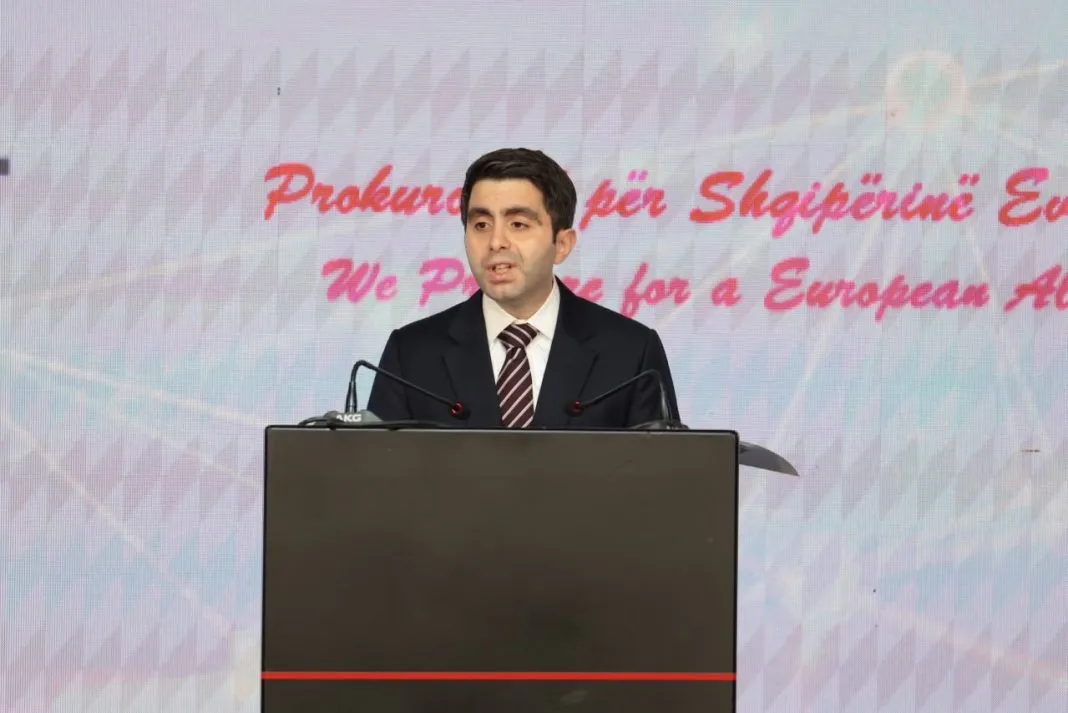
Public procurement should be evaluated through the results it brings to citizens and the way public funds are used, going beyond the development of tenders and contract signing. This was the main message from the head of the Centralized Procurement Operator, Jonaid Myzyri, at the event for reforming centralized procurements.
According to Myzyri, respecting the law and deadlines remains fundamental, but the success of a procurement should also be measured by the quality of planning, the service obtained, and the value the investment creates for society. The reform aims for the state to act as a strategic buyer, combining the needs of institutions and better utilizing its purchasing power.
“The success of the procurement system is not measured solely by the fact that a tender was conducted according to the law,” Myzyri emphasized.
A 13-step cycle that begins before the tender announcement
The presented model is based on a 13-step interconnected workflow that starts long before the procedure is published and continues with the measurement of results. At its core are strategic planning, standardization of technical specifications, market analysis, centralized procurement, and digitalization.
Procurement planning is expected to be linked from the outset to the preparation of medium-term budget programs, approval, and detailing of the budget. Subsequently, this process will be realized by gathering the needs of institutions to avoid the accumulation of requests at the end of the year and the pressure created by lack of time.
For institutions, this approach aims to bring more security and less administrative burden. For businesses, more predictability regarding public demand and the ability to organize offers, investments, and service provision in a timely manner.
Standardized specifications to avoid ambiguities and delays
An important part of the reform is the national standardization of technical specifications. Myzyri pointed out that the same product or service is often described differently by various institutions, repeating the work and creating delays and uncertainties.
According to him, the drafting of specifications is sometimes accompanied by the perception that the requirements may have been tailored to favor certain operators. For this reason, WBOO aims to strengthen its role in drafting and harmonizing them, in cooperation with local and foreign experts and specialists from beneficiary institutions.
For recurring needs, stable specifications will be used, while for special requirements, the necessary flexibility will be maintained. The presented objective is that by March 2027, the number of standardized technical specification catalogs will reach 30.
Purchase evaluation will increasingly take into account energy efficiency, environmental impact, durability, and costs during product use. This means that the initial purchase price should be considered together with the expenses and benefits the product brings throughout its use.
Framework agreement and a platform for institutional orders
Myzyri announced that the market and price analysis will serve to develop purchasing strategies. Small, fragmented, and repetitive procedures will be grouped into larger framework agreements, based on the needs and respective funds of the institutions.
According to him, over 50 such agreements are planned to be published during next December.
Part of this model is also the “Albzone” platform, designed as a virtual administrative store. Institutions will be able to select the products and services they need and forward their requests to the WPO, while the system will link them to the relevant framework agreements.
Economic operators will have their own profiles, through which they will track orders and the progress of the process. The goal is for institutions to receive the service on time and with the required quality, making it easier to track purchases.
Work continues even after signing the contract
In the new model, signing the contract is not considered the end of the work. Myzyri emphasized the need to analyze what has worked, where problems have arisen, and how future purchases can be improved.
This approach places the measurement of results in the function of future planning: experience from a contract should help improve specifications, purchasing strategy, and service quality.
In presenting the WBC results, Myzyri reported over 185 million euros in investments procured during the July–October period of this year, more than 612 procedures, the participation of over 463 economic operators, and services for more than 256 institutions. According to him, savings for the state budget exceeded 31.8 million euros just during this period.
He also pointed out that, since October 20, through WBO, Albania has started the voluntary publication of procedures on the European TED platform. This gives the procedures greater international visibility and expands the possibility of participation by foreign operators.
Procurement as an instrument for employment
According to Myzyri, procurement results should also be viewed through the opportunities created in the economy and employment. He announced that during the June–October period, participating economic operators declared their commitment to employ over 356 people, of whom 289 are from the lists of unemployed job seekers and 67 from social service schemes.
The presented objective is that by 2027, through public procurement, opportunities for 1,000 new jobs will be created. The fulfillment of commitments will be monitored together with the relevant institutions and beneficiaries.
Myzyri linked the implementation of the reform to strengthening expertise, modernizing the structure, and developing technological systems. He mentioned cooperation with UNOPS, the exchange of experience with Austria’s central purchasing body, BBG, as well as staff training supported by the Academy of European Law, ERA.
For WBO, the intended change is that every public procurement is evaluated based on what it brings to institutions, businesses, and citizens: higher quality services, timely investments, and more efficient use of funds. /ekofin.al
