


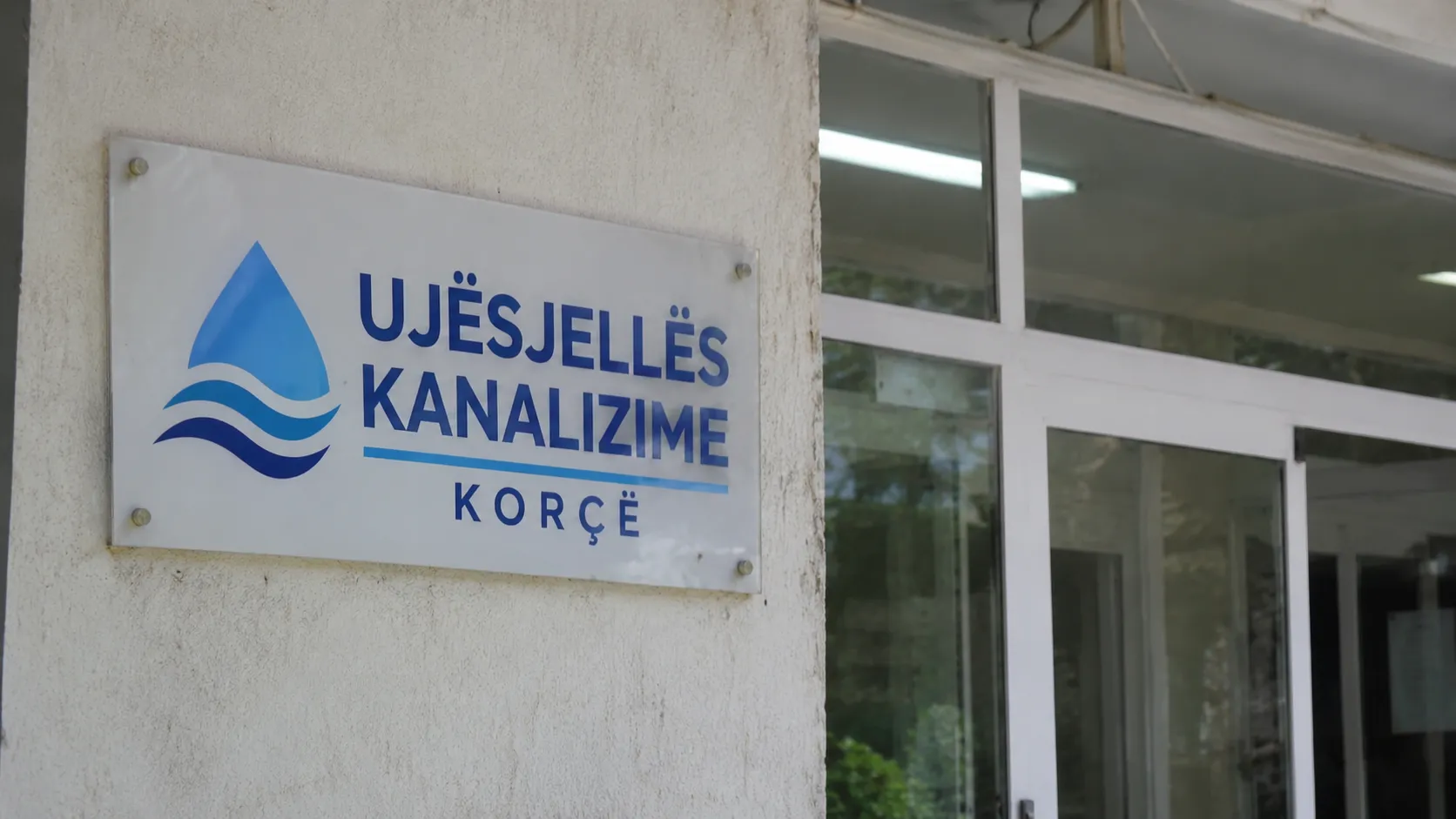
The Regional Water Supply and Sewerage Company of Korçë has not paid any principal or interest installment on two loans totaling 29.5 million euros, while unpaid obligations from clients have reached 422 million lek. The Supreme State Audit finds that the inability to repay the loans has burdened the state budget, while problems with collecting invoices and managing subsidies have increased the company’s financial difficulties.
Two loans totaling 29.5 million euros with no repayment
According to the audit, the Korçë Regional Water Supply has four loans with an initial total value of 39.47 million euros, taken to finance water supply and sewage infrastructure.
The main problem is related to two of them. The first loan, worth 14.5 million euros, was taken in 2008 from the European Investment Bank (EIB) for the construction of the sewage system and the wastewater treatment plant Korça III. The second loan, worth 15 million euros, was taken in 2019 from the German bank KfW for the Korça IV sewerage project.
For both loans, the Supreme State Audit (KLSH) found that by September 30, 2025, the company had not paid any installment of principal or interest. Only the accumulated and unpaid interest on these loans had reached 4.47 million euros, of which about 1.28 million euros pertained to the audited period.
According to the report, the non-payment of these obligations has burdened the state budget due to payments made by the Ministry of Finance.
In total, out of the company’s four loans, the remaining principal to be repaid by the end of September 2025 was 36.29 million euros. During the audit period, only 821 thousand euros of principal and about 138 thousand euros of interest were repaid, related to the other two loans, for which payments were made regularly.
The issue of non-repayment was also raised by the Agency for the Management of Guarantees and Non-Performing Loans, which in April 2024 had requested the repayment of accumulated obligations for two loans.
In its response, the company argued that the refusal to approve the tariff increase by the Water Regulatory Entity (ERRU) had caused a financial shortfall of 20.6 million euros.
KLSH recommends that the administrator and the Economic Directorate develop an action plan regarding the company’s payment capabilities and negotiate with the Ministry of Finance an agreement for the installment repayment of obligations.
Client debts reach 422 million lek, mostly from families
Alongside loan obligations, Korçë Water Supply also faces a considerable stock of unpaid bills from subscribers.
According to audit data, client liabilities at the end of September 2025 reached 422.07 million lek, up from 382.52 million lek at the beginning of 2023.
This represents an increase of about 39.55 million lek during the audited period.
The vast majority of the liabilities are borne by families, with 368.60 million lek, or about 87% of the total. Businesses have 28.07 million lek in unpaid obligations, while public institutions have 25.40 million lek.
Another development is the increase in institutional debts. From around 16.99 million lek at the beginning of 2023, their liabilities reached 25.40 million lek in September 2025, with an increase of 8.41 million lek.
KLSH assesses that the increase in liabilities demonstrates the insufficient work of the company’s responsible structures in collecting invoices.
Auditors recommend that, alongside the interruption of water supply for debtors, a concrete plan be developed to recover debts, giving clients the option to repay in installments and following administrative and legal procedures when necessary.
Meanwhile, the company itself also had outstanding obligations towards suppliers. At the end of September 2025, the Supreme State Audit (KLSH) identified 26 entities with invoices whose payment deadlines had passed, totaling 134.96 million lek.
The 30 million lek subsidy was used for investments, even though there were debts to OSHEE
Another finding of the audit relates to the use of funds provided from the state budget to support the creation of regional water supply companies.
The National Agency of Water Supply, Sewerage and Waste Infrastructure (AKUM) had granted a subsidy of 30 million lek to the Korçë Regional Water Supply.
According to the directive of the Ministry of Infrastructure and Energy, these funds were to be used as a priority for settling the overdue obligations of the former water supply companies, including salaries, taxes, and electricity. Only in the absence of such obligations could the subsidy be used for investments.
However, the Supreme State Audit found that the company had used 30 million lek for investments, even though it had inherited 29 contracts with OSHEE from the former Maliq Water Supply, with total liabilities of 113.36 million lek.
The financed investments included interventions in water supply infrastructure, purchase of pumps, electrical panels, and improvements to pumping stations.
Although the funds were used for infrastructure needs, the Supreme State Audit (KLSH) considers that their destination was contrary to the relevant directive, as the company had overdue liabilities that should have been paid with priority.
The audit also identified discrepancies in the accounting of the debt inherited from the former Maliq Water Supply Company. In the transfer documentation, the obligation to OSHEE was recorded at 123.71 million lek, while the subsequent reconciliation determined it at 113.36 million lek.
According to the Supreme State Audit (KLSH), this difference has resulted in an inaccurate reflection of liabilities in the company’s financial statements.
On this matter, the auditors request an analysis of the responsibilities for the use of the subsidy and the taking of measures to ensure that funds are not used contrary to their intended purpose in the future.
The Supreme State Audit Institution (KLSH) is requesting a plan to settle obligations and strengthen collections.
The identified problems indicate that the Korçë Regional Water Supply Company simultaneously faces significant long-term liabilities from loans, unpaid bills from subscribers, and overdue debts to suppliers.
KLSH demands that the company’s management take measures to plan loan repayments, improve revenue collection, reconcile obligations to OSHEE, and comply with the conditions for using subsidies. /ekofin.al
