


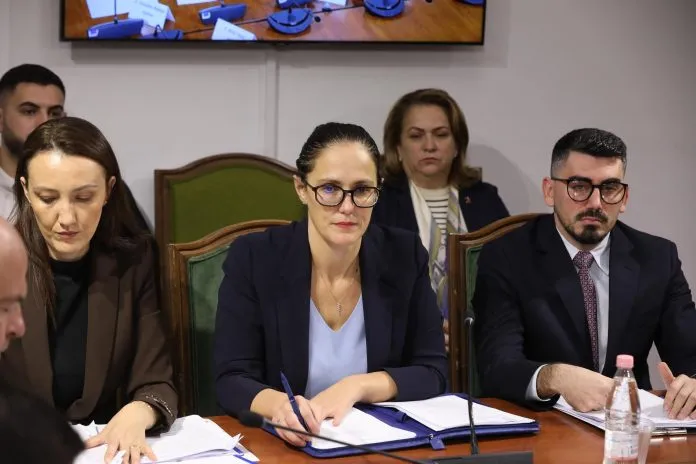
The Minister of Economy and Innovation, Delina Ibrahimaj, today presented to the Commission on Natural Resources, Infrastructure, and Sustainable Development the proposed changes to the draft law “On Social Housing,” emphasizing that through this revision the aim is to expand support beyond traditional social housing categories, including young people, young couples, professionals, and middle-income families.
The minister stated that the changes aim to respond to demographic and economic developments, the increase in housing and rent prices, as well as the need for new instruments that facilitate access to housing.
“Today, there are families who are not included in the traditional categories of social housing, but at the same time, they cannot afford market prices. Therefore, for this reason, it is necessary for us to present and approve proposals for amendments to the law, which include affordable housing,” Ibrahimaj stated.
Presenting the progress of existing programs, the minister announced that since 2018, around 30,000 families, or approximately 100,000 citizens, have been supported through various housing instruments. Of these, 14,000 families have benefited from rent subsidies, over 7,000 families have received concessional loans, while more than 1,000 social housing has been built and housing conditions have improved for more than 6,000 families.
The proposed changes foresee two new facilitated credit programs. The first includes full interest subsidies for homes valued up to 60,000 euros, while the second program foresees loans with a 3% interest rate for homes valued up to 200,000 euros. Both programs foresee the use of guarantee instruments to cover the down payment, facilitating access to credit for families and young people who cannot afford to save upfront.
Illustrating the benefit of a zero-interest loan, Ibrahimaj gave the example of an apartment valued at 6 million lek, where the monthly installment over a 30-year period would be about 16,700 lek, compared to about 32,000 lek which would be paid with an interest rate of 5%.
“So, the beneficiaries of this loan are 15,000 lek per month, which remains more in the pockets of young families, young professionals, or young couples with the benefit of this loan and subsidy, than if they had taken a regular loan,” she said.
Another new instrument is subsidizing up to 50% of the rent for a limited period, for young people, couples, and professionals who move to other cities for studies or employment. The draft law also foresees a “rent in purchase” mechanism, through which a portion of the rent paid can be calculated as a discount from the price of the apartment if the tenant decides to buy it.
Another innovation is the model of developing new neighborhoods on state-owned land, using the 30-40-30 formula: 30% housing for social housing, 40% for affordable housing, and 30% for the free market.
“In this way, we guarantee that we will have proper integration of social categories as well, who need to live integrated and need to live in neighborhoods where there are schools, infrastructure, nurseries, and kindergartens,” the minister emphasized.
From an institutional perspective, the draft law foresees the creation of a Steering Board, under the leadership of the minister responsible for housing, as well as the strengthening of the structures that will implement the new policies. Additionally, the creation of the Housing and Social Cohesion Fund is foreseen, where financing from the state budget, municipal funds, and other legal sources will be consolidated.
According to the minister, one of the main goals of this mechanism is to utilize unused funds from municipalities, which come from the 3% obligation for social housing. Ibrahimaj announced that this concerns about 11.5 billion lek accumulated in municipal budgets, which, through the new fund, can be used for affordable social housing programs.
The minister linked the housing reform to other government economic policies aimed at reducing the cost of living and increasing the incomes of Albanian families, also referring to the proposed changes in the Fiscal Package to raise the income tax threshold from 200,000 to 300,000 lek per month.
“This is a very important draft law, which comes in full context and in the entire concept of policies that the Albanian government has presented to Parliament, where the aim is for us to support Albanian families in reducing the cost of living,” concluded Ibrahimaj. /atsh
