


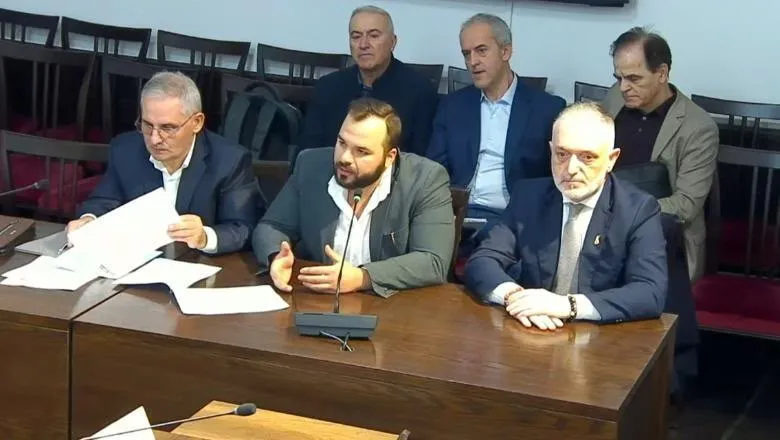
The reduction of the VAT threshold from 10 million to 5 million lek has sparked opposition from representatives of the liberal professions, who warned that they will again turn to the Constitutional Court if the legal changes are approved in their current form.
During discussions in the Committee on Economy, Employment, and Finance in the Albanian Parliament, lawyer Lulzim Alushaj, representative of the Alliance of Free Professions, called on the government to reconsider the proposal, also recalling the previous legal battle over the income tax of freelance professionals, which they won in the Constitutional Court.
“The immediate and such drastic lowering of the threshold will affect a portion of the liberal professions. How much will the government collect from lowering the threshold and what impact does this have on liberal professions? If this law passes in this form, there are some shortcomings that need to be addressed by the Constitutional Court,” declared Alushaj.
According to him, inclusion in the VAT scheme will particularly impact professionals who provide services, such as lawyers, dentists, and auditors, since the cost increase cannot always be passed on to the consumer.
“An immediate 21% increase in the VAT formula would directly affect the incomes of professionals, because as soon as they were freed from a burden in 2024, from income tax, a second blow came, which is their inclusion in the VAT scheme,” he said.
Alushaj also raised concerns about the retroactive effect that, according to him, the proposed changes to VAT and dividends have, arguing that they undermine legal certainty.
“The dividend law has retroactive effect, and the VAT law has retroactive effect. Both are in complete violation of the Constitution. In this, we ask you to have some form of reflection,” the lawyer stated.
He warned that freelancers are ready to follow the same legal path as in the case of income tax: “If this law passes in this form, there are some shortcomings that need to be addressed by the Constitutional Court,” said Alushaj, calling for reflection from lawmakers
Meanwhile, accountant Artur Papajani warned that lowering the VAT threshold could encourage informality instead of fighting it.
“This rapid change of the threshold, with a strange amplitude, we have not seen in other countries. We went directly from 2 million to 10 million, from 10 to 5 million, and this has consequences for the number of taxpayers,” Papajani declared.
He opposed the argument that lowering the threshold would help in the fight against informality, emphasizing that the affected businesses are registered entities.
“The threshold has nothing to do with informality, because all those passing through the threshold are formal, registered businesses. By bringing them back again, they will try to push informality, they will try to fragment the turnover, and this is not in everyone’s interest,” he said.
Papajani proposed setting the VAT threshold at 8 million lek, referring to calculations that, according to him, have been made by the International Monetary Fund. He also requested that the costs that businesses and the tax administration will face from implementing the new scheme be assessed.
According to him, the change in the threshold risks affecting some farmers as well, who may lose the benefits from the compensation scheme.
Lawyer Alushaj also opposed the claim that the tax administration is prepared to implement the changes, mentioning unjustified fines, failure to respond, and deadline extensions.
Discussions on fiscal changes were also accompanied by a debate between lawyer Lulzim Alushaj and Socialist MP Erion Braçe.
