


The Agency for the Management of Seized and Confiscated Assets (AAPSK) continues to expand international and regional cooperation, focusing on strengthening institutional capacities, exchanging experiences, and promoting the best European practices for the administration and social reuse of confiscated assets.
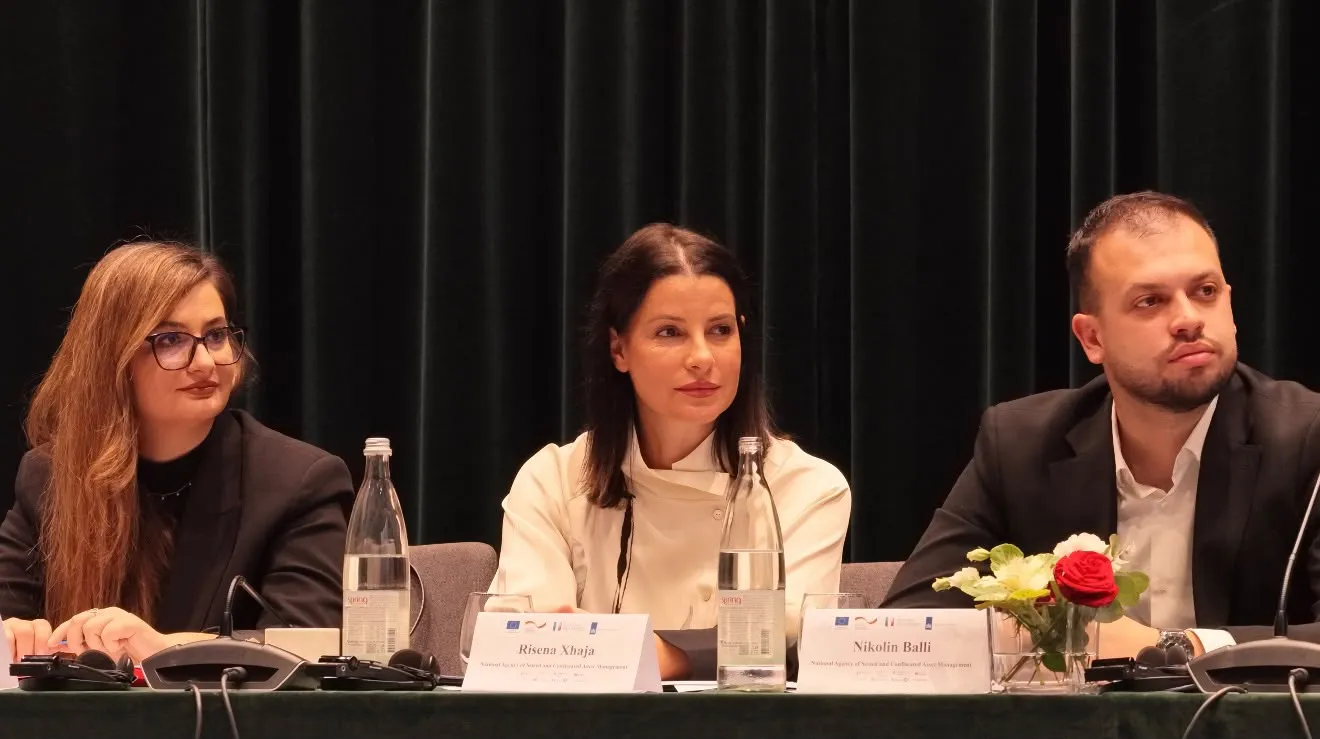
In this context, AAPSK participated in the Steering Committee Meeting of the regional project EU4FAST – “EU Support for Strengthening the Fight Against Migrant Smuggling and Human Trafficking in the Western Balkans,” held on November 12 in Tirana, with the participation of representatives from Albanian institutions, international partners, and project implementing organizations.
During the meeting, the progress of inter-institutional cooperation, the results achieved with EU4FAST support, as well as opportunities for further development of joint initiatives in the fight against organized crime were discussed.
In her speech, the Chief Administrator of AAPSK, Risena Xhaja, appreciated the support of international partners, emphasizing the importance of regional cooperation not only in combating criminal activity but also in managing the assets derived from it.
“EU4FAST represents an important initiative in strengthening institutional capacities and regional cooperation in the fight against migrant smuggling and human trafficking. In this context, special importance is also given to the economic dimension of the fight against crime, from tracking and seizing criminal assets to their confiscation, administration, and social reuse,” Xhaja stated.
One of the concrete results of AAPSK’s international cooperation is the signing of a Memorandum of Understanding with the counterpart institution of Bosnia and Herzegovina, FAZUOI, an initiative also supported by the EU4FAST project.
Another important moment of this partnership was the international conference “From Confiscation to Public Good,” held in Tirana on May 26, 2026, with the support of EU4FAST.
An important dimension of AAPSK’s engagement remains the promotion of the social reuse of confiscated assets, as an instrument that gives a direct impact to the fight against crime in society.
In this regard, international cooperation helps identify sustainable models that enable the use of these assets to support vulnerable groups, trafficking victims, and communities.
“This message takes on special importance also in the context of the fight against human trafficking, where the social reuse of confiscated assets can contribute to supporting victims, vulnerable groups, and communities,” emphasized the Chief Administrator of AAPSK.
According to her, international partnerships create opportunities to improve the way assets are managed and to increase their economic and social impact.
During her speech, Xhaja expressed gratitude to the European Union, the German Federal Government, the Italian Ministry of the Interior, the Ministry of Foreign Affairs of the Kingdom of the Netherlands, GIZ, and other implementing partners of the EU4FAST project.
She assessed that international support has created concrete opportunities to expand regional cooperation and strengthen relations with counterpart institutions.
