


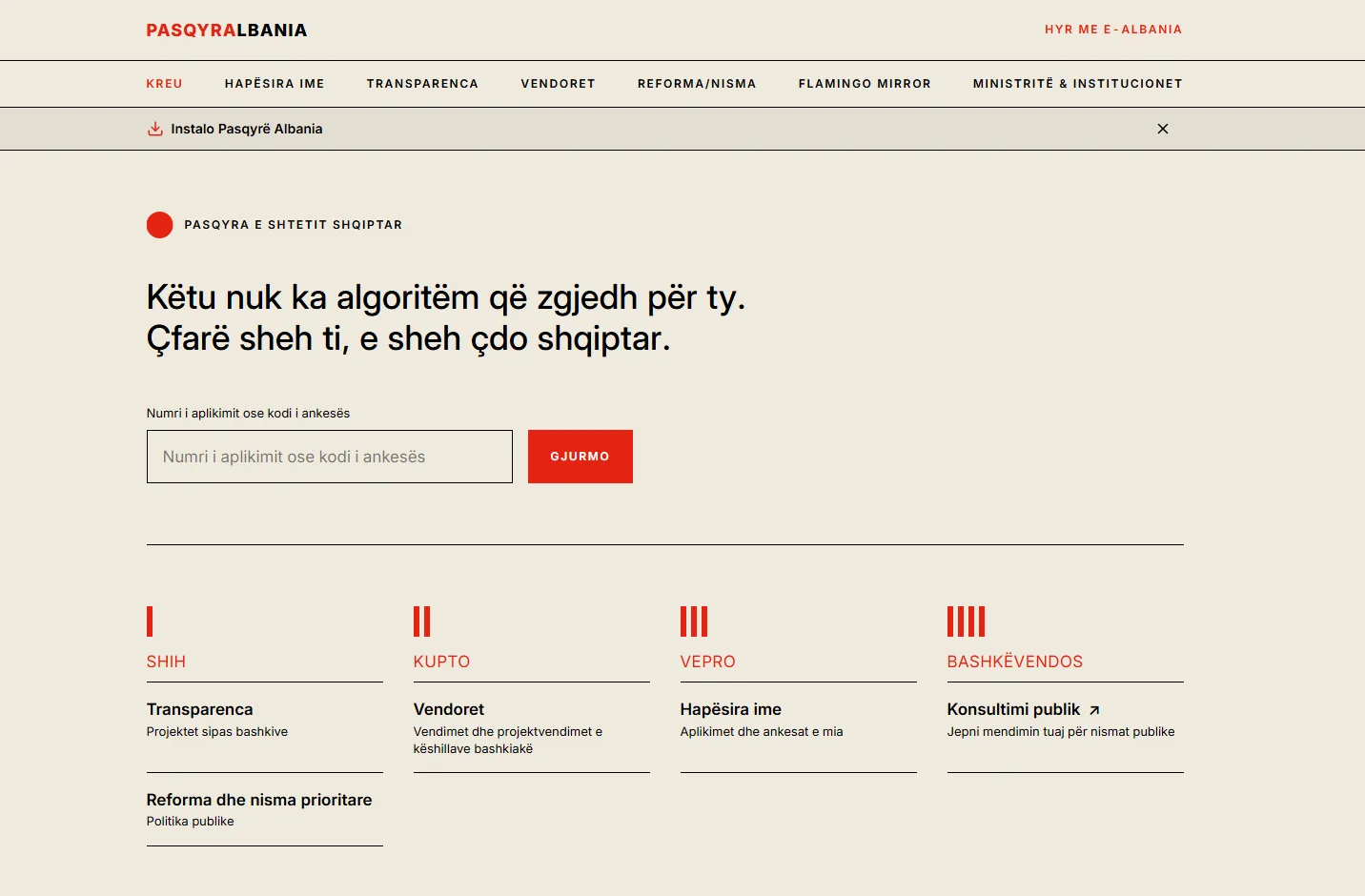
A new national platform for transparency and communication with citizens is planned to be created through amendments to the law “On Electronic Governance.” The proposed draft law aims to strengthen citizens’ and businesses’ access to public information, enable the monitoring of public projects, and create an electronic mechanism for tracking requests and complaints addressed to institutions.
The initiative foresees the addition of a special article to law no. 43/2023, through which the creation of the “Pasqyra Albania” platform is defined, conceived as a point of interaction between public authorities and citizens.
According to the draft law, the platform will interact with government systems through the government interoperability platform, as well as with other electronic systems of public authorities. In this way, users will have the opportunity to access public information and documentation, consult relevant documents, and track the progress of public projects.
Another planned functionality is the tracking and tracking of requests and complaints from citizens and private entities, in accordance with the deadlines set by the relevant legislation. This aims to create greater transparency regarding the handling of requests and communication with the administration.
The draft law also foresees that the platform may be expanded in the future with additional modules and functionalities, in line with its purpose. Development and maintenance will be carried out by the National Agency for Information Society (AKSHI), either directly or through information and communication technology operators.
Broader access for businesses and individuals to state databases
Another important change concerns the possibility for private natural and legal persons to access data from state databases, in accordance with the current legislation.
For this purpose, the draft law foresees that ICT systems and websites will be included within the scope of their respective responsibilities, as well as enabling the exposure of web services from databases, through which individuals and private entities can access primary data.
These interventions aim to create more structured opportunities for the private sector’s interaction with state databases, always according to the rules set out in the relevant legislation.
Inclusion of virtual infrastructure and cloud services
The changes also affect the technological infrastructure of electronic governance. The draft law expands the definition of infrastructure to include, alongside physical infrastructure, virtual infrastructure and cloud computing services.
Specifically, it is foreseen that the Government Data Center and the Work Continuity Center will include physical and virtual infrastructure, as well as cloud computing services, which are managed by AKSHI, either directly or through ICT operating companies.
In this way, the draft law aims to adapt the legal framework to technological developments and the expansion of the digital infrastructure of the public administration./ekofin.al
