


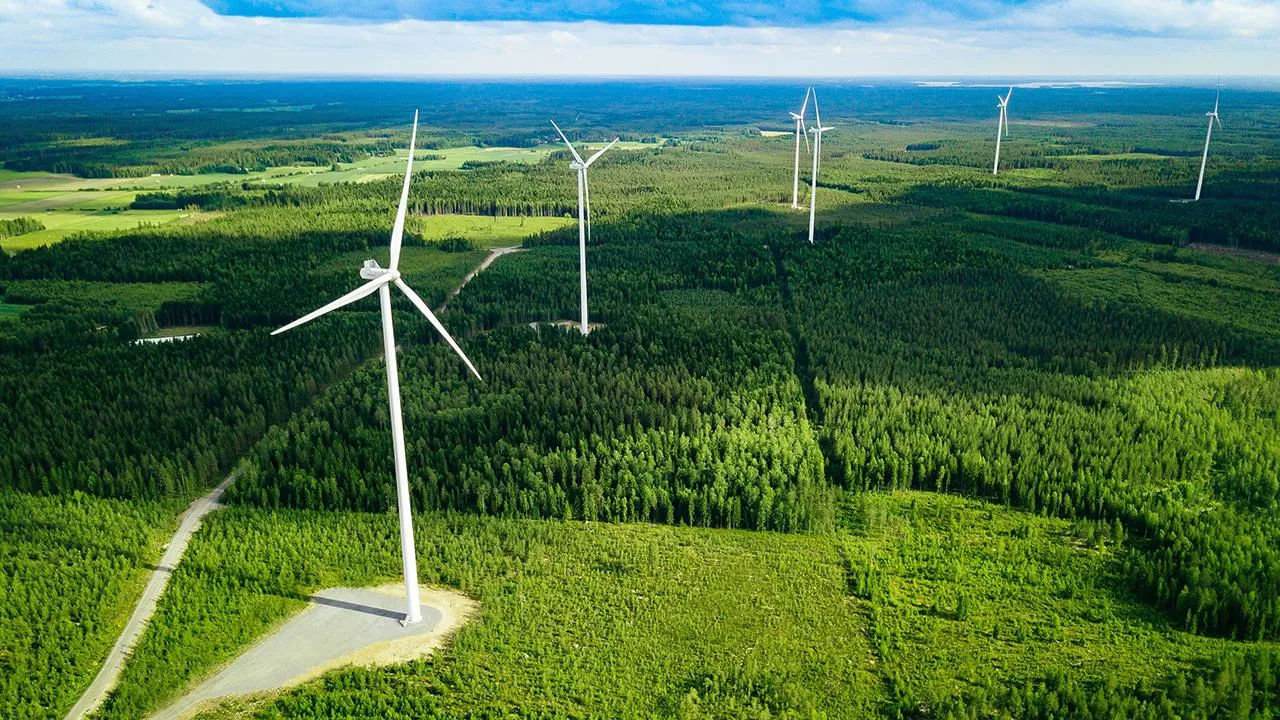
The rapid expansion of wind energy in Finland is creating an unusual situation in the electricity market: during periods when production exceeds demand, energy prices fall below zero, to the point where producers can pay to feed energy into the grid. Only during 2025, electricity was traded at below zero prices for 465 hours, while in 2024 this phenomenon was recorded for 724 hours.
The news agency Reuters reported that installed wind energy capacities in Finland have nearly tripled within four years, from 3,257 megawatts (MW) in 2021 to 9,433 MW by the end of 2025. Meanwhile, the number of hours when the energy price has dropped below zero has increased significantly, from just five hours in 2021 to hundreds of hours over the past two years.
According to the 2025 annual report of the wind energy program at the International Energy Agency (IEA Wind TCP), just last year Finland added 1,023 MW of new capacity through the installation of 158 turbines. In total, the country counts 2,002 turbines, while wind production reached a record 22 terawatt-hours (TWh), covering 26.1% of the national electricity demand.
Wind energy has become the second largest source of electricity production in Finland, after nuclear power. Wind production increased by about 9% compared to 2024, while almost all installed capacities are located on land.
How can the price of energy fall below zero?
The phenomenon occurs when electricity production exceeds demand and the market cannot absorb the entire amount produced. During periods of strong winds, turbines produce large amounts of energy, while consumption can be relatively low, especially at night or on days with mild temperatures.
Under these conditions, the wholesale market price could fall below zero. This means that some producers agree to pay for the energy they feed into the grid instead of stopping production. In international markets, this phenomenon is known as negative energy prices.
A specific case was recorded on May 24, 2026, when, according to the Finnish public broadcaster Yle, the energy price remained below zero for seven hours, reaching a low level of minus 0.96 euro cents per kilowatt-hour (kWh). The decline came amid mild temperatures and strong winds, which increased production from turbines.
However, a below-zero price in the wholesale market does not automatically mean free energy for all consumers. Households with contracts linked to exchange prices can directly benefit from these reductions but continue to pay network fees and taxes. Meanwhile, consumers with fixed-price contracts do not immediately benefit from market fluctuations.
According to Yle, more than one-third of Finnish families have contracts where the energy price varies according to the market.
Finland led Europe in below-zero hours
The International Energy Agency’s 2026 Electricity report highlights that Finland was the European country with the highest percentage of hours when the energy price fell below zero during 2024.
In about 8% of the time, electricity in the wholesale market traded below zero, while Sweden ranked behind it at around 7%.
However, during 2025 the phenomenon eased. The number of hours with below-zero prices fell from 724 to 465, a decrease of about 36%, despite wind energy capacities continuing to expand.
Although hours with below-zero prices decreased, the average electricity price in the day-ahead market fell from 46.1 euros/MWh in 2024 to 40.8 euros/MWh in 2025, according to Electricity Maps data. This represents a decrease of about 11.5%.
Batteries, the solution to save energy when production is high
The increase in wind production is creating a new challenge for energy companies: how to store energy during periods when production is high and prices fall below zero, to use or sell it later when demand and prices rise.
This phenomenon is driving investments in battery energy storage systems. On February 25, 2026, the Norwegian company Statkraft and the Swedish developer OX2 announced a seven-year agreement for two large battery systems in western Finland, with capacities of 110 MW and 125 MW respectively.
Both systems will have a combined storage capacity of 470 megawatt-hours (MWh) and are expected to start operating in 2028. They will be located near two wind farms, utilizing the shared connection to the power grid. /ekofin.al
