


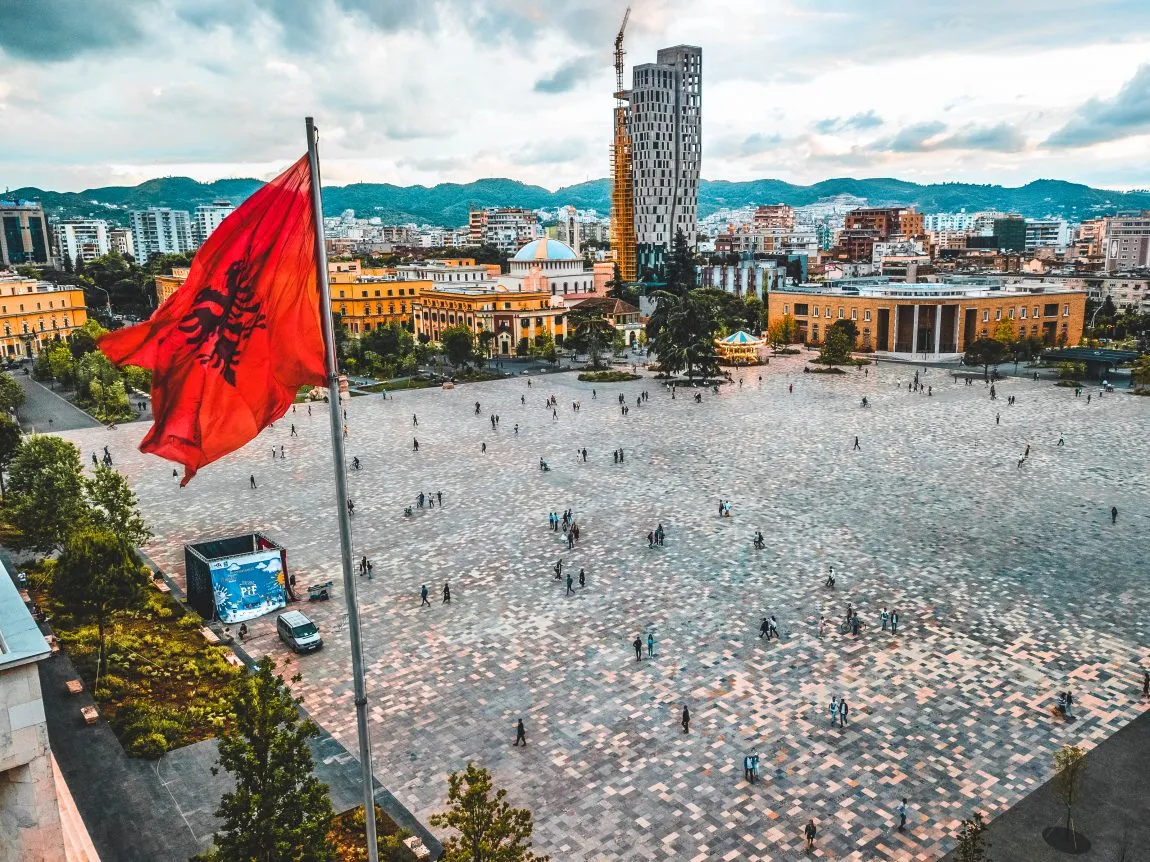
Tirana continues to deepen its weight in the Albanian economy, generating almost half of the country’s Gross Domestic Product. On the other hand, the counties of Kukës, Dibër, and Berat remain significantly below the national average for economic output per capita, highlighting large disparities in economic development between regions.
Data published by INSTAT for 2024 show that Albania’s Gross Domestic Product (GDP) reached 2.517 billion lek at current prices, with a real increase of 4.03% compared to 2023.
But the distribution of this growth indicates a strong economic concentration in the capital. Tirana County contributed 3.24 percentage points to the country’s economic growth, out of a total of 4.03 percentage points. Following it are Durrës with 0.29 percentage points and Vlorë with 0.15 percentage points.
In terms of value produced, Tirana generated 1.181 billion lek in GDP, or 46.94% of the national economy. Compared to 2023, its share in GDP increased from 45.75% to 46.94%, confirming the further strengthening of the capital’s economic role.
The center of the country holds more than half of the economy
The breakdown by statistical regions shows that the Central Region, which includes Tirana and Elbasan, achieved 52.87% of the national GDP in 2024. This region also recorded the highest real growth, at 6.43%.
Meanwhile, the Northern Region contributed 21.68% to the economy and had a real growth of only 1.60%. The Southern Region accounted for 25.45% of GDP, with an increase of 1.31%.
These figures show that economic growth has not been evenly distributed across the territory. While the Center has increased its weight in the national economy, the North and South have lost relative shares compared to 2023.
Tirana leads in GDP per capita, Kukësi at the bottom of the ranking
The differences become even more noticeable when the economy is measured per capita. According to INSTAT, GDP per capita in Albania reached 1,059 thousand lek in 2024.
Tirana recorded the highest level, with 1,556 thousand lek per capita, about 47% above the national average. Following it are Durrës with 1,152 thousand lek, while Fier with 1,034 thousand lek.
At the other end stands Kukës, with only 568 thousand lek GDP per capita, or 46.32% less than the national average. Dibra recorded 610 thousand lek, 42.38% below the average, while Berat 613 thousand lek, 42.15% less.
Other districts also remain significantly below the average. Elbasan recorded 652 thousand lek per capita, Korça 686 thousand lek, Lezha 723 thousand lek, and Shkodra 777 thousand lek.
Another significant indicator is that only Tirana and Durrës are above the national average for GDP per capita, while all other counties are below it.
The Southern economy relies more on agriculture, while Tirana relies more on services
The structure of the economy by branches also reflects differences in the regional development model.
At the national level, trade, transport, accommodation, and food service account for 21.82% of the gross value added, being the largest group of economic activities. Following them are agriculture, forestry, and fishing with 17.68%, construction with 14.11%, and public administration, education, and health with 13.10%.
In Tirana, the economy has a different profile from the rest of the country. Trade, transport, accommodation, and food service account for 25.29% of the district’s gross value added, while public administration, education, and healthcare account for 17.24%. Construction contributes 17.17%.
In contrast, agriculture has a very low share in the capital’s economy, only 1.68%.
In the Southern Region, agriculture, forestry, and fishing account for 38.93% of the gross value added. The share of this sector is particularly high in Berat, at 47.72%, and in Fier, at 45.59%. In Korçë, agriculture also accounts for 39.05% of the regional economy.
In the North, agriculture accounts for 22.73% of the gross value added, while trade, transport, accommodation, and food service account for 22.17%./ekofin.al
