


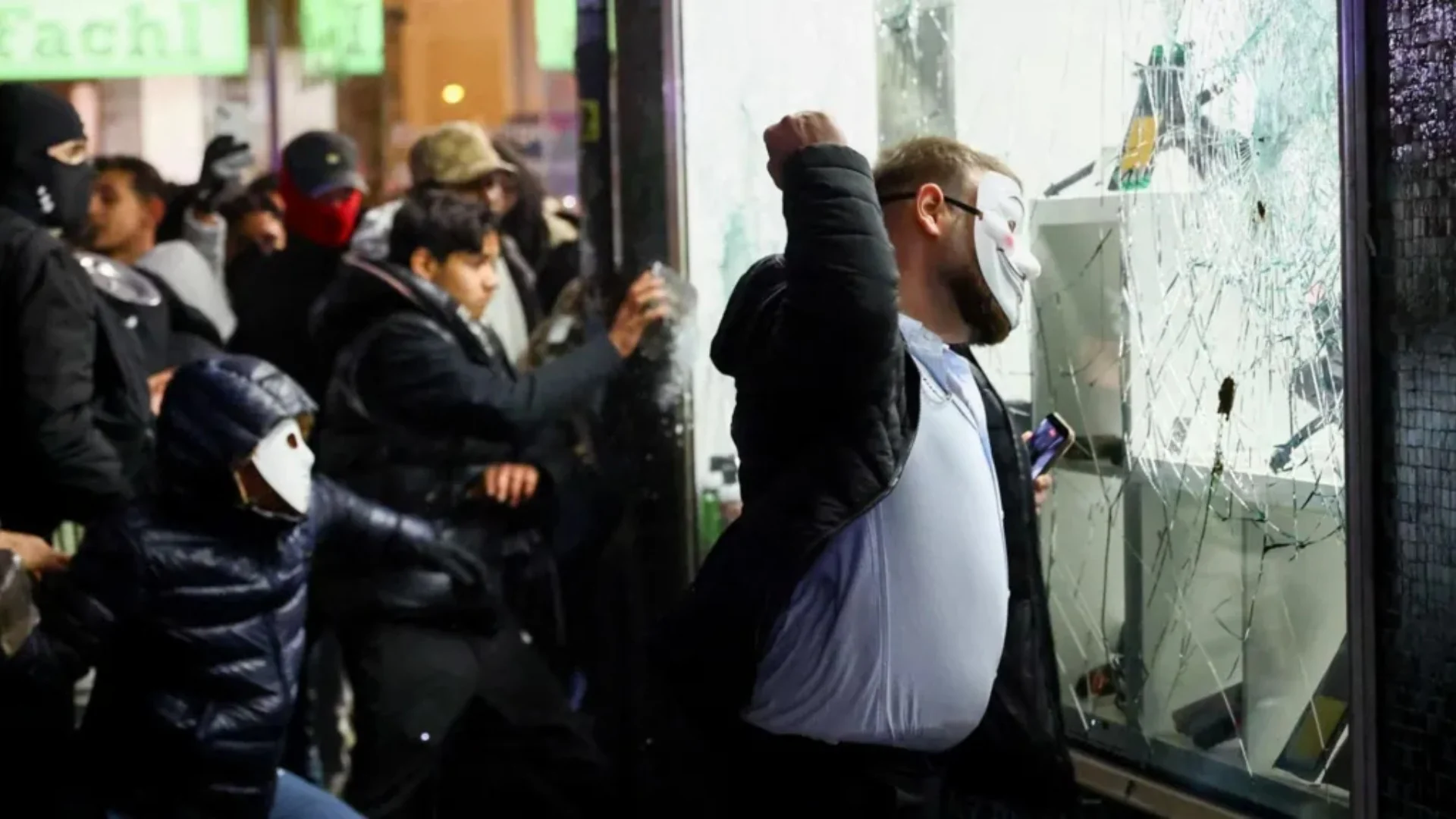
Protests against the rising cost of living in Germany ended in violent incidents, as groups of protesters looted stores and clashed with police in several cities across the country.
The most serious incidents were recorded on Saturday evening in Frankfurt, Germany’s financial center. Besides Frankfurt, clashes and acts of violence were also reported in Berlin, Cologne, and Hamburg. The police announced that they used water cannons to disperse protesters, who attacked law enforcement and emergency services with fireworks, stones, and bottles.
Thousands of citizens participated during the day in demonstrations, which were initially mostly peaceful. The protests were organized by the activist group Gen Z regelt, which translates to “Generation Z takes the lead,” and focused on insufficient school funding, rising living costs, cuts in public spending, and mandatory military service.
As night fell, the situation got out of control. In Frankfurt, police blocked a large part of the main shopping street after several shops were attacked and their windows were broken. According to the AFP agency, the police made a significant number of arrests.
Authorities in Frankfurt, Munich, and Berlin reported up to 18,000 protest participants, roughly half the number the organizers had anticipated. However, German media reported that in several cities across the country, tens of thousands of citizens took to the streets.
The spokesperson for the Gen Z regel group, Lina Friedrich, stated that the demonstrations aimed to defend peace and freedom, not to support war or coercion.
“For us, the most important thing is better support for the health and education systems. We are against mandatory military service and in favor of a fairer distribution of the financial burden,” she stated.
In a statement on social network X, the Frankfurt police confirmed that “violent riots” were taking place in the city center. According to authorities, some shops had their windows broken, and Molotov cocktails were also thrown at emergency services. In later updates, the police announced that a gun store had also been attacked, where the display windows were broken. After the arrest of a suspect, the authorities seized two weapons.
The Interior Minister of the state of Hesse, Roman Poseck, stated that around 100 left-wing extremists infiltrated the Frankfurt protest, who, according to him, were clearly identified. He described the violent developments as shameful and warned against the repetition of scenes similar to those in France.
Protests are spreading across Europe
On the same day, massive protests were also held in France, where over 320,000 people participated in demonstrations in various cities across the country. This was the third consecutive weekend of protests, mostly peaceful, against the high cost of living and the weakening of public services, especially in education. French authorities deployed thousands of police officers to manage the situation. Tear gas was used in several cities, while after clashes in Toulouse, Lyon, and Marseille, over 500 arrests were made.
French Interior Minister Laurent Nunez announced that a police officer was injured by a Molotov cocktail. Meanwhile, police in Paris reported that several hundred violent protesters had attacked security forces with blunt objects. Protests and clashes were also recorded in Italy, Rome, and Turin. In Portugal, police intervened to disperse a tented camp after a march where thousands of citizens opposed a rent bill, which they claim could worsen the housing crisis.
Young people on the streets against the economic crisis and cuts
In recent weeks, young people have taken to the streets in protests in several European countries, including France, Belgium, Ireland, Spain, Portugal, Italy, Greece, Serbia, and Albania. Although demands vary from one country to another, the main concerns relate to the rising cost of living, difficulties in securing housing, the quality of education, and cuts in public services.
Recent movements show that social discontent is becoming an increasingly important issue for younger generations in Europe. /Top Channel
