


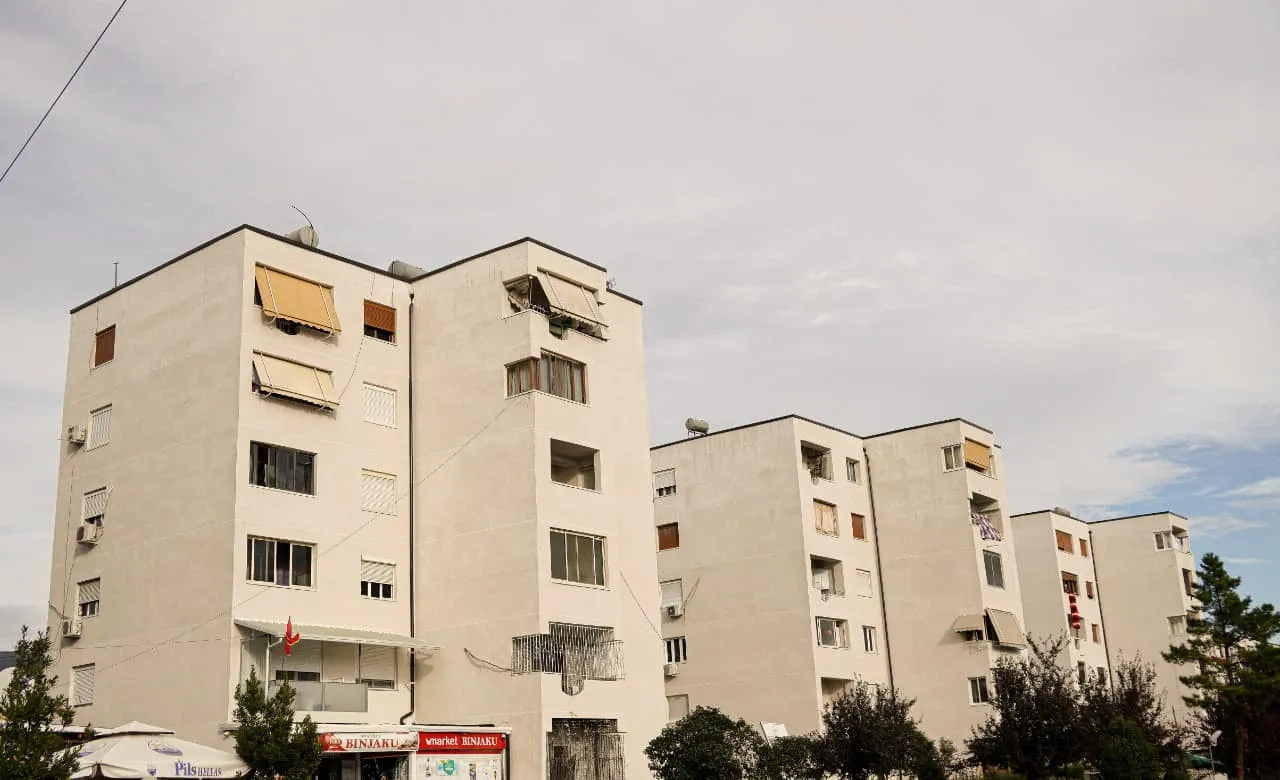
Albania ranks among the European countries where housing costs have the lowest share in household incomes, according to Eurostat data for 2025. Only 2.6% of the Albanian population lives in households that spend more than 40% of their disposable income on housing, a level almost three times lower than the European Union average of 7.7%.
With this indicator, Albania ranks second to last among the 34 European countries included in the comparison, ahead of only Cyprus, where this percentage is 2.4%. The result places our country ahead of all other Western Balkan economies in terms of the percentage of the population facing a high financial burden from housing costs.
According to Eurostat methodology, a family is considered to be overburdened by housing costs when housing expenses exceed 40% of disposable income, after deducting taxes and social contributions.
These expenses include rent or mortgage loan interest, electricity, water, gas, and heating bills, as well as maintenance, repairs, insurance, and taxes related to the residence.

In absolute terms, the data show that around 61,000 people in Albania live in households where housing costs exceed the threshold of 40% of income. This figure is significantly lower compared to other countries in the region, where Serbia counts about 519,000 people, North Macedonia 102,000, and Montenegro 54,000.
Even in comparison with European Union countries, Albania shows a significantly lower indicator. In Greece, which leads the European ranking, 26.4% of the population spends over 40% of their income on housing, or more than ten times the level recorded in Albania.
In Germany, this percentage reaches 11.2%, in Sweden 10.8%, in Spain 7.2%, in France 6.4%, and in Italy 5%.
The differences become even more pronounced when analyzing families at risk of poverty.
According to Eurostat, only 8.2% of people at risk of poverty in Albania live in households that spend over 40% of their disposable income on housing. This is the second lowest rate in Europe, after Cyprus at 7.6%, and well below the European Union average of 29.1%.
In Greece, the situation is completely different, as 82.6% of people at risk of poverty face such a financial burden. In Denmark, this percentage reaches 59.8%, in Switzerland 56.1%, in Germany 35%, while in Italy 21.7%.
This means that, according to Eurostat’s statistical indicator, even Albanian families with low incomes are less exposed to overload from housing costs than families in the same category in the vast majority of European countries.

However, a low level of this indicator does not necessarily mean that housing in Albania is more affordable to buy or that citizens have fewer difficulties securing a home.
The indicator measures the ratio between housing expenses and disposable income, not directly the price of apartments in relation to wages or the ability of young families to enter the property market.
In interpreting the data for Albania, the structure of housing ownership must also be taken into account, where a considerable portion of families live in houses they own, often without monthly obligations for rent or mortgage loans. This may influence the reduction of the share of housing expenses in household budgets, although the data presented do not specify how much of the difference with other countries is explained by this factor.
On the other hand, the rise in apartment prices, especially in Tirana and coastal areas, as well as rental costs, remain important issues for families looking to buy or rent a home.
At the European level, the housing crisis has deepened over the past decade. According to Eurostat, housing prices in the European Union increased on average by 69% from 2015 until the second quarter of 2026. In some member states, prices have more than doubled, while rents and energy costs have risen simultaneously.
Currently, over 34 million European Union citizens live in households that spend more than 40% of their disposable income on housing. Germany has the highest number of affected people, with around 9.4 million, followed by France with 4.4 million, Spain with 3.5 million, and Italy with 2.9 million.

For Albania, the data highlight a significant contrast: while the country ranks among the European economies with the lowest percentage of citizens spending over 40% of their income on housing, this does not exclude the difficulties faced by young families and homeless individuals in coping with market prices.
Consequently, the Eurostat indicator provides an overview of the current burden of housing expenses on families, but it alone is not sufficient to assess the affordability of buying a home in Albania. /Adapted from Euronews, ekofin.al
