


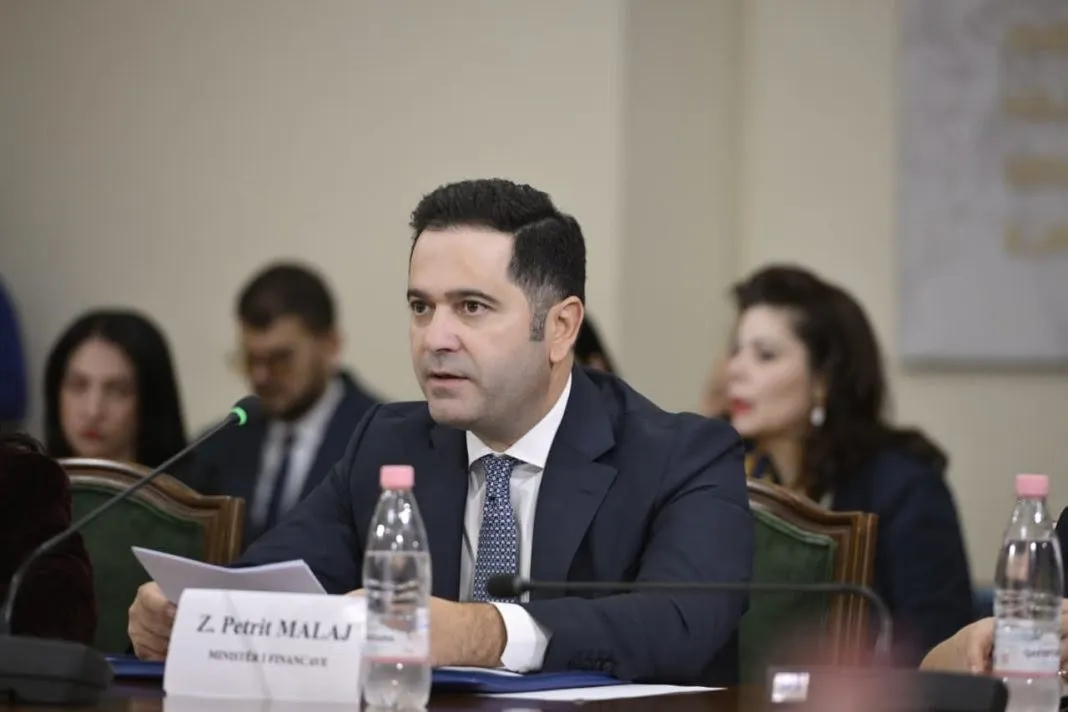
The Minister of Finance, Petrit Malaj, defended the proposed changes to the 2027 Fiscal Package in the Parliamentary Committee on Economy, stating that their effect on the state budget will be neutral and that these are not tax increases, but rather a redistribution of the fiscal burden. However, this statement contradicts the financial effects presented in the accompanying reports of the draft laws of the Fiscal Package itself, where the additional revenues projected from the tax changes turn out to be higher than the proposed reliefs.
During the presentation to the commission, Malaj emphasized that the principle on which the package is built is income redistribution, aiming to protect vulnerable groups and support the middle class.
“We do not have a tax increase, but a redistribution of taxes,” the minister declared, responding to criticism from business representatives and economic organizations, who have warned that the changes will bring a higher fiscal burden.
But beyond political statements, the official documentation accompanying the draft laws presents a different picture.
The increase of the dividend tax from 8% to 15%, the increase of the profit tax from 15% to 17%, the increase of the standard VAT rate from 20% to 21%, as well as the expansion of the taxpayer base by lowering the VAT registration threshold from 10 million to 5 million lek, are measures aimed at generating additional revenue for the budget.
On the other hand, the proposed reliefs include reducing VAT on basic food products from 20% to 6%, changes to personal income tax, and removing the circulation tax from fuel prices, transferring it to the annual vehicle tax.
According to the minister, the revenues generated from the increase in dividend tax will be used to finance the relief of the payroll tax.
“The increase in the dividend tax and the money coming from this increase will be passed on and distributed through the increase of the salary bracket, which we have raised from 200,000 to 300,000 lek,” Malaj explained.
The minister also argued that reducing VAT on basic products creates a higher budget cost than the revenues generated by increasing the standard VAT rate by one percentage point.
According to him, the negative difference created by these two measures is about 20 million euros, which will be compensated by lowering the VAT registration threshold from 10 million to 5 million lek.
Malaj stated that this measure has been continuously requested by international institutions, including the International Monetary Fund, arguing that Albania currently has one of the highest VAT registration thresholds.
Another negative effect on the budget, according to the minister, will come from changing the method of collecting the circulation tax, which will be removed from the fuel price and transferred to motor vehicles.
Malaj admitted that the government has not transferred all the revenue it generated from the 27 lek per liter of fuel tax to the annual vehicle tax.
“The deficit in this case is about 5 billion lek or 50 million euros,” he declared.
In conclusion, the minister insisted that the overall balance of the Fiscal Package is practically neutral.
“If we add up and subtract all these policies one after another, the effect is zero or minus 300 million lek for the state budget,” said Malaj.
He added that the only additional revenue for the budget will come from the increase in tobacco excise, as part of harmonizing with European Union levels.
However, this is precisely where the discrepancy arises between the minister’s statements and the fiscal effects presented in the package documentation. The draft law reports foresee additional revenues from a series of measures, while the fiscal reliefs have their respective costs. If, as shown by comparing these forecasts, the additional revenues exceed the reliefs, then the package cannot be considered neutral without a full reconciliation of all effects.
Furthermore, the statement that there is no tax increase does not align with the very content of the draft laws, which foresee direct increases in certain tax rates. Even if part of the collected revenues is used to finance reliefs for other categories, this does not change the fact that for businesses and individuals affected by the new rates, tax liabilities increase.
This is also one of the main reasons for the objections from business organizations, including the American Chamber of Commerce, the Union of Albanian Producers, and Confindustria Albania, which have called for a full analysis of the economic impact and consultation before approving the changes.
The debate over the 2027 Fiscal Package, in this way, is not limited only to whether the government is redistributing the tax burden among different categories, but also to the transparency of its final balance. /ekofin.al
