


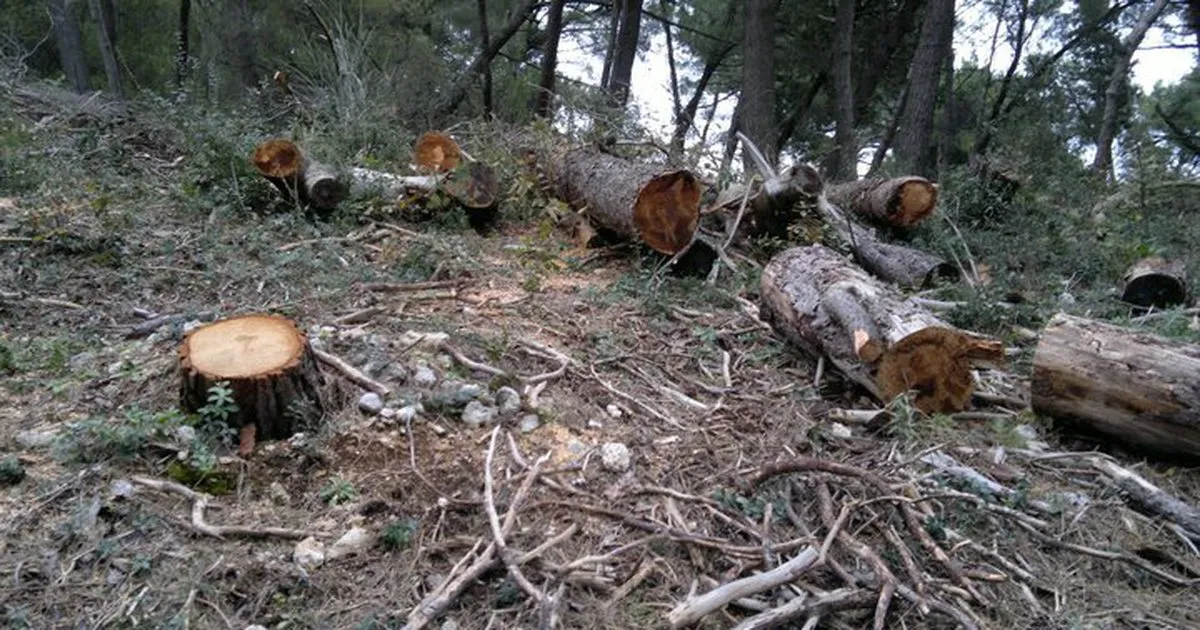
Albania continues to face high informality in the firewood market, degradation of forest areas, and significant dependence on timber imports. A report from the Ministry of Environment, submitted to the United Nations Economic Commission for Europe (UNECE), highlights that up to 90% of the firewood market is estimated to operate informally, while about 71% of forest areas consist of degraded forests, coppices, or low shrubs.
The document, held by ekofin.al and submitted on October 23, 2026, was prepared for the 84th session of the UNECE Forestry and Forestry Committee, which will take place from November 4 to 6, 2026. It analyzes the sector’s developments over the years 2025–2026 and the outlook for 2027.
The report highlights a significant contradiction: although Albania has had a moratorium on logging since 2016, the sector continues to face informality, difficulties in tracking timber, and structural problems that hinder the development of the processing industry.
Up to 90% of the firewood market outside the formal market
One of the most concerning findings of the document relates to informality in the firewood market.
Referring to a sectoral study prepared for rural development in Albania, the report emphasizes that 80–90% of the firewood market is estimated to be informal.
This market remains especially important for the rural economy, where many families continue to use wood as the main energy source for heating, cooking, and other household needs.
According to the cited data, the average consumption of families using wood reaches 5.36 cubic meters per year, while for families relying exclusively on wood as an energy source, consumption rises to 6.4 cubic meters.
The report also highlights that, according to the local authorities involved in the study, the demand for firewood is higher than the quantity that can be legally and sustainably obtained from the forests.
This situation creates pressure on the forest fund and complicates the control of the origin of the timber traded in the country.
It should be emphasized that the assessment of informality is based on a 2021 study, cited by the Ministry in the 2026 report, and does not represent a new market measurement for this year.
About 71% of forest areas are degraded or have low timber potential
According to the report, Albania’s national forest and pasture fund includes 1,731,891 hectares, based on INSTAT data for 2025.
However, a considerable surface area does not necessarily translate into high timber wealth.
The Ministry of Environment notes that about 71% of the forested areas consist of coppices, highly degraded zones, or low shrubs, while the volume of standing timber remains low.
The document emphasizes that, since the 2000s, Albania has lost about 100,000 hectares of forest due to intensive logging, landslides, erosion, overgrazing, and the use of firewood for heating.
According to the report, these processes have exceeded the natural rate of forest growth, leading to a reduction in timber reserves and a deterioration in their quality.
The consequences are not limited only to the forest economy. Forest degradation increases the risk of flooding, reduces soil fertility, erosion, and causes loss of biodiversity.
The moratorium reduced recorded violations but did not solve market problems
The report assesses that the moratorium imposed in February 2016 has positively influenced the strengthening of formal control and the preservation of forests.
According to the cited data, the number of administrative offenses registered in the forest fund has decreased from 443 in 2015 to only 2 in 2024.
However, the decrease in administratively recorded violations is not necessarily an indicator of the disappearance of illegal exploitation.
The document itself admits that enforcement of the rules remains weak in some links and that the timber traceability system is still underdeveloped.
Currently, Albania does not have a unified national system that would enable the tracking of timber from the moment of cutting until the final sale.
Most operators continue to keep paper registers that are not integrated with national databases.
This makes it more difficult to verify the origin of the wood, its legality, and its movement along the supply chain.
The furniture industry, over 90% of basic materials come from imports
Another identified problem relates to the manufacturing industry’s dependence on imports.
According to the report, over 90% of raw materials and wood-based panels used in the domestic furniture industry are imported.
Limitations in domestic supply, poor forest infrastructure, and lack of modern technology have caused a significant portion of small and medium enterprises to rely on semi-processed materials from abroad.
In 2023 alone, Albania imported about 26.86 million dollars worth of sawn timber, according to World Bank data cited in the report.
The main suppliers were Montenegro, with 8.36 million dollars, Bosnia and Herzegovina, with 7.87 million dollars, as well as Finland, with 2.35 million dollars.
On the other hand, about 70% of Albanian furniture exports are directed to the Italian market, indicating a high concentration of sales in a single destination.
This creates a situation where the Albanian industry imports the vast majority of the materials needed for production, while relying mainly on a foreign market for its exports.
Up to 30% of usable timber is lost before processing
The report also highlights serious problems of economic efficiency in the supply chain.
Due to inadequate forest infrastructure, lack of modern machinery, and high reliance on manual labor, it is estimated that 25–30% of the usable wood volume is lost before reaching the processing saws.
Narrow and worn-out forest roads increase transportation costs, while outdated equipment limits business productivity.
This translates into higher costs for the domestic industry and lower competitiveness against foreign producers.
The report also highlights that Albania currently does not have domestic industrial capacities for pulp and paper production, relying entirely on imports of these products, including cardboard and packaging materials.
The carbon market, an opportunity still in its early stages
Beyond the problems of the forestry sector, the document also addresses the perspective of developing the carbon market.
Albania aims to participate in voluntary cooperation mechanisms under Article 6 of the Paris Agreement and to sell carbon credits by 2035.
Additionally, an emissions trading system is under development, which aims to align with European Union standards.
However, the report classifies the Albanian carbon market framework as still in the early stages of development.
Forests under municipal administration, the management challenge remains
Another important element relates to the management of the forest fund.
According to the document, only 3% of forest land is privately owned. Of the publicly administered area, 77% falls under the jurisdiction of municipalities and 20% is included in protected zones.
This places local government in a key role in forest management and protection.
However, the report highlights that the decentralization of forest management, accompanied by frequent administrative restructurings and institutional difficulties, has not succeeded in eliminating the problems of uncontrolled resource exploitation. /ekofin.al
