


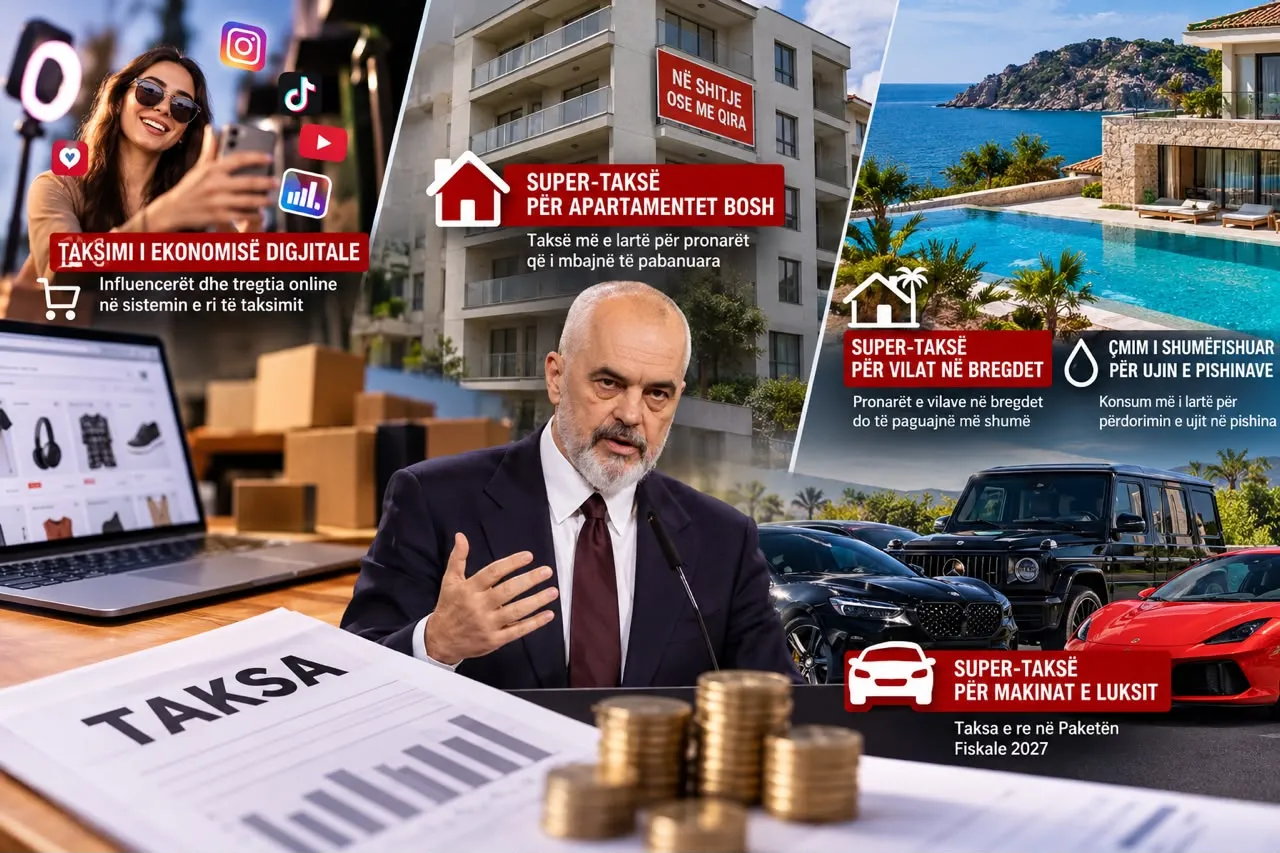
The government is preparing a new taxation system for the digital economy, which will include revenues generated from social networks and online trade. At the same time, higher taxes are planned for vacant apartments, coastal villas, and luxury vehicles, as well as multiplied fees for pool water consumption.
Prime Minister Edi Rama has announced another package of fiscal interventions, which aims to broaden the taxpayer base and impose a higher tax burden on individuals who earn significant income from digital activities or own expensive assets.
In his statement on fiscal changes, Rama announced that the Ministry of Finance is preparing a special project for taxing the digital economy, starting with individuals who generate income through social networks and continuing with genuine e-commerce activities.
“The time has come for a new taxation system for the digital economy, starting with those who live quite well, and I am very happy about this, with likes and followers, and continuing with genuine digital commerce,” declared the Prime Minister.
This initiative is expected to particularly affect content creators on social networks, known as influencers, who generate income from advertisements, commercial collaborations, product and service promotion, as well as other forms of monetizing their audience.
Online commerce will also be a focus, an economic activity that has expanded significantly with the development of digital platforms and the increasing use of social networks to sell products and services.
However, the Prime Minister did not provide details about possible tax rates, income thresholds, or how these activities will be identified and declared. These elements are expected to be defined in the project being prepared by the Ministry of Finance.
Super-tax on apartments that are kept empty
Another announced intervention concerns the real estate market, where the government aims to impose a higher tax on owners who buy apartments and keep them unoccupied without offering them for rent.
According to Rama, keeping an empty apartment is a right of the owner, but this choice should be accompanied by a higher fiscal obligation.
“A super property tax for those who buy and keep empty apartments, refusing to rent them out. It is their right, but they have to pay,” he said.
The Prime Minister referred to the practices of several European countries that have implemented similar measures to cope with the rising cost of housing.
Such a tax could aim to encourage owners to put apartments on the rental market, increasing the supply of available housing.
However, the criteria on which an apartment will be considered empty, the minimum non-use period, or the level of tax to be applied have not yet been made public.
Villas on the coast will be taxed more, and water for swimming pools will also become more expensive.
The new fiscal interventions will also include luxury properties in coastal areas.
Rama warned of the imposition of a super-tax on villas on the coast, arguing that the owners of these properties should contribute more through the fiscal system.
At the same time, the government aims to set a multiplied price for the water used for swimming pools.
This measure would create differentiated treatment of water consumption for luxury needs compared to regular household consumption.
For these changes as well, the specific norms, calculation methods, or categories of properties subject to additional obligations have not yet been determined.
According to the Prime Minister’s statement, the taxation of empty apartments and villas on the coast will be addressed through another legislative initiative.
Super tax also on luxury cars
Unlike the measures planned for property, a new tax on luxury vehicles is expected to be directly included in the 2027 Fiscal Package.
The Prime Minister confirmed that the government aims to increase the tax burden for this category of vehicles, but without specifying the tax level or the criteria that will be used to classify a vehicle as luxury.
For this reason, it remains to be clarified whether the new tax will be based on the vehicle’s value, technical characteristics, year of manufacture, or a combination of these indicators.
Redistribution of the fiscal burden, the government’s argument
The Prime Minister presented these measures as part of a broader fiscal policy aimed at redistributing the tax burden and supporting categories facing greater difficulties due to the rising cost of living.
According to him, rapid economic development also creates differences in income and wealth, which the government aims to narrow through fiscal instruments.
The announced interventions indicate a shift towards higher taxation of luxury assets, unused properties, and economic activities carried out in the digital space.
However, some of these measures are still in the preparation phase and have not been accompanied by draft laws or published assessments of fiscal effects. /ekofin.al
