


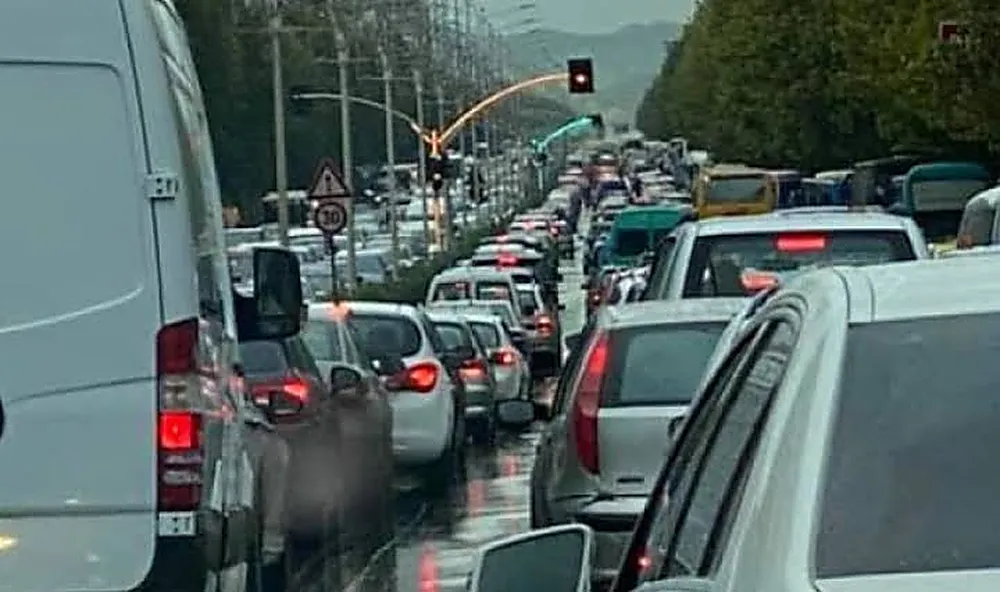
Tirana concentrates about 35% of active road vehicles in Albania, while the number of vehicles registered in the capital remains high. However, the Municipality does not conduct periodic traffic measurements across the entire road network and there are no documented studies on traffic management. The Supreme State Audit notes that, despite the congested roads, traffic management mainly relies on operational interventions at traffic lights, without complete and updated analyses of vehicle movement.
According to the performance audit report for the period 2023–2025, the Municipality of Tirana does not carry out systematic traffic measurements at the level of the entire road network it manages. In official responses to auditors, the institution clarified that measurements are only carried out when problems are identified at specific road junctions, with the aim of finding solutions for them.
In practice, traffic is managed through traffic light operation plans, which are adjusted according to time slots and the situation at intersections. According to the Municipality, peak hours are 07:00–09:00 in the morning, 12:00–13:00 at noon, and 16:00–19:00 in the afternoon. Management is carried out through the traffic light control system, camera footage, and communication with the State Police, but these interventions are not accompanied by documented analyses for the entire road network.
According to the report, the deficiency is the absence of an Urban Traffic Plan, drafted and approved as a separate document. The municipality considers traffic planning as part of the General Local Plan and the Sustainable Urban Mobility Plan, while the Supreme State Audit emphasizes the need for a special technical document that includes traffic organization, parking, public transport, pedestrian and bicycle movement, as well as an analysis of the road network.
Why is traffic getting heavier in Tirana?
The report identifies several factors influencing traffic congestion, starting with the high concentration of vehicles. According to data from DPSHTRR, cited by the Supreme State Audit (KLSH), about 35% of active vehicles in Albania are located in Tirana County. Only during 2025, around 41% of the total new vehicles in the country were registered in this county.
Pressure on roads is also related to residents’ dependence on private cars. According to the European Commission study “Quality of Life in European Cities 2023,” referenced by the Supreme State Audit Institution (KLSH), over 55% of Tirana’s residents use their car as their primary means of daily commuting. Conversely, only 22% use public transport on a typical day, ranking Tirana 82nd among 83 cities included in the study.
Also, another factor is rapid urban development. According to the planning documents cited in the audit, the expansion of the outskirts, informal urbanization, and the lack of adequate infrastructure have created weak transport connections with the center. This has increased the need for daily travel and has increased the burden on the city’s main roads.
The situation is also affected by insufficient infrastructure for public transport. The Supreme State Audit (KLSH) notes that only 8.8 kilometers of roads, or 11% of the length of main urban roads, have dedicated lanes for buses. For comparison, the BRT rapid transit project foresees covering 31.9 kilometers, or 39.8% of this network.
The lack of lanes causes buses to operate in general traffic, while their stops at stations may create additional obstacles for other vehicles. According to auditors, this situation reduces the speed of public transport and citizens’ trust in this service, limiting the possibility for urban buses to serve as an alternative to private cars.
The problematic traffic monitoring system as well
Besides the lack of studies, the Supreme State Audit (KLSH) highlights deficiencies in the operation of the technological system used to monitor turnover.
Verification carried out on July 1, 2026, showed that 40 out of 71 installed cameras, or 56.3%, were not transmitting footage. For 11 of them, the broadcast interruption lasted from 2 to 7 years.
The audit also found that the central platform for displaying footage was not fully functional, while the electronic devices intended to inform vehicle drivers about road conditions were not in use.
For this reason, KLSH recommends drafting the Urban Traffic Plan and periodically conducting measurements and analyses of traffic throughout the road network under the Municipality’s administration by 2027. /ekofin.al
