


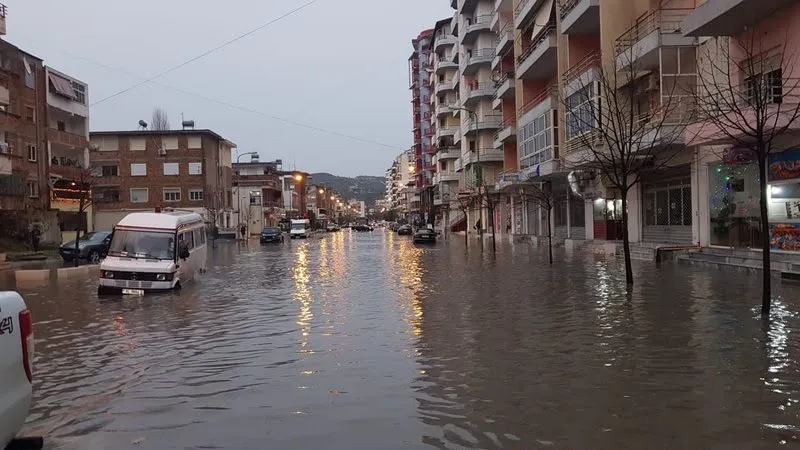
About 20 minutes of rainfall were enough for some streets in the city of Vlora to be covered by water again, reviving a problem that has accompanied the coastal city for years.
The situation created on the evening of October 21, 2026, brings back into focus the massive floods of October 4, 2024, which caused significant material damage, as well as the findings of an audit by the Supreme State Audit, which had identified serious deficiencies in the drainage system and infrastructure management.
The first autumn rains have caused water to accumulate in several areas of Vlora, including the neighborhoods “Pavarësia”, “Muradie”, “28 Nëntori”, the historic area, “Ismail Qemali” boulevard, as well as the streets near the “Shefqet Musaraj” library.
On some routes, water levels have reached up to 40 centimeters, making vehicle traffic and citizens more difficult.
The issue is also related to the partial operation of the city’s hydroelectric plant, which, due to restoration work, is not operating with all four pumps.
Meanwhile, the lack of sewage cleaning continues to be another concern for the removal of rainwater.
But the situation is not unknown to the responsible institutions.
After the October 2024 floods, the Supreme State Audit (KLSH) conducted a thematic audit to verify the causes, consequences, and responses of institutions. The final report, consulted by ekofin.al, identified 20 findings and 23 recommendations, highlighting infrastructural deficiencies, lack of investments, maintenance problems, and ineffective inter-institutional cooperation.
SCA: Uncleaned canals, the main cause of the 2024 floods
One of the most important conclusions of the audit relates to the condition of the drainage network.
The Supreme State Audit (KLSH) found that some of the city’s canals had not been cleaned for more than 30 years, being blocked by alluvium, waste, and inert materials.
According to the report, the vast majority of stormwater wells were out of order due to lack of cleaning, while their dimensions were insufficient to withstand heavy rainfall.
The auditors also noted that the construction works for the new water supply system on the city streets had contributed to the presence of inert materials in the sewage network.
In its overall conclusion, KLSH emphasizes that the failure to clean the open channels was the main cause of the flooding on October 4, 2024, as these channels constitute the main arteries for the removal of rainwater.
The report concludes that if the drainage infrastructure had been functional and operated at full capacity, the risk of a flood of October 2024 scale would have been low.
Hydrovore without backup pumps and without emergency generator
Another issue identified by the Supreme State Audit (KLSH) was directly related to the pumping stations and their capacity to remove water.
The audit found that the hydropower plant in the city of Vlora was operating without backup pumps, while the power line supplying it was old and lacked a generator dedicated to emergency situations.
Problems were also identified at the Akërnia hydroelectric plant.
According to the Supreme State Audit (KLSH), during the floods on October 4, 2024, this hydropower plant was operating at only 45% capacity due to problems with electrical voltage.
The report highlighted that private entities were also receiving energy from the pumping station’s supply line, affecting voltage stability and the operating capacity of the equipment.
These findings show that the pumping infrastructure had serious problems precisely at the moments when its maximum operation was needed.
The situation in October 2026, when the city’s hydropower plant is reported not to be functioning with all four pumps due to ongoing work, also highlights the importance of reserve capacities and system readiness during the rainy season.
No investment in the drainage system during the years 2023–2024
One of the most concerning findings of the audit related to the lack of investments.
The Supreme State Audit (KLSH) found that the Vlora Water Supply and Sewerage Company had not prepared investment plans and had not made investments during the 2023–2024 period to improve the drainage system and protect against floods in the city and urban areas under its jurisdiction.
According to the report, no investments in the drainage system had been planned or carried out by the previous structures during the recent years reviewed.
Another structural problem was related to the failure to separate polluted water networks from rainwater networks.
The Supreme State Audit (KLSH) noted that during heavy rains, to prevent flooding, Water Supply and Sewerage workers would open wells to allow surface water to enter the wastewater network.
This practice caused the mixing of rainwater with polluted water and significantly increased the volume that the pumping stations had to handle.
Consequently, the problem was not limited to the blocked channels but also included how the city’s sewage system was constructed and operated.
Shared responsibilities among institutions, ineffective cooperation
The audit also identified problems in the administration of drainage infrastructure. According to the Supreme State Audit (KLSH), the transfer of several channels and facilities from the drainage structures to the Municipality of Vlora was not accompanied by complete technical documentation, including maps, channel profiles, and data on hydrotechnical works.
In one case, only the pumping station building had been transferred to the Municipality of Vlora, while the channel that supplied water to it had not been transferred. This situation had created uncertainty regarding maintenance responsibilities.
KLSH assessed that inter-institutional cooperation was not effective, as the drainage scheme was not fully managed by the municipality. Secondary and tertiary canals were the responsibility of local structures, while main canals were managed by state irrigation and drainage structures.
The report also highlighted that some canals in the Akërnia and Orikum areas had not been cleaned for more than 15 years, while planned works on several other canals had not been completed.
The Supreme State Audit requested urgent intervention to prevent flooding
At the conclusion of the audit, the Supreme State Audit recommended a series of measures for the responsible institutions.
These included the rehabilitation and complete cleaning of drainage channels, improvement of the electricity supply to pumping stations, ensuring their uninterrupted operation, and conducting continuous technical inspections.
KLSH also requested a clear definition of institutional responsibilities, improved coordination among structures, and identification of constructions that obstruct the functioning of drainage systems.
In its conclusion, the institution warned that cleaning the channels and rehabilitating the drainage system was an urgent task, since without the proper functioning of this infrastructure, the city of Vlora would remain constantly exposed to flooding.
Two years after the major floods, Vlora faces the same problem again
The situation created by yesterday’s rainfall raises questions about the measures taken after the 2024 floods and the recommendations of the Supreme State Audit.
However, the audit report documents the situation identified during the audit period and does not specify how many of the recommendations were implemented by October 2026.
The fact that only 20 minutes of rainfall has been enough to create significant water accumulations on several city streets shows that the capacity for water drainage remains an issue that requires attention.
Beyond the difficulties in traffic, repeated floods pose a risk to homes, businesses, vehicles, and public infrastructure, bringing potential economic costs to citizens and commercial activities.
Two years after the massive floods of October 2024, the question arises as to how many of the 23 recommendations of the Supreme State Audit have actually been implemented and whether the investments made have been sufficient to reduce the risk of flooding. /ekofin.al
